
Railroad Snow Plows: Keeping The Lines Open
Last revised: September 4, 2024
By: Adam Burns
Railroad snow plows may be some of the least used pieces of maintenance equipment a railroad owns. However, they are also some of the most important when called upon to open a rail line that is buried in several inches or feet of snow.
While some diesel locomotives today are equipped with small plows on the head end, this is only effective for light snowfall as once snow totals reach into the feet railroads generally have to break out heavier equipment.
Historically, this would mean either the venerable wedge plow or legendary rotary plow.
However, while of those plows still find work today, railroads often use other tools at their disposal such as flangers, Jordan Spreaders, or a ballast regulator equipped with a plow.
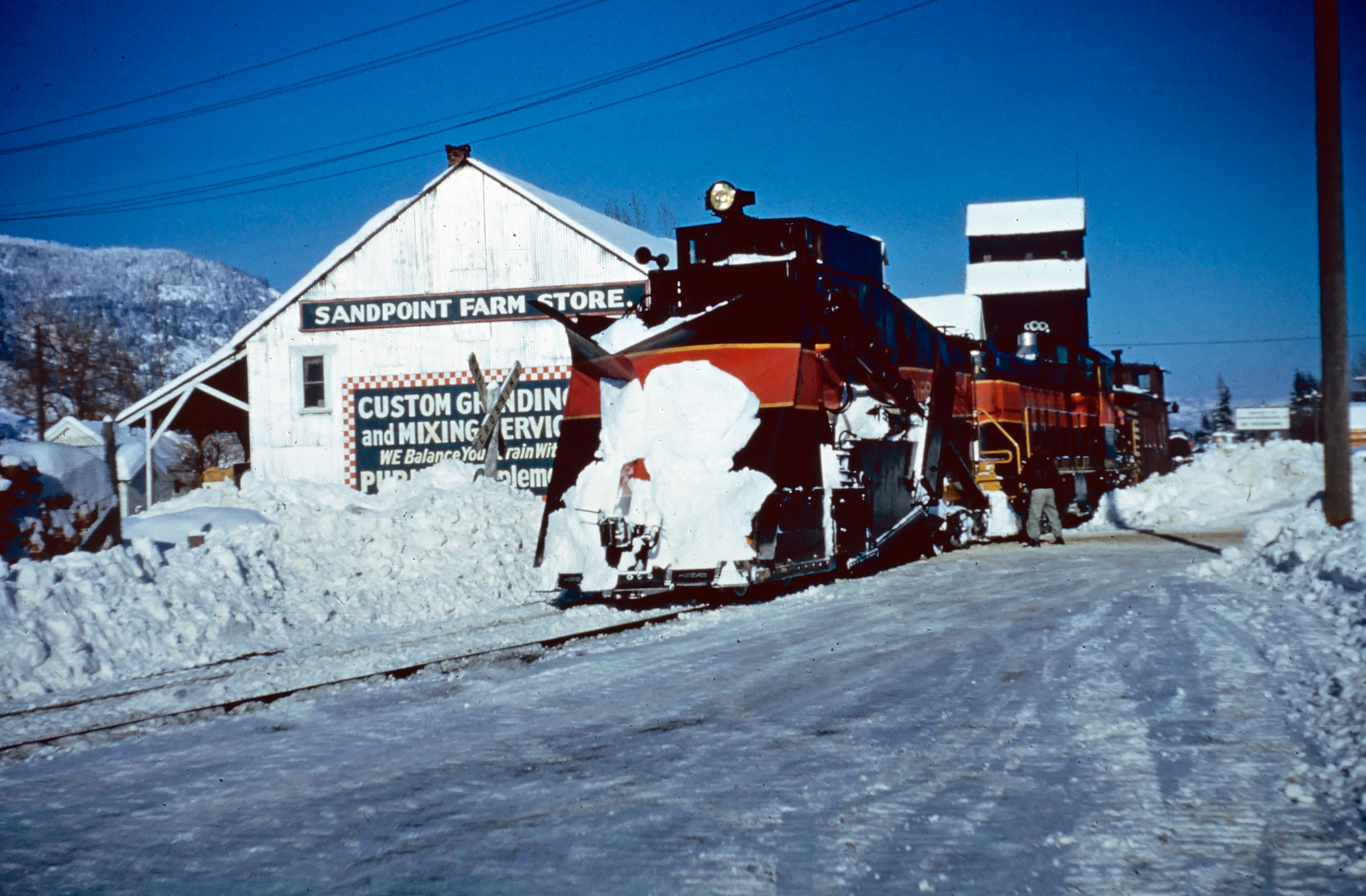 A Spokane International wedge plow and an RS1 are seen here carrying out snow removal in Sandpoint, Idaho on February 20, 1951. Photographer unknown. American-Rails.com collection.
One of the first, and most common types of railroad snow plows used was the wedge plow. As its name implies the wedge plow used a simple wedged design, in later years made from reinforced iron or steel.
The railroad snow plow itself was usually attached to the front of either a customized rail car of some type with a pilot house attached to the top for the spotting crew.
One of the most common types of wedge plows were those built by the Russell Snow Plow Company, which began manufacturing the machines after World War I.
Developed with a bit of versatility, Russells were equipped with wings attached to the outside of what was known as the "tongue" (the wedge device that actually plowed the snow clear of the track), which could be adjusted.
All wedge plows could not propel themselves and required being pushed by a locomotive.
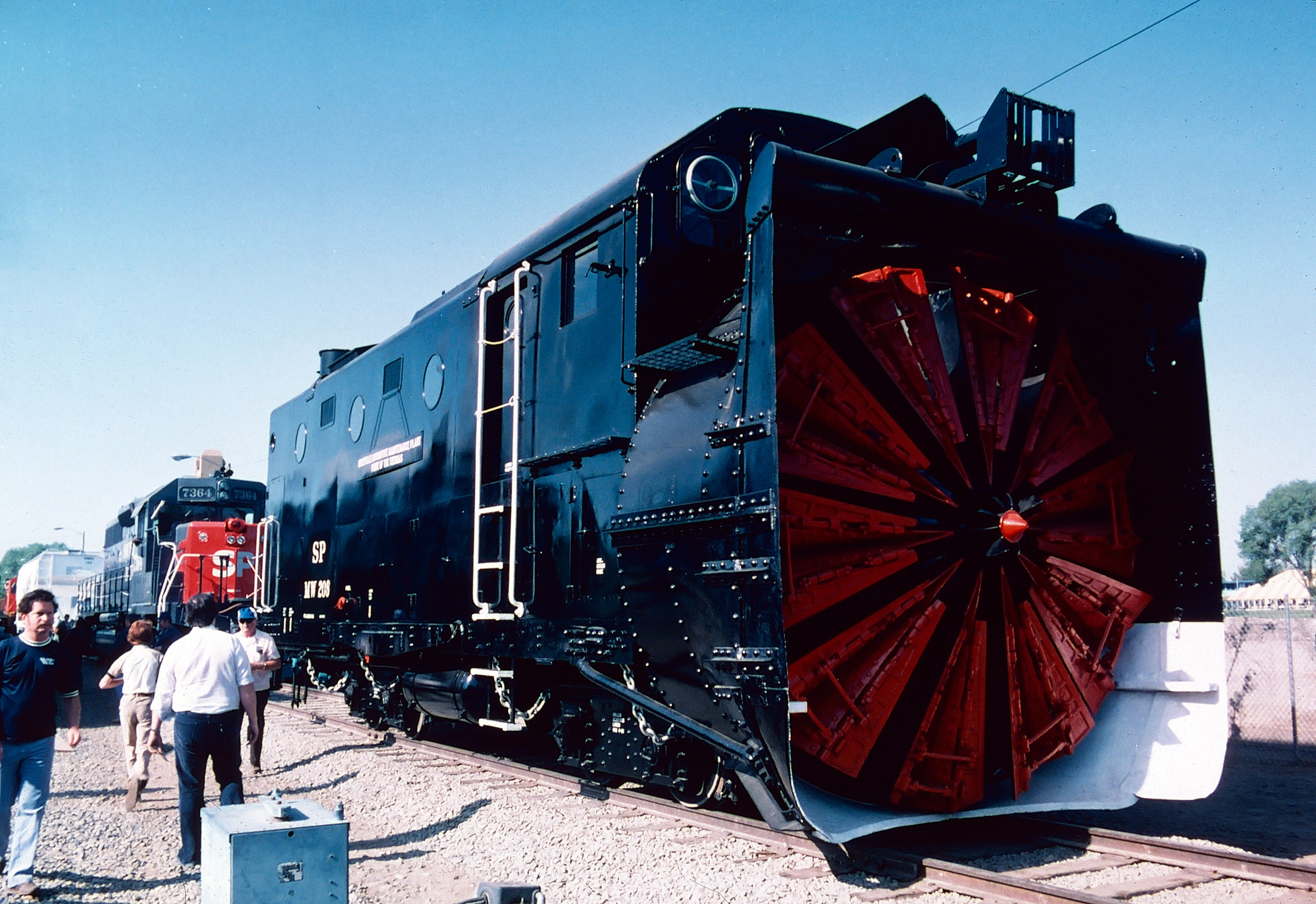 Southern Pacific rotary snow plow MW208 is seen here on display at Railfair '81 in Sacramento, California during May of 1981. Note Southern Pacific SD40R #7364 in the background. Today, the plow is preserved at the Western Pacific Railroad Museum. William Myers photo. American-Rails.com collection.
For maximum performance these plows were weighted as heavy as possible so they could not only move larges amounts of snow but also to decrease the chance that the machine would derail at an iced-over flangeway, particularly at crossings.
Some of the Russell plows are still in use to this day as they are still an effective means to remove snow from the tracks.
While they remain in service their effectiveness has been diminished by newer railroad "snow plows", which can perform multiple tasks aside from just removing snow (such as ballast regulators).
The biggest problem with wedge plows, and any plow which has no means of self-propelling itself is two-fold:
- First it must be pushed by one or multiple locomotives (increasing the cost of operating the equipment).
- There are also inherent dangers involved because the spotters in the plow must do the navigating for the engineer(s) and crew trailing.
To be most effective in removing snow, wedge plows must operate at high speeds sometimes as fast as 50 mph
This is a serious problem if a spotter does not know the territory or loses focus as disasters and derailments can occur.
As such, they must constantly be on the lookout for upcoming obstacles (such as crossings, where the plow must be lifted so as not damage and derail the equipment).
Interestingly, sometimes in areas which receive large amounts of snow railroads will place markers at crossings, and other ground obstacles, high enough that even in the deepest snow a crew can know exactly where and when a crossing is located.
When most railfans and historians think of railroad snow plows, one comes to mind among all others, the legendary rotary plows.
These behemoth machines were fist developed by J.W. Eliot as early as the 1850s, and improved upon by Orange Jull.
However, the rotary was not perfected until Jull sold the rights of the rotary design to John and Edward Leslie in 1883.
The initial design by Jull worked by using two large fans that spun in the opposite direction of one another at a desired rpm with the two fans working in tandem; the outer-most set sucked the snow into the blades while the second fan deposited the snow out of a chute located above.
The Leslies perfected and simplified this initial design by using a single fan which could trap and scoop the snow, and then depositing it out of the chute.
Overall superior to the initial design the Leslie rotary plow was to manufacturers for production and it became the most successful such rotary ever built (the Leslie name was eventually purchased by the American Locomotive Company, Alco).
The main advantage of rotary plows was that they could move tremendous amounts of snow and clear lines that were buried in far deeper snowfall totals (even heavy, wet snow) than wedge plows.
Not only could the fan design move more snow than the simple wedge, the fan itself was driven by a steam engine, giving it the power to move all of that snow.
A rotary still had to be pushed by a trailing locomotive just like a wedge plow.
However, it could do so at much slower speeds, which was much safer for the spotting crew who did not have to feel like they were on a roller coaster ride zipping along down the line.
As railroad snow plows go, rotaries did have an inherent draw back. Because they were steam driven they required a full crew to keep them operating, not to mention the spotting crew that was also on board.
Being very expensive to operate, and typically only needed where extremely large amounts of snow fell during the winter season, they were mostly relegated to western mountain regions such as the Southern Pacific, Rio Grande, Great Northern, Northern Pacific, and Milwaukee Road.
Due to high costs rotary plows were only brought out when absolutely needed but they could put on quite a show if one was lucky enough to witness them in action. Today, a few holdouts remain but they are very rare to see.
Even when some rotaries were updated with diesel technology which made them cheaper to operate, such as the Southern Pacific's fleet used on Donner Pass, they have lost appeal for newer forms of snow removal equipment.
Today, railroads rely on a host of cheaper alternatives to keep the rails clear such as snow blowers (which can be equipped to ballast regulators, which can also be equipped with traditional plows) and snow jets, such as those built by Harco and Essco.
Jets and blowers are ideal for keeping switches and yards clear of snow, or for electrified lines that use third rail and must keep it clear of snow and ice.
Still, when the snow is relentless nothing can quite compare to a rotary or wedge plow, which will still be called upon today in those rare circumstances.
Recent Articles


-
Milwaukee Road Diesel Roster: (All Time)
Oct 26, 26 01:44 PM
 All-time diesel roster of the Milwaukee Road. 1,208 locomotives, each frame once. Alco, Baldwin, Davenport, EMD, Fairbanks-Morse, General Electric, and Whitcomb, with builder numbers.
 -
Milwaukee Road Steam Roster (All-Time): Post-1900
Oct 26, 26 01:38 PM
 Milwaukee Road steam locomotives built since 1900. Prairies, Mikados, the N-class articulateds, the S-class 4-8-4s, and the Hiawatha Atlantics and Hudsons. Quantity column 1,974. Unique frames 1,951.
 -
Milwaukee Road: Map, Electrification, Logo, History
Oct 26, 26 01:20 PM
 The Milwaukee Road, from the Milwaukee & Mississippi of 1850 to the Pacific Coast Extension, the Hiawathas, and the Soo Line sale. Why Lines West should have stayed.
 -
Lake Superior & Ishpeming Railroad: Map, Roster, History
Oct 25, 26 11:38 PM
 Lake Superior & Ishpeming Railroad, reporting mark LSI, from the Marquette Range to the Presque Isle ore dock. The 1954 steam list and the diesels the railroad owned.
 -
Kansas City Southern Steam Roster (Built Since 1900)
Oct 25, 26 09:09 PM
 Steam locomotives of the Kansas City Southern built since 1900, with the Louisiana & Arkansas and the Texas company.
 -
Kansas City Southern Diesel Roster (Built New)
Oct 25, 26 11:46 AM
All-time diesel roster of the Kansas City Southern. E units, F units, Geeps, SD40s through SD70ACes, Fairbanks-Morse, Baldwin, Alco, and General Electric, with serials and order numbers. -
Kansas City Southern Railway: Map, Photos, History
Oct 25, 26 12:24 AM
 The Kansas City Southern, from Arthur Stilwell's Gulf line to Canadian Pacific Kansas City on April 14, 2023. Steam and diesel rosters, the Southern Belle, and the Louisiana & Arkansas.
 -
Indiana Harbor Belt Diesel Roster (All-Time)
Oct 25, 26 12:17 AM
 All-time diesel roster of the Indiana Harbor Belt. 202 locomotive frames, each counted once. NW2s, SW7s, SW1500s, road switchers, and gensets. Slugs and boosters are outside the count.
 -
Indiana Harbor Belt Steam Roster (Built Since 1900)
Oct 25, 26 12:13 AM
 Steam locomotives of the Indiana Harbor Belt built since 1900. 182 engines, each counted once. 0-6-0s, 2-6-0s, 0-8-0s, and 2-8-2s. The three U-4a switchers are three-cylinder Brooks engines of 1927.
 -
Indiana Harbor Belt Railroad: Map, Rosters, History
Oct 25, 26 12:00 AM
 Indiana Harbor Belt, the inner belt across the Calumet, from the East Chicago Belt of May 16, 1896. Renamed June 29, 1907. Still operating, headquarters Hammond. Steam roster is the companion, 182 loc…
 -
NYC's "P Motor" Electric Locomotives
Oct 24, 26 11:43 PM
 New York Central P motors: 22 Alco-GE 2-C+C-2 electrics, Cleveland Union Terminal 1050–1071, class P-1a. 3,030 hp one-hour on 3,000-volt DC catenary, then 660-volt third rail as P-2a and P-2b.
 -
Illinois Terminal Car Roster
Oct 24, 26 11:40 PM
 Illinois Terminal cars. Mainline motors, the 1948 streamliners, sleepers, Alton and Valley Division cars, express motors, and the line cars rebuilt from pull cars.
 -
Illinois Terminal Diesel Roster
Oct 24, 26 09:31 PM
 All-time Illinois Terminal diesels, 62 frames. Alco S-2s and RS-1s, EMD switchers, GP7s, SD39s, GP38-2s, and the two GP20s. Serial numbers from the 1989 roster.
 -
Illinois Terminal Electric Locomotives
Oct 24, 26 08:22 PM
 Illinois Terminal electric locomotives, 57 frames. Class A through Class D, the Decatur-built motors, and the battery locomotives. Class D is the same five Class C frames, rebuilt.
 -
Illinois Terminal Steam Roster
Oct 24, 26 07:37 PM
 Illinois Terminal steam locomotives, 36 frames. Baldwin Moguls, three Class 30 Mikados, Florida East Coast 0-8-0s, and 2-6-0 No. 21, the last fire on June 30, 1950.
 -
Illinois Terminal Railroad: Map, Roster, Photos, History
Oct 24, 26 07:32 PM
Illinois Terminal, McKinley's Illinois Traction System, from the Danville coal towns to St. Louis. The McKinley Bridge, the sleeping cars, the 1937 break with the power company, the 1948 streamliners… -
Southern Railway Diesel Roster (All-Time)
Oct 23, 26 11:00 PM
 All-time diesel roster of the Southern Railway. 2,505 locomotives in the system number series, from the 1939 demonstrator FT to GP50s and B30-7A1s. Serials included.
 -
Illinois Central Diesel Roster (All-Time)
Oct 23, 26 04:06 PM
 Illinois Central and Illinois Central Gulf diesel locomotives, each frame once. The quantity column is 886. Serials and order numbers from Electro-Motive's builder lists. Paducah rebuilds and Gulf, Mo…
 -
Illinois Central Gulf Diesel Roster
Oct 23, 26 04:02 PM
 Illinois Central Gulf operating numbers from August 10, 1972, to February 29, 1988. New frames stay on the Illinois Central diesel roster. Gulf, Mobile and Ohio frames stay on that roster. No Gulf fle…
 -
Illinois Central Railroad: Map, Logo, History
Oct 23, 26 03:50 PM
Illinois Central, the Main Line of Mid-America, from the 1850 land grant to Canadian National control on July 1, 1999. Charter lines, Cairo bridge, Paducah, and the Illinois Central Gulf. Steam quanti… -
Grand Trunk Western Diesel Roster (All-Time)
Oct 23, 26 12:53 PM
 Grand Trunk Western diesel locomotives, each frame once. The quantity column is 377. Serials are filled for the Detroit, Toledo and Ironton and Detroit and Toledo Shore Line engines the railroad kept…
 -
Grand Trunk Western Steam Roster
Oct 23, 26 12:14 PM
 Grand Trunk Western steam locomotives in service about 1937 to 1942, from Richard Leonard's class list. Drury has no chapter. The quantity column is the counted Grand Trunk Western rows. Two mixed Gra…
 -
Grand Trunk Western Railroad: Map, Roster, History
Oct 23, 26 12:09 PM
 Grand Trunk Western, reporting mark GTW, Canadian National's railroad between Port Huron and Chicago. Trade name adopted in 1923. Steam class list quantity 232. Diesel quantity column 377. Identity in…
 -
Green Bay and Western Railroad: Map, Rosters, History
Oct 22, 26 11:18 PM
 Green Bay & Western, the Green Bay Route, reporting mark GBW. From Kewaunee to Winona. Mailer's steam and diesel rosters, and the August 1993 sale to Fox Valley & Western.
 -
Chicago & North Western Class E-4: Streamlined 4-6-4 Hudsons
Oct 22, 26 10:28 PM
 C&NW Class E-4, nine streamlined 4-6-4s, 4001–4009, Alco 1938. 84-inch drivers, 25-by-29 cylinders, 300 psi. Conventional Chicago–Omaha trains. Oil in 1947–48. Retired 1953–1956.
 -
Gateway Western Railway: Map, Roster, History
Oct 22, 26 02:43 PM
 Gateway Western Railway, reporting mark GWWR. Class II from Kansas City to East St. Louis. Kansas City Southern control May 5, 1997. The 1992 diesel fleet, with serials and order numbers.


