Railroad Jobs: Employment Information
Last revised: September 11, 2024
In this section the subject of railroad jobs and careers is highlighted. As the website has grown I have steadily received evermore questions regarding this very subject. There have also been many inquiries regarding possible openings here at American-Rails.com.
Please let me stress that this website is not a railroad company, is not affiliated with any railroad or railroad-related business in any way, and does not have any positions available for hiring. - The information provided here is to help job searchers in the process of a finding employment within the industry by listing contact information on a state-by-state basis.
Employment Information
There are also articles highlighting specific fields such as engineers, conductors, signal maintainers, etc. as well as major railroads. For questions concerning potential openings please contact the company in question.
If you are interested in a position within the railroad industry peruse the major job search websites (Indeed, Monster, etc.) or browse the career web pages of railroads in your area.
Salaries
Working on the railroad is an excellent career offering an outstanding salary and benefits. Your salary, working in the field as either a track maintainer or member of the train crew, varies greatly but typically starts out in the high $30,000's (minimum) as a maintainer while crewmen usually begin in the $50,000's.
In addition, seniority positions (such as trainmaster and roadmaster) as well as skill positions (such as signal maintainer) can earn $60,000 - $80,000+ immediately.
After many years of employment it is quite possible for any of these positions to earn $100,000+ annually. Finally, to learn more about working in the industry consider the book, "Working On the Railroad," by author Brian Solomon.
The title offers an introductory look and historical perspective about the field. It only provides a brief synopsis but nevertheless should answer many of your questions about railroads and its many well-known careers.
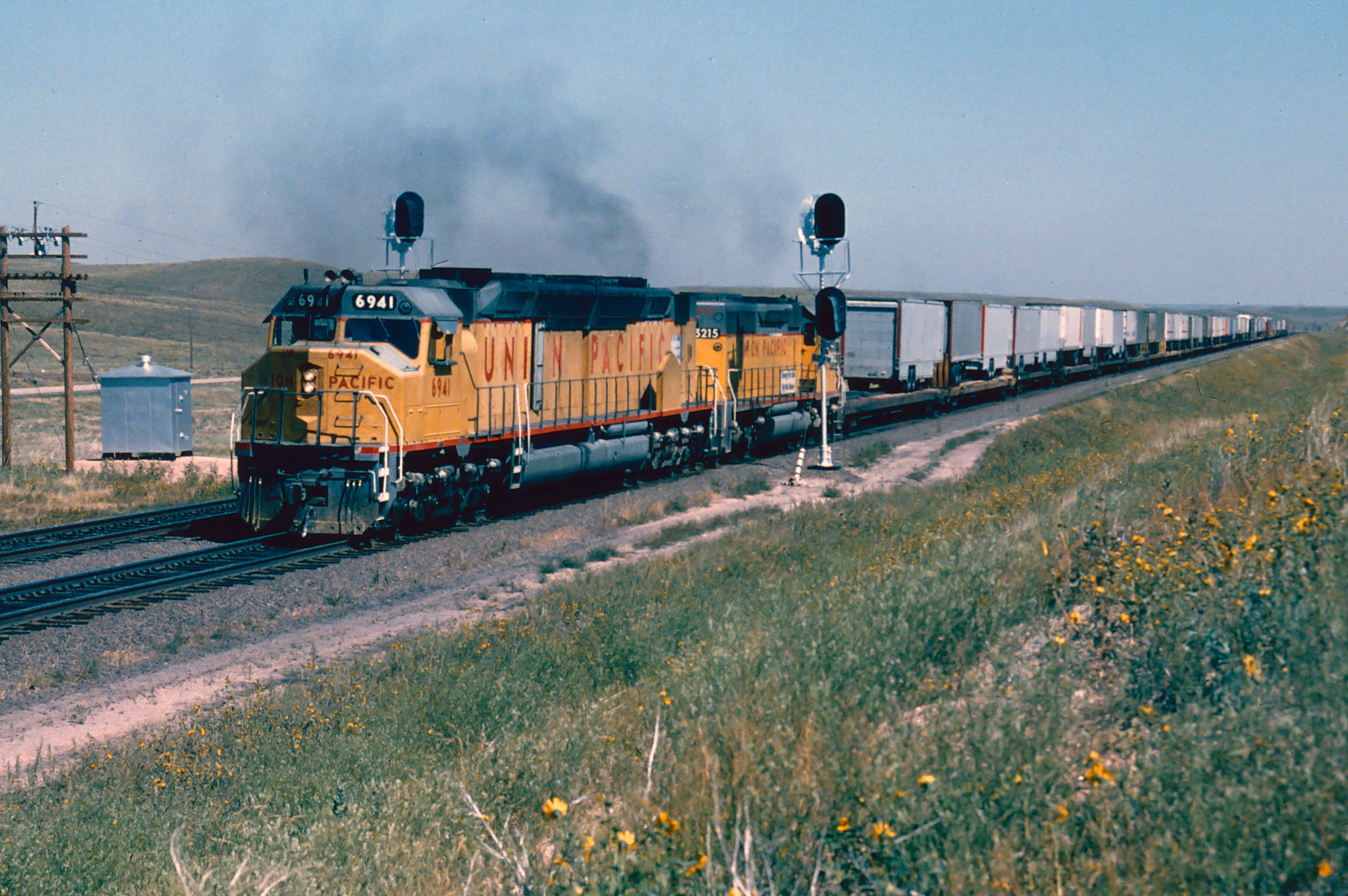 Union Pacific DDA40X "Centennial" #6941 and SD40-2 #3215 hustle trailers westbound up Sherman Hill just west of Borie, Wyoming at Milepost 521.4 signals during the summer of 1984. Mike Bledsoe photo. American-Rails.com collection.
Overview
If you are interested in working for the railroad you will be entering one of America's oldest professions with a heritage dating back to the Granite Railway of Massachusetts (1826). The iron horse is credited with transforming this country into an industrial powerhouse.
While the Granite Railway is recognized as the very first, the Baltimore & Ohio's chartering in 1827 created the first modern common-carrier (defined as a company which offers transportation services to the general public and must be willing to haul any legal goods, or persons, for compensation).
The industry peaked during its "Golden Age," which lasted roughly from the 1880's through World War I. The national network also reached its zenith at this time when, in 1916, 254,037 miles of steel crisscrossed the continent serving the smallest towns to largest cities.
As John Stover notes in his book, "The Routledge Historical Atlas Of The American Railroads" (New York: Routledge, 1999), many other records were broken that year including number of employees (1.701 million), intercity freight traffic (77%), and intercity passenger business (98%).
Railroad employment reached its highest point in 1920 when Mr. Solomon points out that 2.2 million individuals were working for the industry in some capacity, equaling 7.25% of the labor force. Today, according to the Association of American Railroads there are only 166,000 employees.
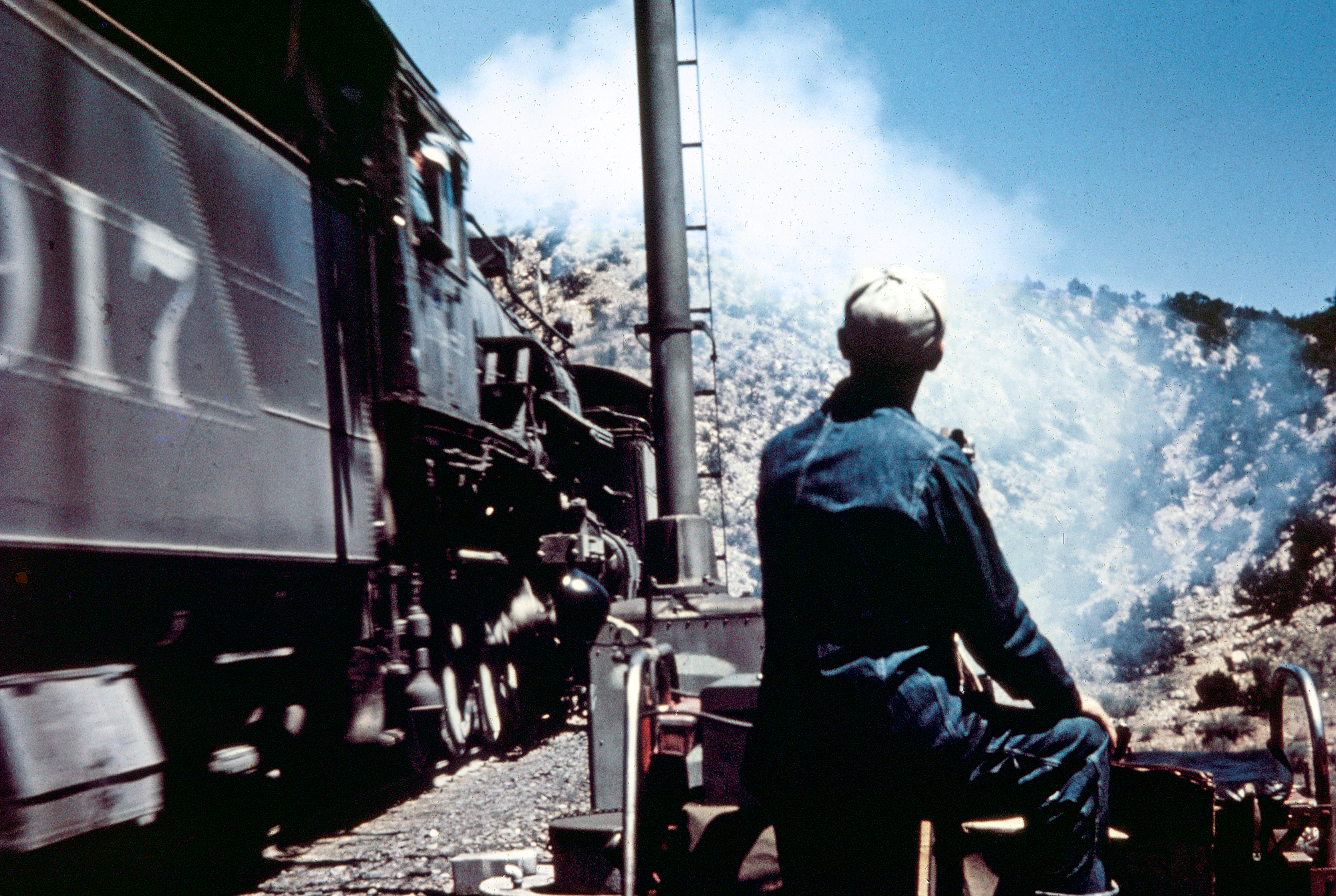 A Santa Fe track inspector watches as a pair of steam locomotives work a passenger train over New Mexico's Glorieta Pass, circa 1950. Ed Olsen photo. American-Rails.com collection.
An often forgotten industry was the interurban. In a time before the automobile, at the turn of the 20th century, it blossomed into a major rapid transit network, linking much of the Midwest and East (as well as parts of the West) with electrically-operated service.
Unfortunately, it suffered serious limitations in competition against standard steam railroads, such as inferior rights-of-way (some of which ran along public roadways), steep grades, and lack of a significant carload freight business.
However, this did not stop investors from spending millions in their development. In their book, "The Electric Interurban Railways In America," authors Dr. George Hilton and John Due note that the network peaked at 16,100 miles by the World War I era.
As a result there were several thousand employed within this industry, jobs that ranged from track maintenance, mechanics, and motormen (an individual who operated the electrified cars/locomotives) to signal maintainers, dispatchers, and agents.
Alas, Henry Ford's Model-T doomed an industry which already suffered serious limitations and a high operating ratio.
Many interurbans were abandoned after the Great Depression of 1929 and virtually no new mileage was constructed. By the end of World War II only a few thousands remained in use, largely by those systems which had developed a substantial freight business.
How The Industry Has Changed
The advent of electronics and computers has changed the face of railroading drastically over the last 50 years.
The use of such technologies have allowed companies to vastly downsize their workforce and remove many trackside structures such as interlocking towers, depots, section houses (buildings once situated at various points which housed track workers), wayside telephones/booths (used to call the nearest dispatcher), and other various shanties.
These have been eliminated and centralized; all Class I carriers, and even smaller freight lines, usually operate only one, or a few, dispatching centers which govern the entire network.
Years ago this was not the case as railroads maintained numerous dispatching locations which protected only sections of a particular corridor.
This has also abolished the ubiquitous agent, individuals once stationed at depots across the country to provide train crews paper train orders in territory not protected by Centralized Traffic Control (CTC).
The art of grabbing orders was a time-honored tradition in which crewmen took great pride. Surprisingly, it was still practiced in some areas through the 1980's!
Except for signal stands/bridges, railroad rights-of-way have become increasingly barren over the years as structures previously mentioned were no longer needed.
Improvements in locomotive technology have also resulted in the removal of others, such as coaling towers, water tanks, and roundhouses.
All three were needed in the days of steam to keep a locomotive fueled and in operation: coaling towers were large monolith-like buildings, filled with coal and situated at various points; the water tank was even more numerous as locomotives could travel no more than a 100 miles before requiring refreshment.
Finally, the roundhouse provided a stable where the machines could not only be turned (since they cannot easily be operated in both directions) but also maintained if light work was needed (all heavy work was performed at a major shops complex where the locomotive could be entirely disassembled and rebuilt).
Steam locomotives were one reason why railroads employed millions as it required an army to keep them in proper working order.
The diesel changed all that; it could operate further, more efficiently and was single-handedly responsible for the elimination of the roundhouse, water tank, and coaling tower. The number of maintenance personnel was also greatly reduced.
Another area which required many men was track maintenance, employing hundreds of thousands (especially during the 19th century) to keep the rights-of-way, rails, and ballast up to proper standards so trains could run safely and on-time.
However, as mechanization took hold these positions were slowly eliminated. While the upfront capital to purchase machines was expensive, railroads soon realized they quickly paid for themselves.
As the old phrase goes, time is money, and devices such as Jordan Spreaders, Ballast Regulators, Spike Inserters/Pullers, Tampers, and Tie Cranes could perform such work much, much faster than a traditional maintenance-of-way gang using picks, shovels, and tie tongs.
Interestingly, in today's highly mechanized world, physical labor has been almost entirely eliminated from track maintenance unless only a quick repair/replacement is needed. It is simply too time consuming and expensive to have such work performed manually, even for small short lines and tourist attractions.
Through a combination of new competition (highways and airlines) and severe government regulation railroads slowly declined over the next several decades with only a brief traffic recovery occurring during World War II.
There were two primary factors for such high employment at that time. First, before mechanization and computers an army of workers were needed to maintain the right-of-way, ensuring trains arrived on-time and at the proper destination.
Second, during the steam era locomotives required three crewmen on the head-end (engineer, brakeman, and fireman) and two in the caboose (conductor and flagman) to ensure safe operation.
Things were somewhat different on a passenger train where the crew stayed either in the locomotive or on-board. The head-conductor in this case was always well-dressed and pulled double-duty overseeing the train and attending to passengers' needs.
For purposes of this section the topic of crewmen, or those working in the field, will be highlighted (signal maintainers, roadmaster, laborer, etc.).
If you are interested in a management field or eventually attaining that position please visit a Class I's website regarding either their trainee or internship programs.
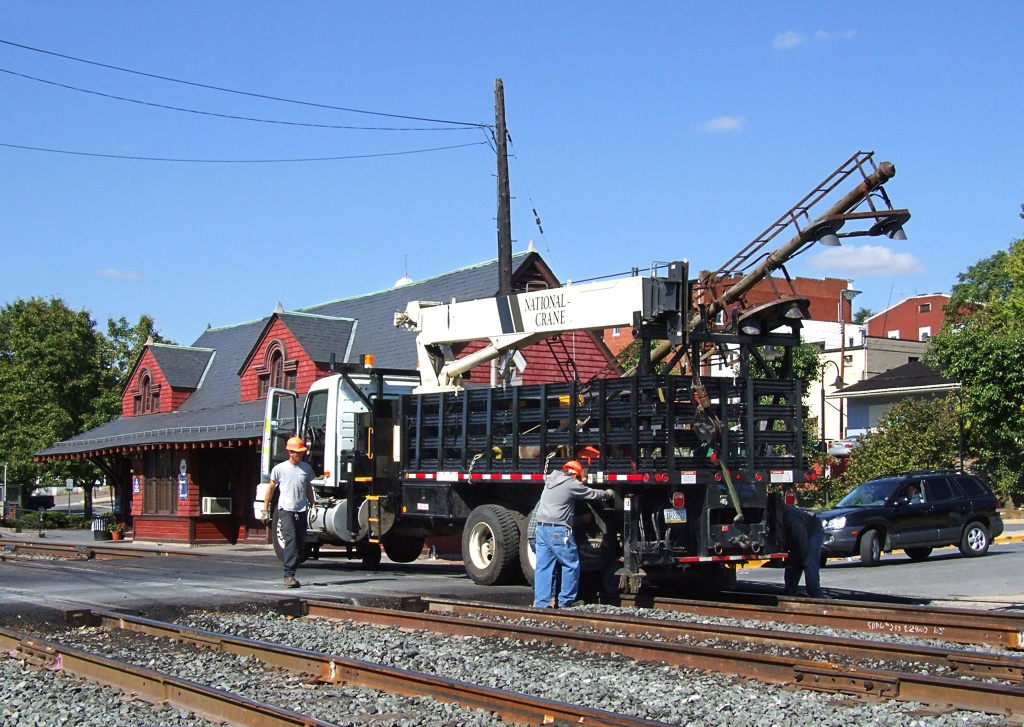 Three CSX signal maintainers are about to clear their hi-rail from the main line at Brunswick, Maryland after having taken down a venerable B&O CPL on October 13, 2007. Rob Kitchen photo.
Railroading today has changed much since the era predating World War II. A contemporary freight crew generally includes only two individuals, the engineer and conductor, while passenger trains are no longer operated by private companies.
In addition, new technologies like computers, diesels, and heavy machinery have replaced much of the human element.
When the steam locomotive disappeared in the 1950's, followed by the introduction of the "FRED" (Flashing Rear End Device) or end-of-train device (EOT, it monitors a train's air brakes from the rear car and contains a flashing red light for safety purposes), there was no longer a need for the fireman or flagman (the brakeman occasionally is still utilized).
The FRED also led to the caboose's removal in the 1980's while the conductor was transferred to the head-end. This beloved car was extremely expensive to maintain and railroads were happy to see it go. Another important improvement was the introduction of wireless radio in the 1960's.
Before its introduction crews and dispatchers had no way of keeping in direct contact (The PRR is most well-known for operating its "Trainphone" before wireless radio was introduced. The system used electromagnetic induction with large antennas attached to locomotives and cabooses, not radio waves, for instant communication.).
Safety Throughout The Years
While safety on the job is paramount in today's railroad industry, this was not always the case. The 19th century was defined by the hubris of magnates only interested in further enriching themselves.
As a result, and with little government regulation, these tycoons refused to implement most types of safety equipment, despite George Westinghouse's invention of the automatic air brake in 1869 and Eli Janney's automatic coupler of 1873.
These devices were so revolutionary they remain in regular use today. However, it took government oversight to force moguls into actually spending the necessary money to see their implementation.
As Mr. Solomon notes in his book, "By the mid-1870s, railroad accidents had become commonplace and serious collisions occurred on a weekly basis...During this wild and dangerous time, thousands of railroaders lost their lives every year, and many more were injured and maimed."
The wanton disrespect for life was appalling; they cared little for their workers and was happy to replace them on a weekly, or even daily, basis if killed on the job.
They also had no respect the average worker's well-being and employment.
Railroading was an extremely hazardous occupation in the 19th century, made worse following the severe financial Panic of 1873, which left the country in one of its worst economic times.
It was caused largely by the Jay Cooke & Company's failure, a banking firm which held millions in Northern Pacific Railway bonds.
As a result, a domino effect ensued that eventually resulted in some 115 railroads going bankrupt by 1874. A year later a total of 18,000 businesses had either closed or entered reorganization.
In his book, "The Great Labor Uprising Of 1877," author Philip S. Foner details the struggles of many workers during that decade (the depression would last until the spring of 1879).
During these times there were few labor unions and those which did exist carried little power to protect their members' jobs.
As the Brother of Locomotive Engineers put it, then the country's only true railroad union: "Are not railway employees in this year of grace, 1873, enduring a tyranny compared with which British taxation in colonial days was as nothing, and of which the crack of the slave whip is only a fair type?"
The 1870's economic woes resulted in many railroaders' salaries cut to the point they could no longer afford to feed their families.
As a result, it sparked what now has been recognized as the "Great Railroad Strike of 1877" (originally referred to as the "Great Uprising").
It all began between November, 1873 and July, 1874 when many workers struck following an initial round of pay cuts carried out on 18 different railroads located east of the Mississippi River.
However, these events lasted only for a few weeks and neither garnered national attention nor resulted in serious violence.
But as the depression deepened and the cuts continued it reached a crescendo during the spring through early summer of 1877.
The railroads which carried out these latest pay cuts included the Missouri Pacific; Pennsylvania; Lehigh Valley; Delaware, Lacakwanna & Western; Michigan Southern; Indianapolis & St. Louis; Vandalia; New York Central & Hudson River; Northern Central; Baltimore & Ohio; Northern Pacific; and Chicago, Burlington & Quincy.
The strikes began on the B&O just before noon on July 16th at Camden Junction, Maryland (Baltimore). Later that day they spread to Martinsburg, West Virginia, the location of a major B&O shops complex.
It then continued on to numerous other systems where workers, from firemen to engineers, sought restoration of their previous wages. Alas, in the end their efforts proved futile and resulted in neither arbitration nor restitution.
The powerful and arrogant corporate machine crushed the strikers by force when company presidents successfully procured the help of federal troops and state militias; in the most famous incidents 11 were killed in Baltimore, 42 in Pittsburgh, and 12 in Reading (Pennsylvania) when armed personnel shot unarmed citizens in what were deemed "riots" and "mobs" even though the protests had largely been peaceful.
The railroads' power continued throughout the 19th century as upper management refused listening to workers' grievances. The "Great Strike," although a failure, ultimately proved the catalyst for change.
Achieving widespread sympathy from their local communities, the public at large, and other laborers, strikes for better pay/working conditions were carried out across various industries.
These efforts eventually led to strong federal support for organized labor, particularly following the Pullman Strike of 1894.
More legislation would follow into the 20th century, resulting in strong union support that minimized railroads' and corporations' draconian rule over their employees.
Around the same time, Congress began mandating implementation numerous safety standards to reduce deaths and injuries on the job. In time, these effort, and others, made the industry a much safer place for both employees and passengers.
The first move involved the elimination of strap-iron rail which could cause deadly "snake heads," capable of killing or maiming travelers by working lose from their wooden support bases and tearing through a car's wooden floor.
Next, Congress passed the Railway Safety Appliance Act in 1893 mandating all rail cars be equipped with both Westinghouse's automatic air brake and Eli Hamilton Janney's automatic knuckle-coupler.
As mentioned above these devices changed the industry for the better; the former eliminated the brakeman's requirement to travel the cars' catwalks and set each hand-brake manually while the latter no longer necessitated a worker be in two cars' presence during the coupling process (the dreaded "link and pin" system).
During the 20th century railroads were also required to operate cars with steel-frames for added structural strength. This was later amended to include all-steel body cars.
Working In The Industry
While I do have a little knowledge on general railroad subjects please let me stress I have never worked in the industry and therefore probably cannot answer any job-specific questions you may have.
For that you will need to contact the company in question; each have their own hiring practices and work-related/corporate rules. If you have never been employed within this industry such a career is not for the faint of heart.
The backbreaking work of replacing ties, spikes and rails by hand is largely a thing of the past. You will also find newer locomotives often feature creature comforts like air-conditioning and heat.
However, many of the elements that have led many to state such a career is like a marriage still hold true. Train crewmen regularly work long hours and can be called out at any time of day.
Nevertheless, there is a great pride among railroaders, many of whom not only enjoy their career but also are third or fourth generation employees whose grandfathers and great grandfathers worked for legendary names like the New York Central, Pennsylvania, Great Northern, Baltimore & Ohio, and Santa Fe.
While a more predictable work schedule does come with seniority, don’t expect it to occur within a short period of time.
Some folks wait 20 years or more to land a "9 to 5" workday, which usually consists of yard assignments or "local" jobs (a short freight serving centralized customers within a specific area).
Long hours and days away from loved ones are typical on the big Class I railroads. However, if qualified you can sometimes find openings on short lines (Class IIIs) and regionals (Class IIs).
Positions
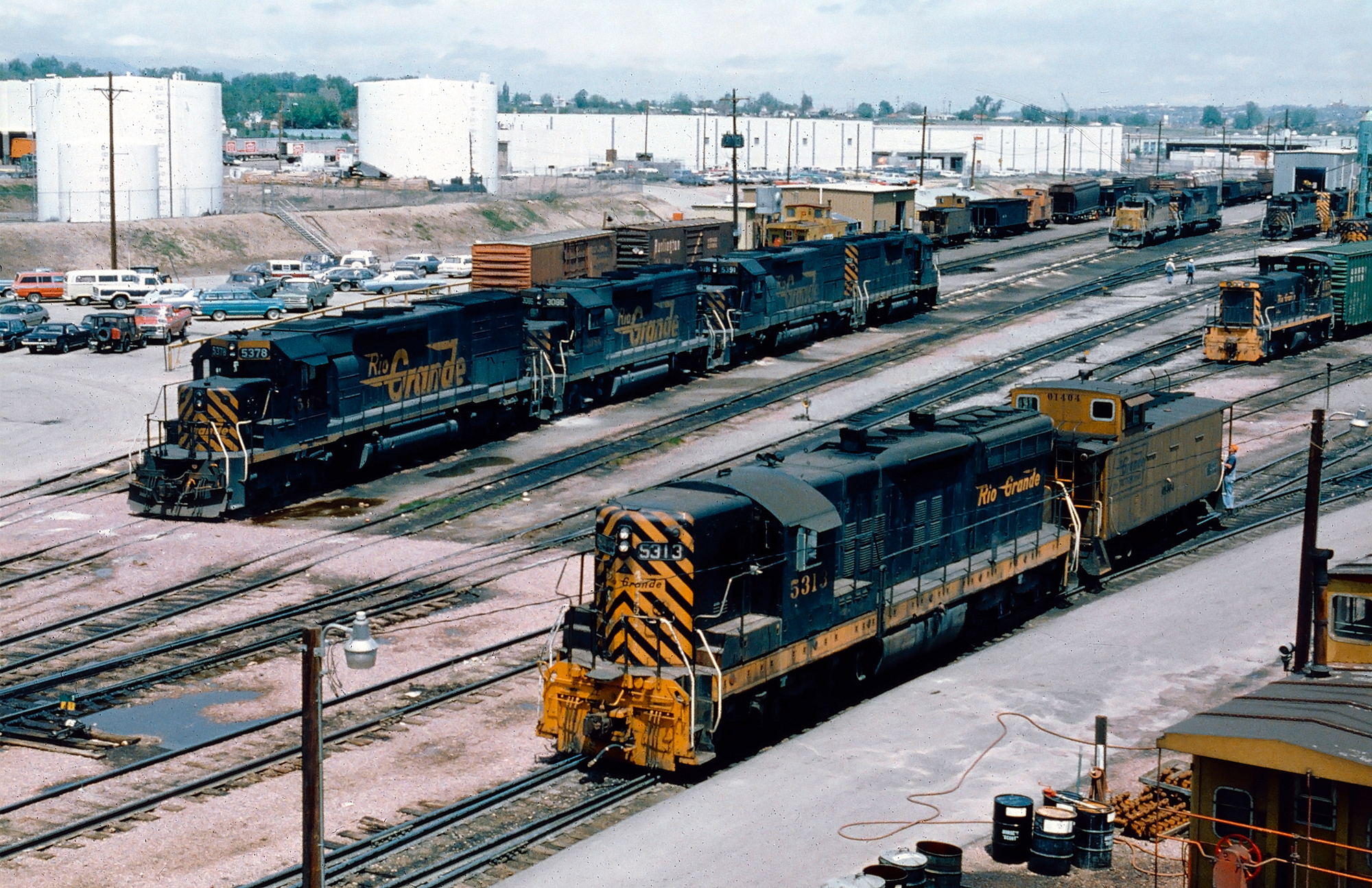 Rio Grande's North Yard in Denver, Colorado is seen here in 1983. Mike Bledsoe photo. American-Rails.com collection.
These smaller carriers do not carry the earnings potential of Class I's (which sometimes can reach six figures) but they do offer a more predictable schedule with fewer hours.
Some of the greatest perks railroad jobs offer are simply the little things. Because most routes cut straight through the wilderness the views are spectacular. And, if you enjoy being your own boss this line of work, in a way, provides it.
During long runs its essentially just you and your conductor/engineer in the cab until your 12-hour shift.
Finally, retirement benefits are perhaps the best of any industry, thanks in large part to the Railroad Retirement Act. It was established in 1935 as a trust fund that railroader’s pay into, entirely separate from the Social Security system.
The pages here will direct you to further information regarding several different careers such as engineers, conductors, maintenance, etc.
Recent Articles


-
Ohio 'Whiskey Tasting' Train Rides
May 30, 26 11:57 AM
 LM&M's Bourbon Train stands out as one of the most distinctive ways to enjoy a relaxing evening out in southwest Ohio: a scenic heritage train ride paired with curated bourbon samples and onboard refr…
 -
Washington 'Whiskey Tasting' Train Rides
May 30, 26 11:56 AM
 Climb aboard the Mt. Rainier Scenic Railroad for a whiskey tasting adventure by train!"
 -
Texas 'Murder Mystery' Dinner Train Rides
May 30, 26 11:54 AM
 Here’s a comprehensive look into the world of murder mystery dinner trains in Texas.
 -
Arkansas 'Wine Tasting' Train Rides
May 30, 26 11:51 AM
 This article takes you through the experience of wine tasting train rides in Arkansas, highlighting their offerings, routes, and the delightful blend of history, scenery, and flavor that makes them so…
 -
California 'Wine Tasting' Train Rides
May 30, 26 11:48 AM
 This article explores the charm, routes, and offerings of these unique wine tasting trains that traverse California’s picturesque landscapes.
 -
Wisconsin 'Wine Tasting' Train Rides
May 30, 26 11:44 AM
 Wisconsin might not be the first state that comes to mind when one thinks of wine, but this scenic region is increasingly gaining recognition for its unique offerings in viticulture.
 -
Bessemer & Lake Erie Diesel Roster (All Time)
May 30, 26 11:40 AM
 The Bessemer & Lake Erie Railroad (B&LE) transitioned to diesel power efficiently, completing full dieselization in 1953 thanks to its focused heavy-haul profile.
 -
Bessemer & Lake Erie Steam Roster (Post 1900)
May 30, 26 11:30 AM
 The Bessemer & Lake Erie Railroad (B&LE), the vital iron ore and coal hauler linking Lake Erie docks at Conneaut, Ohio, to Pittsburgh-area steel mills, operated one of the most specialized steam fleet…
 -
Bangor & Aroostook Steam Roster (Post 1900)
May 29, 26 11:48 PM
 The Bangor & Aroostook Railroad (BAR), Maine’s legendary potato and paper hauler stretching deep into the Aroostook County wilderness, relied on a compact yet hardworking steam fleet for much of its i…
 -
Bangor & Aroostook Diesel Roster (All Time)
May 29, 26 11:33 PM
 BAR prioritized Electro-Motive Division (EMD) products for their reliability in harsh northern Maine winters and on light branch lines, resulting in a roster heavy on versatile road switchers.
 -
Western Pacific Timetables (August, 1952)
May 29, 26 10:09 PM
 These timetables capture the Western Pacific in the final golden years of its passenger operations—offering travelers one last chance to enjoy the dramatic scenery of the Feather River Route in comfor…
 -
Maine 'Dinner Train' Rides At Portland
May 29, 26 12:04 PM
 While this isn’t generally a “dinner train” railroad in the traditional sense—no multi-course meal served en route—Maine Narrow Gauge does offer several popular ride experiences where food and drink a…
 -
Nevada 'Dinner Train' Rides From Ely
May 29, 26 12:01 PM
 If you’ve ever wished you could step through a time portal into the hard-working world of a 1900s short line the Nevada Northern Railway in Ely is about as close as it gets.
 -
Connecticut 'Murder Mystery' Dinner Train Rides
May 29, 26 11:57 AM
 All aboard the intrigue express! One location in Connecticut typically offers a unique and thrilling experience for both locals and visitors alike, murder mystery trains.
 -
Alabama 'Wine Tasting' Train Rides
May 29, 26 11:51 AM
 While the state might not be the first to come to mind when one thinks of wine or train travel, the unique concept of wine tasting trains adds a refreshing twist to the Alabama tourism scene.
 -
Washington 'Wine Tasting' Train Rides
May 29, 26 11:48 AM
 Here’s a detailed look at where and how to ride, what to expect, and practical tips to make the most of wine tasting by rail in Washington.
 -
Colorado "Wild West" Train Rides
May 29, 26 11:36 AM
 If there’s one weekend (or two) at the Colorado Railroad Museum that captures that “living history” spirit better than almost anything else, it’s Wild West Days.
 -
SP&S Railway Timetables (August, 1952)
May 29, 26 09:45 AM
 The information presented here highlights the Spokane, Portland & Seattle Railway's timetables from the August, 1952 edition of the "Official Guide."
 -
Pacific Electric Railway Timetables (January, 1930)
May 28, 26 11:20 PM
 Featured here is the Pacific Electric's timetables listed in the January, 1930 edition of the "Official Guide Of The Railways."
 -
Delaware-Lackawanna Unveils Heritage M630 1776
May 28, 26 01:32 PM
 Genesee Valley Transportation Co., Inc. and “the” Delaware-Lackawanna Railroad Co. Inc. are proud to debut the historic repaint of locomotive #1776, at the D-L’s Von Storch shop in Scranton Pennsylvan…
 -
Michigan Independence Day Train Rides
May 28, 26 01:11 PM
 Each year on Independence Day, the Crossroads Village/Huckleberry Railroad comes alive with a special celebration that blends patriotism, family fun, and old-fashioned charm.
 -
Maryland Independence Day Train Rides
May 28, 26 11:37 AM
 The Walkersville Southern Railroad delivers a charming slice of railroad history through scenic excursions and themed special events. One of its most anticipated annual highlights is the Fireworks Tra…
 -
Kentucky "Wild West" Train Rides
May 28, 26 11:20 AM
 One of KRM’s most crowd-pleasing themed events is “The Outlaw Express,” a Wild West train robbery ride built around family-friendly entertainment and a good cause.
 -
Pennsylvania 'Wild West' Train Rides
May 28, 26 11:10 AM
 The Keystone State is home to a variety of historical attractions, but few experiences can rival the excitement and nostalgia of a Wild West train ride.
 -
Florida 'Wild West' Train Rides
May 28, 26 11:06 AM
 This article delves into wild west rides throughout Florida, the historical context surrounding them, and their undeniable charm.
 -
STB Accepts Revised Union Pacific-Norfolk Merger Application
May 28, 26 11:03 AM
 In a significant development for the U.S. freight rail industry, the Surface Transportation Board (STB) today accepted for consideration the revised major merger application filed by Union Pacific Cor…
 -
West Virginia 'Wild West' Train Rides
May 27, 26 01:26 PM
 While D&GV is known for several different excursions across the region, one of the most entertaining rides on its calendar is the Greenbrier Express Wild West Special.
 -
Arizona 'Wild West' Train Rides
May 27, 26 01:22 PM
 Let's delve into the captivating world of Arizona's Wild West train adventures, currently offered at the popular Grand Canyon Railway.
 -
Michigan 'Wild West' Train Rides
May 27, 26 01:18 PM
 While the term 'wild west' often conjures up images of dusty plains and expansive deserts, Michigan offers its own unique take on this thrilling period of history.
 -
Wisconsin 'Wild West' Train Rides
May 27, 26 01:15 PM
Through a unique blend of interactive entertainment and historical reverence, Wisconsin offers a captivating glimpse into the past with its Wild West train rides. -
Missouri "Father's Day" Train Rides
May 27, 26 01:01 PM
 If you're looking for a unique way to honor your dad this year, why not consider a scenic and historical train ride?
 -
Maryland "Father's Day" Train Rides
May 27, 26 11:38 AM
 Maryland offers some unique and picturesque train rides, including the Walkersville Southern that celebrates dad each June!
 -
Northwestern Steel & Wire: 1936 - 2001
May 26, 26 10:52 PM
 Northwestern Steel & Wire was a major steel manufacturer located in Sterling, Illinois operating from 1936-2001. It was also well known for its extensive industrial railroad, operating steam until 198…
 -
Amtrak Timetables (May, 1972)
May 26, 26 12:32 PM
 Presented here is Amtrak's complete timetable listing from the May, 1972 edition of "The Official Guide Of The Railways."
 -
Georgia 'Wild West' Train Rides
May 26, 26 12:22 PM
Nestled within its lush hills and historic towns, the Peach State offers unforgettable train rides that channel the spirit of the Wild West. -
New Hampshire Independence Day Train Rides
May 26, 26 12:17 PM
Climb aboard Granite State Railway's Firecracker Trains—a patriotic, family-friendly fireworks spectacular rolling right through the heart of New Hampshire's Lakes Region. -
Utah Independence Day Train Rides
May 26, 26 12:14 PM
 Every July, as America celebrates its birthday, the Heber Valley Railroad in Heber City, Utah, rolls out a special tradition: the Freedom Train.
 -
North Carolina "Wild West" Train Rides
May 26, 26 12:12 PM
 North Carolina, a state known for its diverse landscapes ranging from serene beaches to majestic mountains, offers a unique blend of history and adventure through its Wild West train rides.
 -
Pennsylvania 'Wild West' Train Rides
May 26, 26 12:00 PM
 The Keystone State is home to a variety of historical attractions, but few experiences can rival the excitement and nostalgia of a Wild West train ride.
 -
Maine "Father's Day" Train Rides
May 26, 26 11:46 AM
 This year for Father's Day, why not trade the conventional gifts and barbeque in for something exceptional—a scenic train ride across the beautiful state of Maine.
 -
Minnesota "Father's Day" Train Rides
May 26, 26 11:43 AM
 If you're in Minnesota and looking for a unique way to spend this day with your dad, consider taking a scenic train ride.
 -
Pennsylvania Independence Day Train Rides
May 25, 26 11:58 AM
 Pennsylvania’s rich railroad heritage comes alive every Independence Day, but 2026—the nation’s semiquincentennial—offers extra patriotic flair.
 -
Ohio 'Wild West' Train Rides
May 25, 26 11:40 AM
 For those enamored with tales of the Old West, Ohio's railroad experiences offer a unique blend of history, adventure, and natural beauty.
 -
New York 'Wild West' Train Rides
May 25, 26 11:37 AM
Join us as we explore wild west train rides in New York, bringing history to life and offering a memorable escape to another era. -
Kentucky "Father's Day" Train Rides
May 25, 26 11:34 AM
 Kentucky offers a variety of historic and scenic train excursions that provide an unforgettable way to honor and spend quality time with fathers.
 -
Kansas "Father's Day" Train Rides
May 25, 26 11:33 AM
In this guide, we'll explore some of the best train rides available for Father's Day in Kansas. -
Vermont Independence Day Train Rides
May 25, 26 11:21 AM
 On Independence Day, elements come together to offer a unique experience in Vermont: train rides that combine scenic beauty with patriotic celebrations.
 -
Georgia Independence Day Train Rides
May 24, 26 12:26 PM
 As the 4th of July approaches in 2026, the Blue Ridge Scenic Railway in Blue Ridge, Georgia, invites you to celebrate America in true patriotic style aboard its Firecracker Special.
 -
Illinois Independence Day Train Rides
May 24, 26 11:58 AM
 As America gears up for the 4th of July in 2026, the Illinois Railway Museum (IRM) in Union, Illinois, offers the perfect blend of patriotic festivities, family-friendly excitement, and living railroa…
 -
Alabama Independence Day Train Rides
May 24, 26 11:55 AM
 For those seeking a unique way to celebrate the Fourth of July, Alabama offers a distinctive experience: honoring veterans and active military personnel on Independence Day by train.


