
Erie Lackawanna Railway: Map, History, Logo
Last revised: October 11, 2024
By: Adam Burns
The Erie Lackawanna Railway was created in 1960, the result of a
marriage between the Erie Railroad and Delaware, Lackawanna &
Western as a means to cut costs and better streamline operations.
It’s interesting that despite the company lasting only 16 years, EL remains a greatly discussed subject today and admired by those who enjoy all aspects of railroading.
It was one of the earliest mega-mergers carried out across the country to achieve greater efficiency in the face of stiff governmental regulations and falling traffic.
While the new EL enjoyed some savings it was never a strong carrier facing problems both within, and outside of its control.
Following the 1968 Penn Central disaster, EL dealt with one issue after another, most notably the severe flooding from Hurricane Agnes which forced it into bankruptcy.
It initially opted out of Conrail but eventually decided otherwise a few years later. Today, large components of its network east of Ohio are still in use. However, west of Marion, Ohio its Chicago main line has returned to local farmers and property owners.
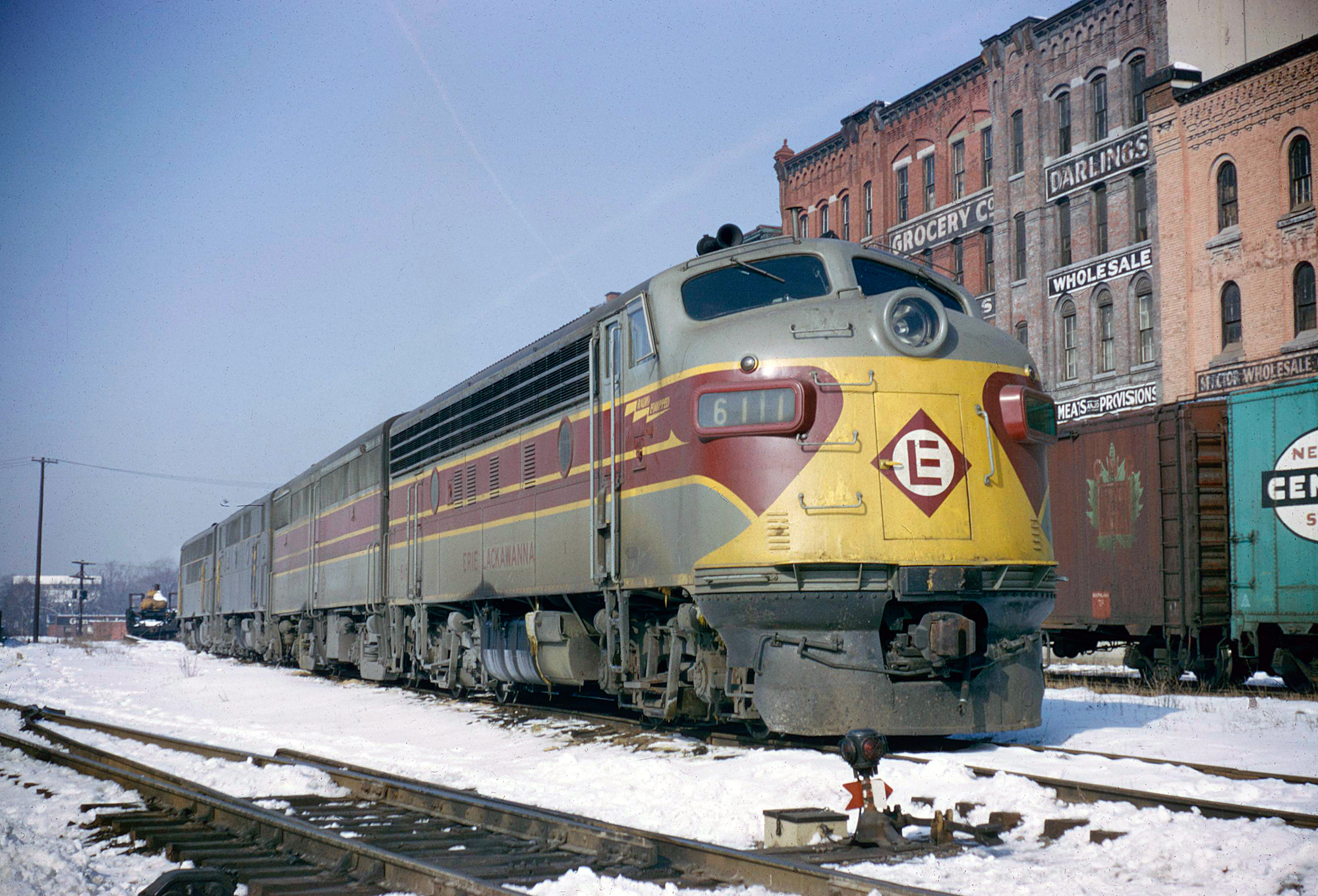 A handsome set of Erie Lackawanna covered wagons, led by F7A #6111, layover in Binghamton, New York during February of 1966. Also note the FB-1. American-Rails.com collection.
History
What eventually became Erie Lackawanna can trace its heritage back to the 1950s when two of the Northeast's competing railroads realized the future looked bleak; the euphoria of record traffic during World War II was quickly dashed by sharp declines afterwards.
The historically successful Delaware, Lackawanna & Western, which had never dealt with bankruptcy after more than a century of service, lost nearly $1 million in 1955 while the Erie tried innovative ways to curb losses by encouraging industrial development along its property and launching new trailer-on-flatcar service (TOFC) during July of 1954.
At A Glance
Hoboken - Newark, New Jersey - Scranton, Pennsylvania - Binghamton, New York Jersey City - Paterson, New Jersey - Port Jervis, New York - Susquehanna - Binghamton Binghamton - Hornell - Buffalo, New York Binghamton - Utica, New York Binghamton - Syracuse - Oswego, New York Lake Hopatcong - Slateford Junction, New Jersey (Lackawanna Cutoff) Scranton - Northumberland/Sunbury, Pennsylvania Corning, New York - Newberry Junction, Pennsylvania Jamestown - Buffalo Port Jervis - Campbell Hall/Maybrook, New York - Suffern, New Jersey Hornell - Salamanca, New York - Youngstown, Ohio - Cleveland Youngstown - Marion, Lima, Ohio - Huntington, Indiana - Hammond, Indiana - Chicago Jersey City - Chicago (main line) | |
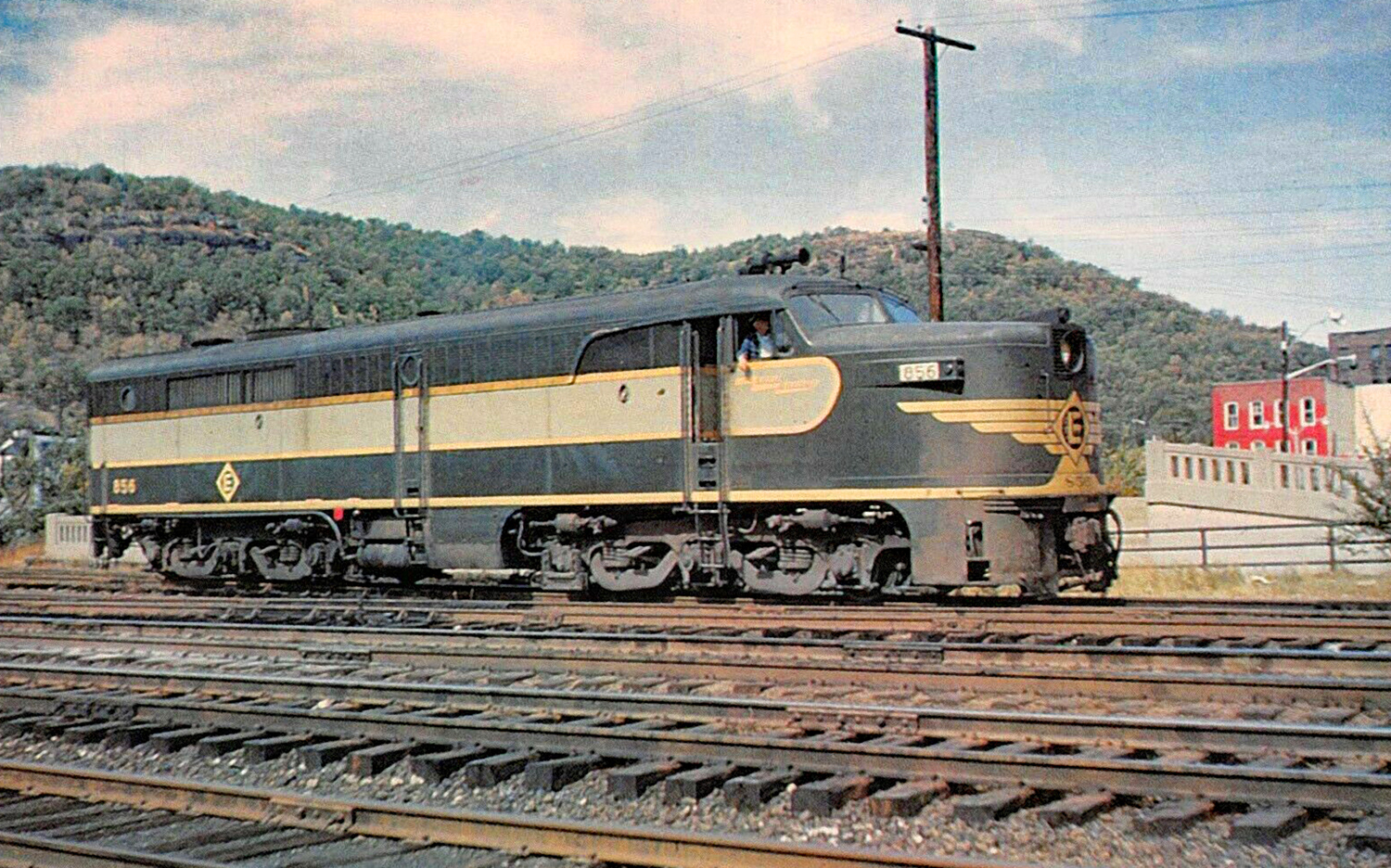 Erie Lackawanna PA-1 #856, still wearing its Erie colors, is seen here in Port Jervis, New York on September 6, 1964. Robert Gayer photo.
The Erie was the fourth way to Chicago, competing in the hotly-contested market alongside the New York Central, Pennsylvania, and Baltimore & Ohio running via Binghamton, Salamanca, Marion, and Rochester.
Its routing was somewhat slower than its competitors but featured a high and wide, double-tracked main line with arguably the best engineered route across Indiana.
According to H. Roger Grant's authoritative title, "Erie Lackawanna: Death Of An American Railroad, 1938-1992," executive John Barringer III noted during the 1920s that, "No other railroad into Chicago has as easy grades as the Erie route," a sentiment echoed by others.
However, the Erie was also hampered with heavy debt throughout much of its history due to four bankruptcies dating back to the Civil War era (1861, 1878, 1893, and 1938). The road to merger began in 1954 when the Erie launched informal talks with the Lackawanna.
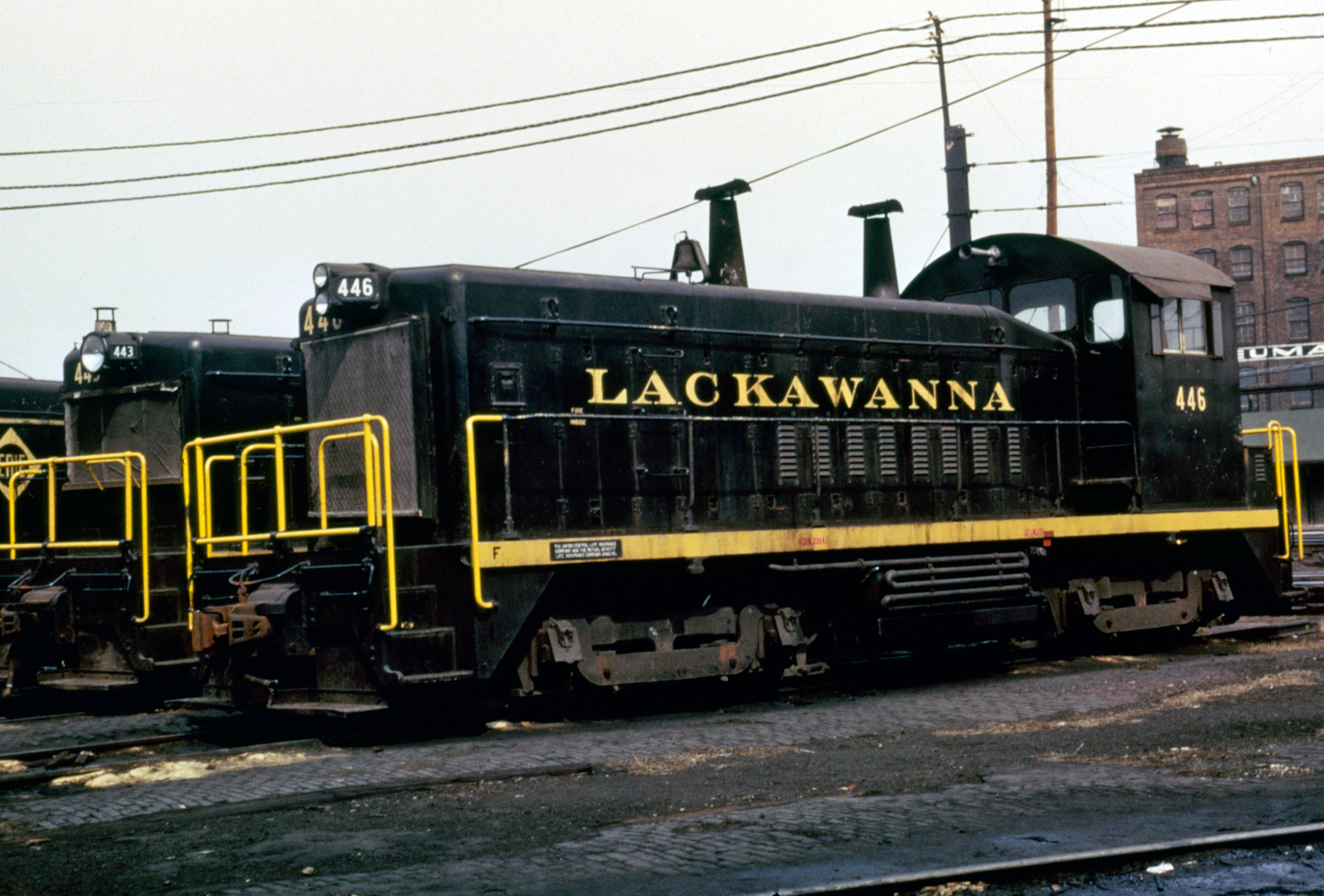 In this early Erie Lackawanna scene, SW9 #446 (ex-Delaware, Lackawanna & Western #551) and #443 (ex-Delaware, Lackawanna & Western #463) layover at the former DL&W's shops and roundhouse in Scranton, Pennsylvania during the early 1960s. American-Rails.com collection.
In the meantime, to cut losses they voluntarily initiated joint operations in various locations; on October 13, 1956 the Erie began using Lackawanna's Hoboken Terminal for commuter services, completing the closure of its Pavonia Terminal in Jersey City on December 12, 1958.
In addition, beginning in 1957 the two shared trackage between Binghamton and Gibson, New York via the Erie's main line.
These moves were nearly unheard of at the time, long before the modern merger movement. On September 10, 1956 studies were launched regarding a formal merger between the Erie, DL&W, and Delaware & Hudson. The inclusion of the D&H would have been a significant boon for the new railroad.
For fiscal year 1955, its net income was more than $9 million, greater than the Erie and Lackawanna's combined (the DL&W actually lost near $1 million that year) while operating only a fraction of the trackage.
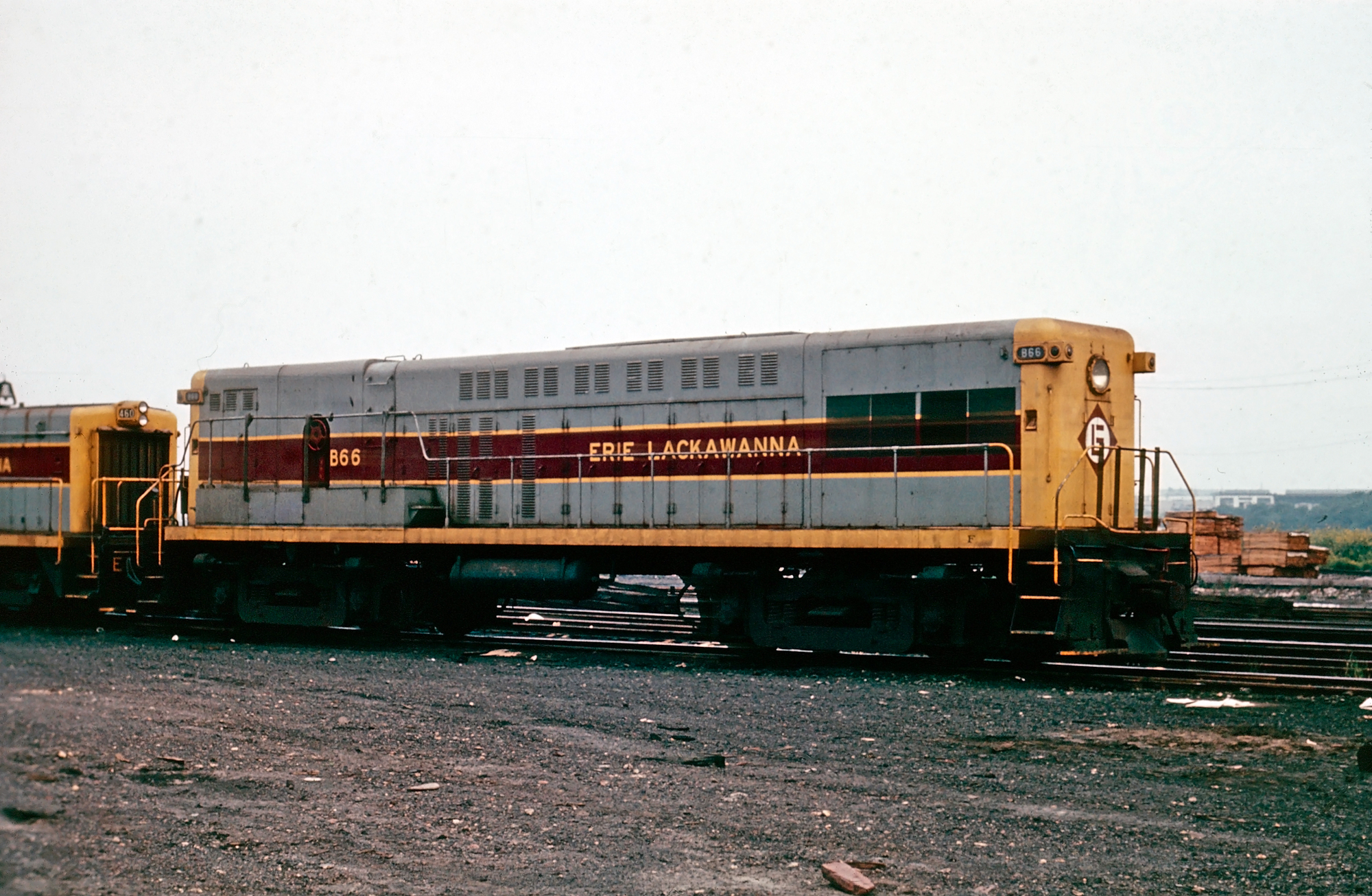 Erie Lackawanna slug B66, formerly DRS 4-4-1500 #1105 rebuilt by the shops in Hornell, New York, is seen here in Secaucus, New Jersey, circa 1969. Photographer unknown. American-Rails.com collection.
The D&H would have also provided new markets through northern New York and Montreal, Quebec. On April 13, 1959 "The Bridge Line" disappointingly dropped out of discussions but the other two roads forged ahead, in part due to the country's deepening recession.
During the entire process they had relied on the consulting firm Wyer, Dick & Company to prepare studies regarding cost savings and potential earnings. The idea of a union between the two roads seemed logical.
The Erie provided the coveted western connection to Chicago while the two roads could merge duplicate facilities and shed redundant trackage along their territories east of Buffalo.
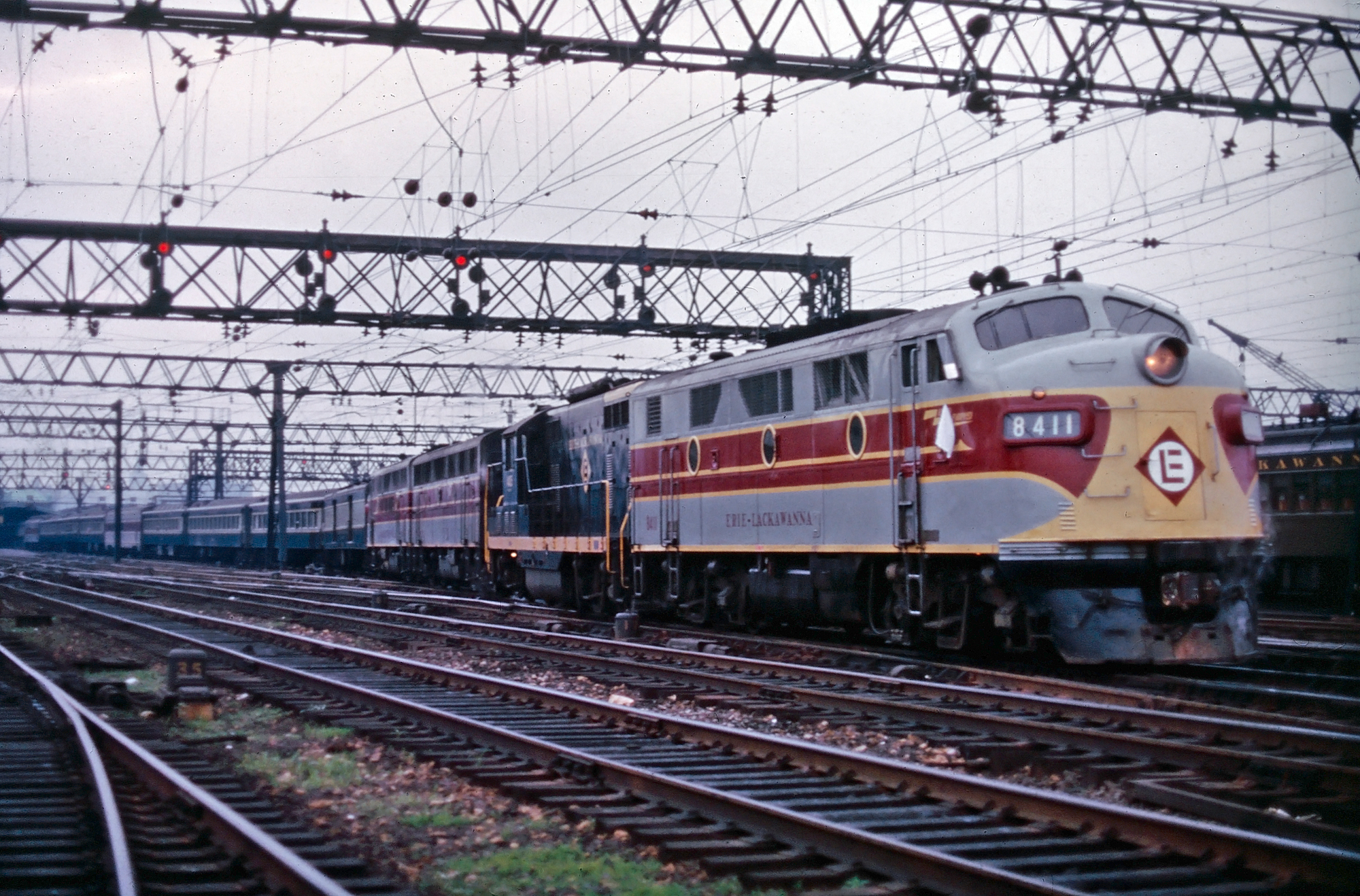 Erie Lackawanna F3A #8411 leads a passenger special out of Hoboken Terminal on June 8, 1963. Photographer unknown. American-Rails.com collection.
Wyer, Dick believed the new company could generate $16.6 million in annual savings, albeit this was dependent upon carrying out infrastructure improvements and/or acquiring new rolling stock/locomotives (i.e., capital expenditures). In addition, net income would rise from $2.8 million in the merger's first year to $24.1 million after five years.
The D&H setback was unfortunate in other ways; not only would it have provided for a stronger overall company but the railroad also carried just one outstanding bond. By comparison, the Erie had seven and the once-vaunted Lackawanna, fifteen.
Logo

The Erie Lackawanna's classic logo was a simple but very creative design using aspects of both predecessor companies. It was created by former Erie fireman Truman Knight, from Stow, Ohio, who worked the Kent Division.
The base concept was his company's old diamond logo but with "Erie" removed from the center. In its place he used a stylized "E" with the top arms slightly disconnected so that it also formed an "L."
Finally, the logo was adorned in Lackawanna's classic maroon instead of Erie's yellow and black, thus incorporating both predecessors into the new design.
The emblem was widely praised by top management and well-liked by employees. It was the winning choice of close to 2,500 entries submitted in a contest to create a new herald; Knight was given twenty shares of common stock in the new EL. Historically, his design will live on as one of the industry's classic logos.
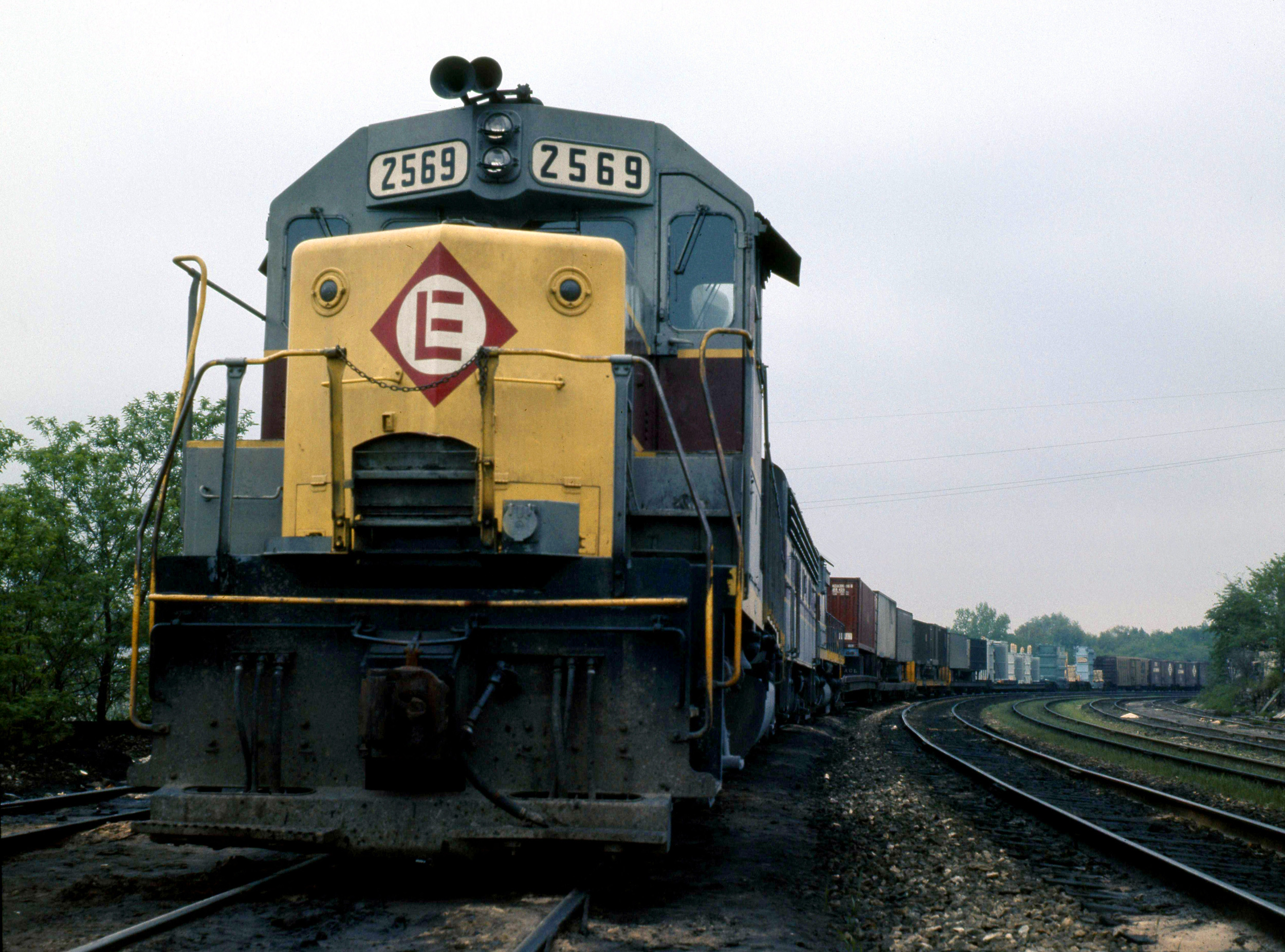 Erie Lackawanna GP35 #2569 appears to be tied down with its train at the west of Kent Yard in Kent, Ohio during May, 1975. Jerry Custer photo.
Formation
Looking back, the D&H may have also helped save the EL from its future bankruptcy, or at the very least enabled its reorganization. Over the next year the process worked its way forward until the Interstate Commerce Commission formally approved the union on September 13, 1960.
The new Erie-Lackawanna Railroad (EL) officially began operations on October 17, 1960 with an entire network of 3,031 miles. In 1963 the company dropped the hyphen and became simply the Erie Lackawanna Railroad.
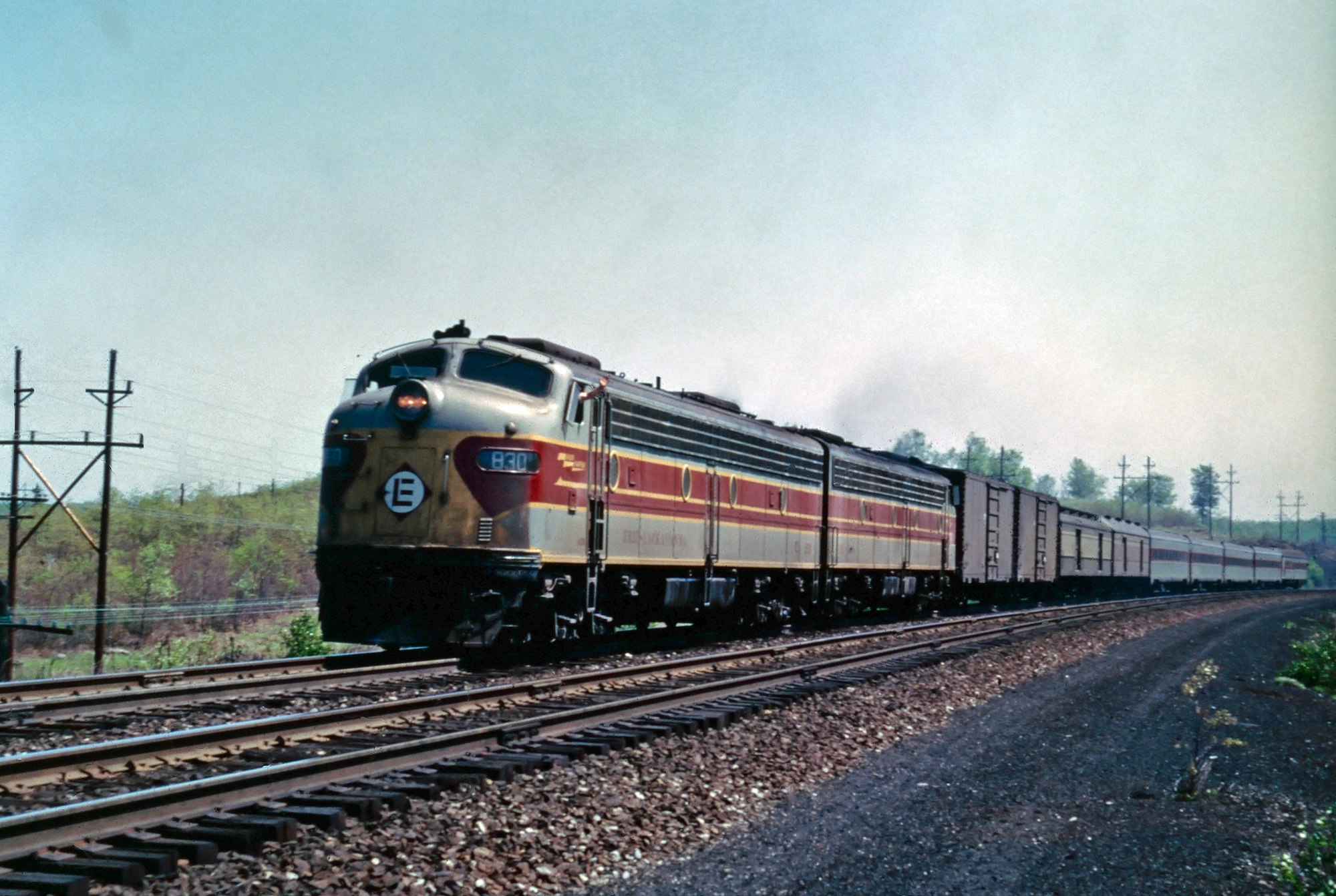 Erie Lackawanna E8A #830 leads the "Lackawanna Limited" at Wharton, New Jersey on May 19, 1963. American-Rails.com collection.
From the very start, EL ran into issues both of its own doing and outside its control. The long-seated rivalry of the two predecessors emerged when Lackawanna's officers were largely ignored in favor of the Erie's.
The issue here was not only one of favoritism and domination but also pragmatism. The DL&W had, historically, always been the much better managed railroad.
The Erie Lackawanna could have certainly used the knowledge and expertise of Lackawanna's top management playing a more direct role in the new company.
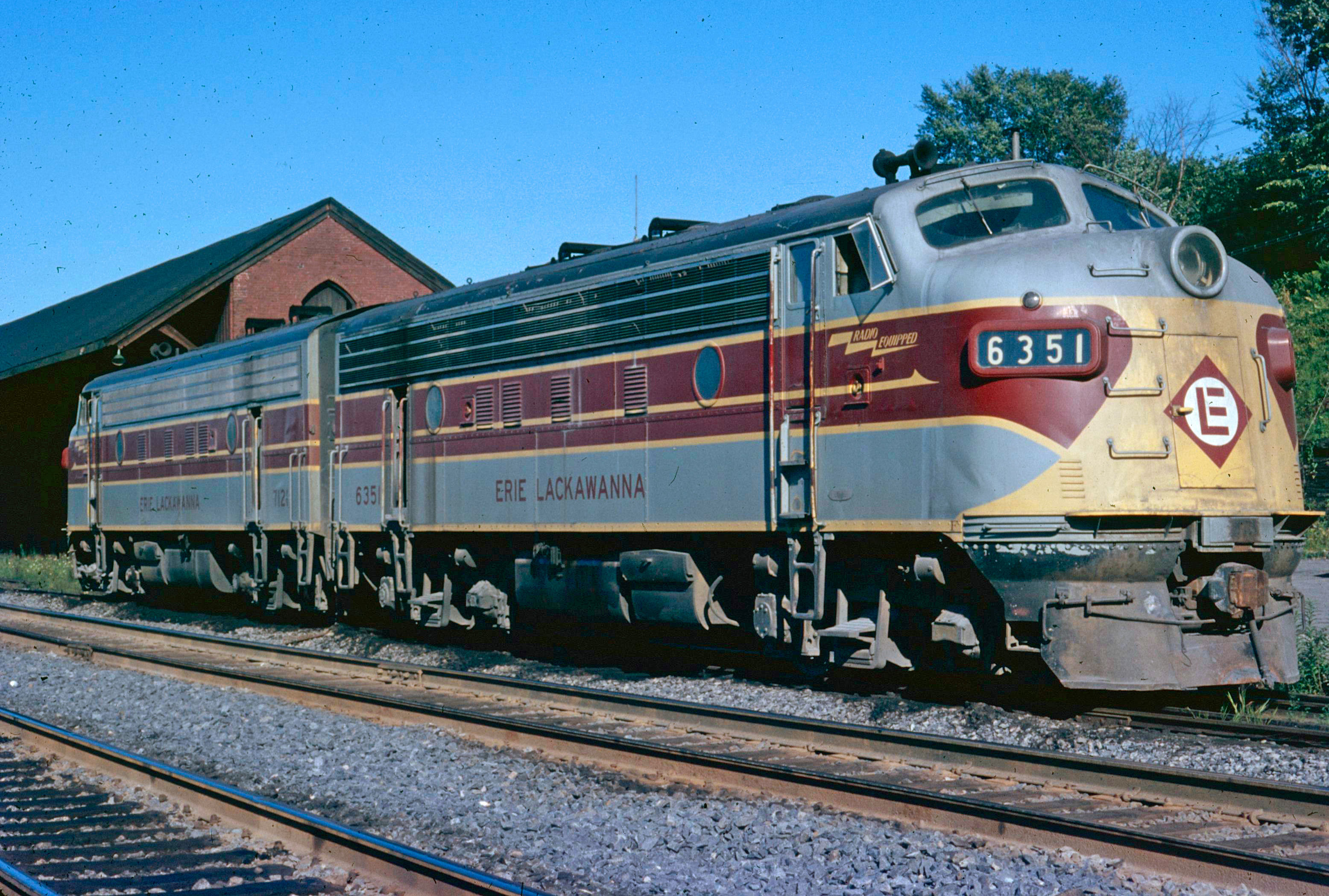 Erie Lackawanna F7A's await their next assignment at Deposit, New York in August, 1969. By this date the F units had been relegated to helper service. Author's collection.
An Erie man, Harry Von Miller, was given EL's first chairmanship as well as duties as president and chief operating officer. His immediate second in command was the Lackawanna's former chief, Perry Shoemaker.
Miller retired just months after EL's creation but instead of Shoemaker being named his replacement another Erie man got the job, Milton McInnes.
Shoemaker received chairmanship of the board but still carried no direct decision making duties and later said so: "I was made chairman, but I certainly didn't run the railroad."
Beyond managerial issues the hope for savings and higher earnings was immediately dashed; in 1961 the company lost more than $26.4 million and $16.6 million the following year.
The EL proved itself a smaller version of the later Penn Central disaster; incoming officers did not work together and the merger was rushed through without proper time to vet and work out all of the details for a smooth transition.
As the Erie's team dominated the show (similar to the PRR at Penn Central), Lackawanna managers eventually left the company or found work with other railroads. By 1962, the road's long term debt stood at more than $322 million and its future appeared grim.
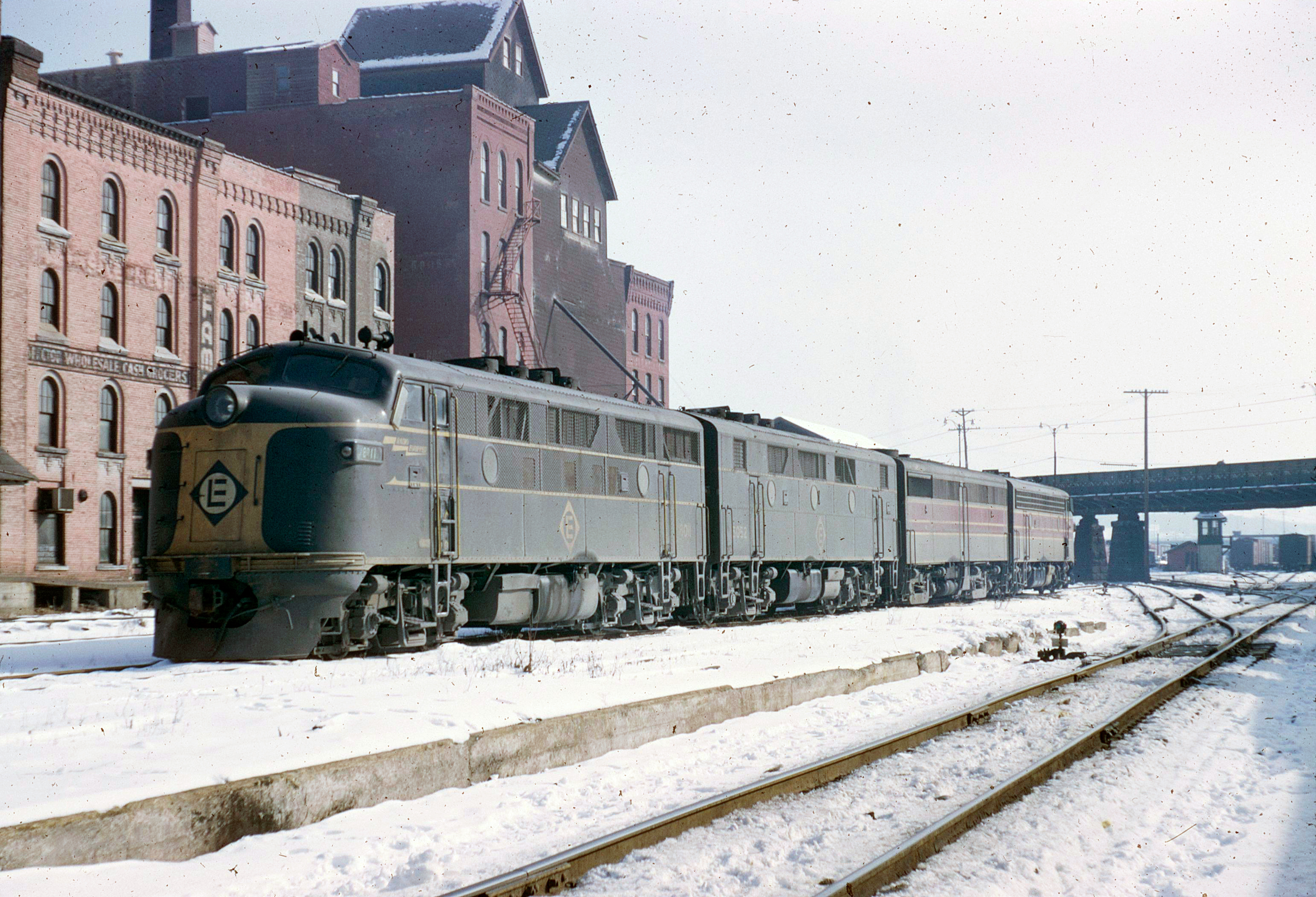 An interesting lash-up of Erie Lackawanna power is on the former Erie at Binghamton, New York in February, 1966. Author's collection.
Enter William "Bill" White, a highly respected executive who had started his career with the Erie and worked his way up the corporate ladder to eventually head several companies including the Virginian, Lackawanna, and even the mighty New York Central.
He formally joined Erie Lackawanna on June 18, 1963 and immediately set about streamlining operations by:
- Restructuring the road's debt.
- Increasing borrowing power to implement capital improvements (notable here was more more than $59 million in loans to acquire new locomotives and rolling stock).
- Doing away with the road's aggressive but failed less-than-carload (LCL) policies to focus on profitable long-haul movements (such as intermodal/TOFC and general merchandise).
- Trying unsuccessfully to eliminate money-losing commuter operations around New York, and bringing in more effective managers. Ironically, this move resulted in many former Lackawanna officers replacing those of Erie heritage.
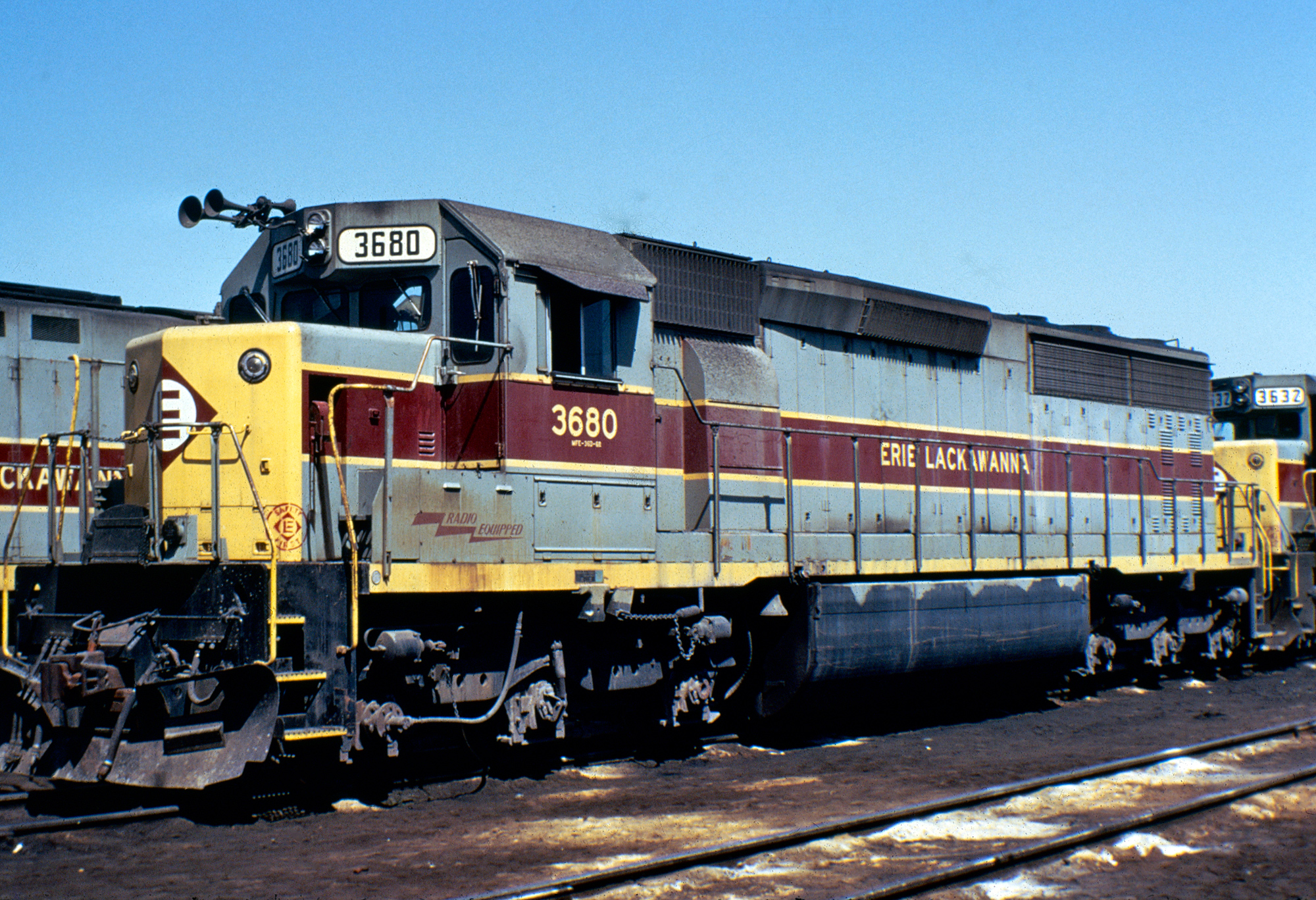 Erie Lackawanna SD45-2 #3680 at Croxton Yard in Secaucus, New Jersey, circa 1975. American-Rails.com collection.
White also looked for a merger partner, believing this was the only true way EL could survive. The Norfolk & Western eventually agreed to acquire the road but from a distance.
To protect itself from EL's financial condition and heavy debt, The Friendly Service Route was placed within a new holding company known as Dereco, Inc. (an interesting name with an interesting history, it would later include the Delaware & Hudson).
The Interstate Commerce Commission approved the idea during December of 1966. The following spring, Bill White passed away unexpectedly and was later replaced by Jack Fishwick from the Norfolk & Western under the corporate banner of the Erie Lackawanna Railway formed on March 1, 1968.
Fishwick's immediate subordinate was the accomplished Gregory Maxwell who was given the presidency. The loss of White was a big blow to the company; he had greatly turned around its situation and avoided bankruptcy.
Although White was unable to eliminate the suffocating commuter operations (long-distance services ended with the cancellation of the Phoebe Snow on November 27, 1966 and later the Lake Cities on January 6, 1970) he accomplished much during his few years.
System Map (1969)
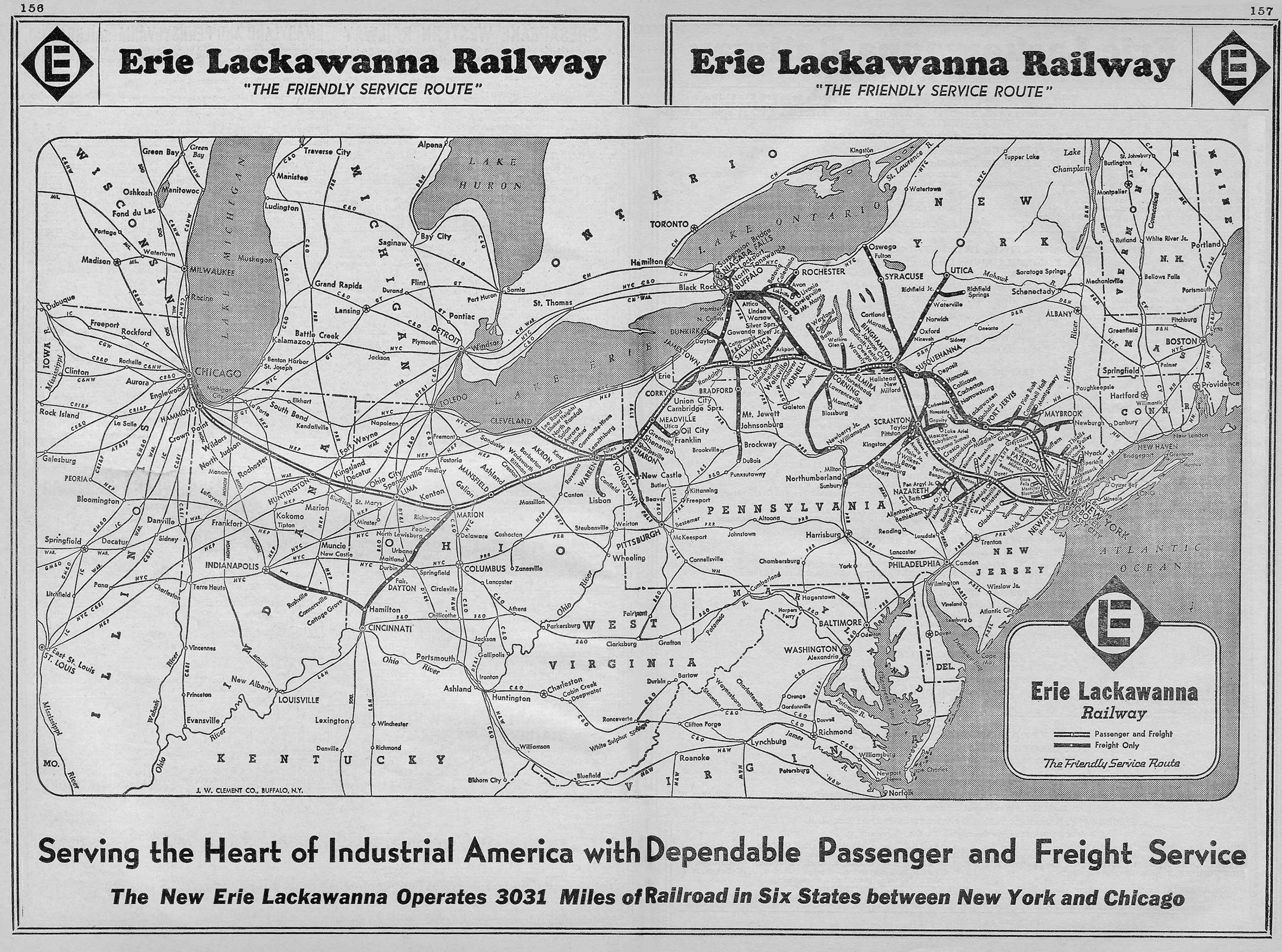
By the late 1960s the EL had posted its first ever profits thanks to aggressive cost-cutting, downsizing, and marketing.
The latter step paid off with the railroad gaining new intermodal/piggyback services and a contract with the United Parcel Service (UPS) in 1970 (this gave the EL five new intermodal trains between New York and Chicago), which continued until the road disappeared into Conrail.
For years, executives from John W. Barriger of the 1920s to Fishwick himself, recognized the Erie's one vital asset, its high and wide Chicago main line devoid of clearances, stiff grades, and sharp curves.
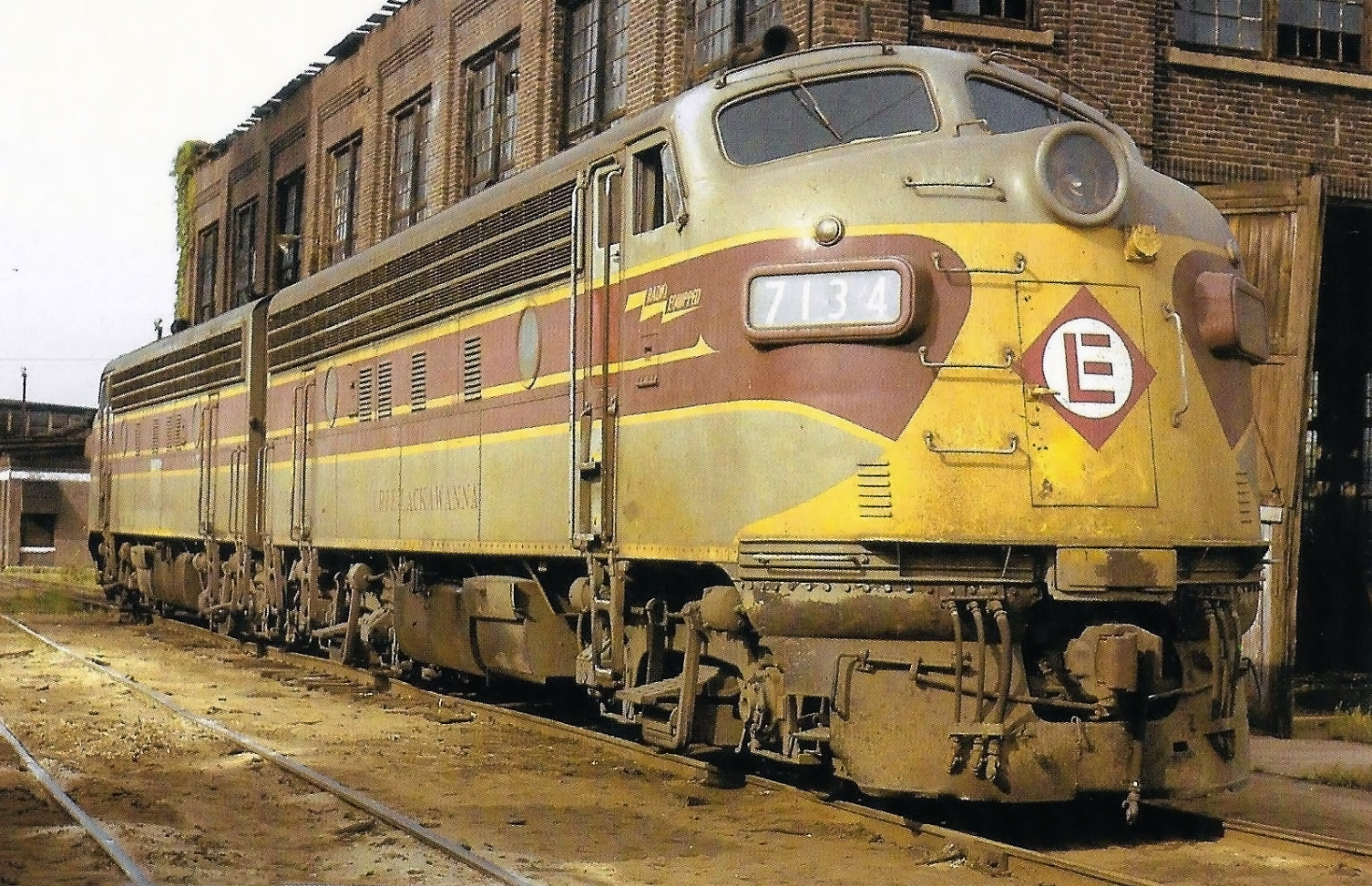 A pair of Erie Lackawanna F7A's layover between assignments at Penn Central's terminal in Maybrook, New York during August of 1972. Henry Butz, photo.
Penn Central
Alas, the colossal Penn Central merger, created on February 1, 1968 through the Pennsylvania and New York Central, began a quick secession of problems for EL just after it posted net incomes that year and into 1969.
The new conglomerate, which added the New Haven on January 1, 1969, severely hurt The Friendly Service Route's freight tonnage. The New Haven had long been an important interchange partner at Maybrook, New York via the Poughkeepsie Bridge transferring tens of thousands of carloads annually.
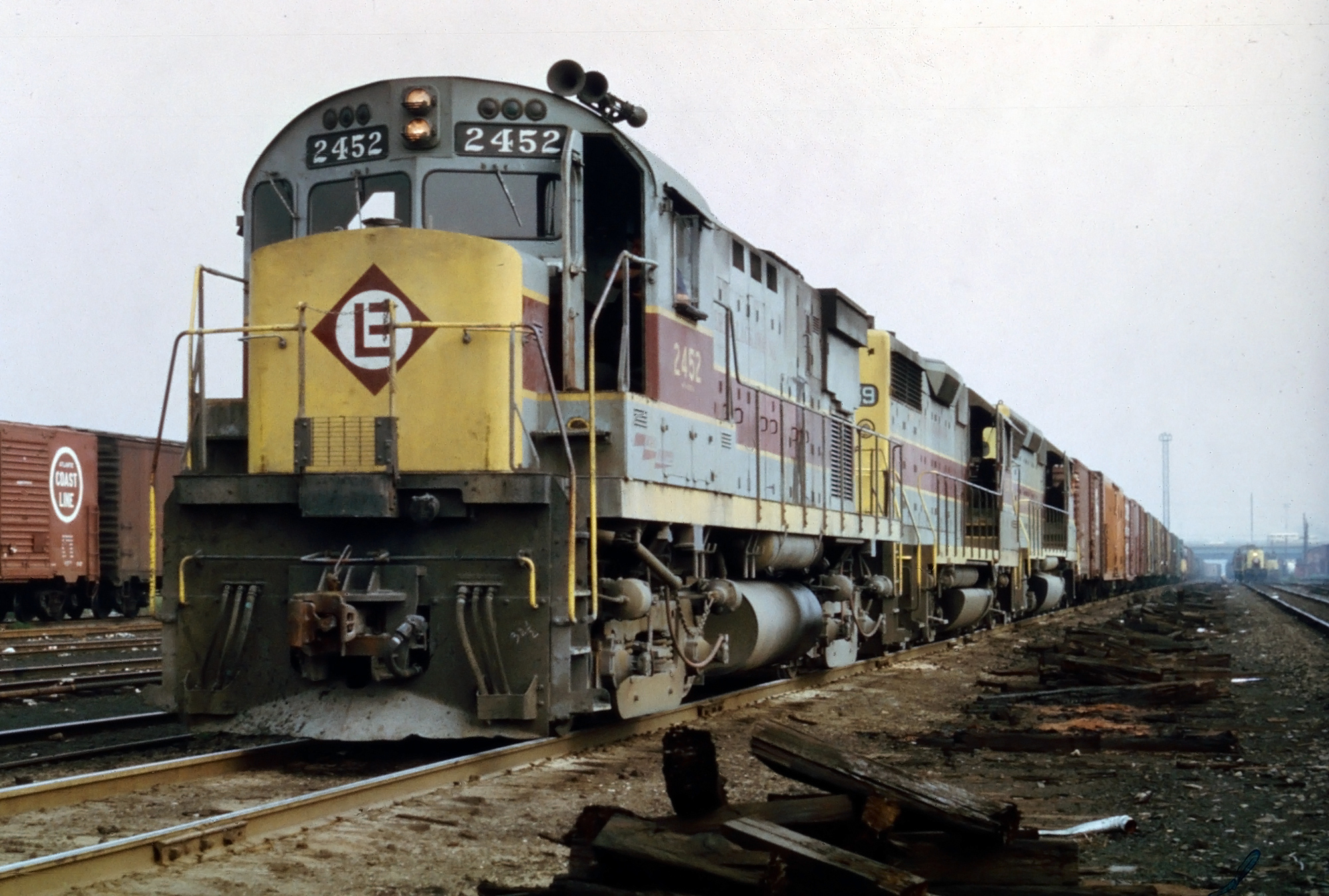 Erie Lackawanna C425 #2452, a GP9, and an SD45 have a long freight at Croxton Yard in Secaucus, New Jersey in August, 1968. Photographer unknown. American-Rails.com collection.
After the first year (1969), numbers dropped by more than a third and had been cut by half through 1970. Since Penn Central could now carry this freight over its own rails there was no need to short-haul itself by interchanging with the Erie Lackawanna.
The declines resulted in more than $17 million of lost annual revenue for EL. On May 8, 1974 the gateway was closed forever when the bridge burned and PC refused to make repairs.
The year 1970 had also witnessed the stunning bankruptcy of Penn Central sending the Northeast's rail industry into chaos; soon, roads which had not already entered receivership were vying for court protection.
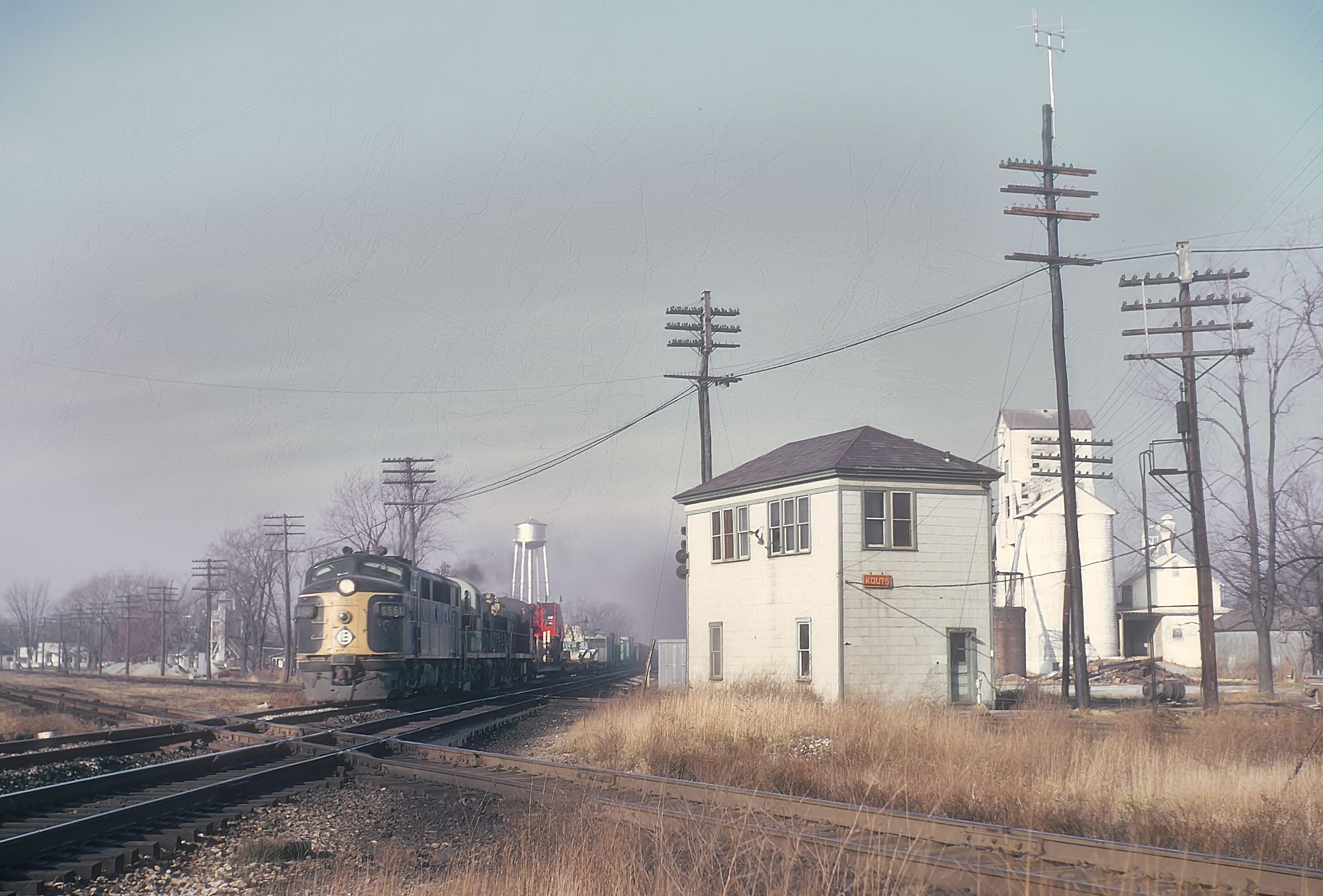 Erie Lackawanna F3A #6561 leads an eastbound freight through the PRR interlocking at Kouts, Indiana in November, 1966. Sadly, no rails remain in this small community today. Rick Burn photo.
Hurricane Agnes
The EL had been able to avoid a similar fate until Hurricane Agnes ravaged the region during June of 1972 causing more than $11 million in damages and lost revenue. The railroad filed for reorganization on June 26, 1972 completing the service disaster across the Northeast.
Not long after its bankruptcy the N&W sold off all interests in the company (roughly $56 million), which was again independent, albeit a realm of the court.
During 1970 Fishwick returned to the Norfolk & Western and handed over the EL's duties to Maxwell, who turned out to be the company's final president and chief executive. Maxwell guided the road as best he could.
In 1973 Congress and President Richard Nixon passed the Shoup-Adams Act (also known as the Regional Rail Reorganization Act, or 3R Act) which stipulated millions in governmental assistance to create what eventually became the quasi-public Consolidated Rail Corporation, or Conrail, to cleanup the mess in the Northeast.
However, EL had the choice of joining or going it alone, eventually deciding upon the latter in 1974. That spring, the bankruptcy judge gave the go ahead for a reorganization and it appeared the railroad would be Conrail's competition to Chicago.
However, after nearly a year of number crunching EL's trustees realized it had little hope of making it on its own and during January of 1975 asked for inclusion into Conrail.
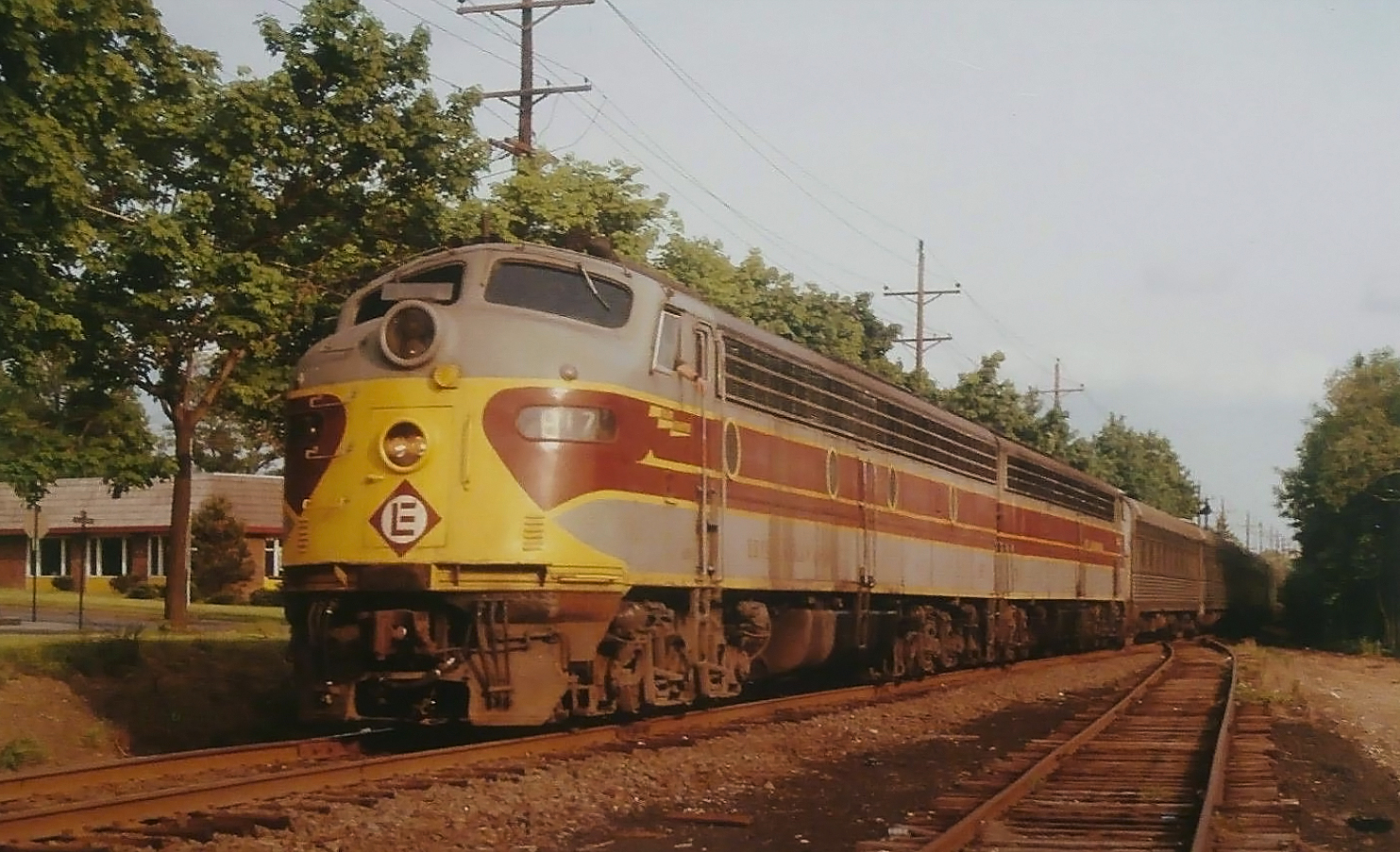 Erie Lackawanna E8A #817 (ex-DL&W) works suburban service with train #1605 (Hoboken, New Jersey - Spring Valley, New York) as it arrives at Hillsdale, New Jersey in August of 1971. Henry Butz photo.
Passenger Trains
Lake Cities: Hoboken - Chicago
As planners worked out the details there was a great desire to have two competing Northeastern systems and not one, gigantic monopoly.
There were various proposals put forth, which included the Erie Lackawanna in competition solely against Conrail or have EL acquired by Norfolk & Western while Chessie System would takeover much of the Reading and Jersey Central to reach the Port of New York.
The latter, according to Rush Loving Jr.'s book, "The Men Who Loved Trains," was referred to as the "Three Systems East" plan.
It was the brainchild of Jim McClellan and assistant Gerald Davies. Their idea was to have the only two profitable systems in the Mid-Atlantic region acquire the aforementioned bankrupts which would provide the port with three railroads.
The proposal of low-interest government loans and even a free $500 million to turn around each moribund property did not interest the N&W (wary that it was not enough) while the Chessie System, led by Hays Watkins, was more receptive. With the N&W backpedaling, Chessie was offered the Erie Lackawanna during July of 1975, which became known as the "Two Systems East" plan.
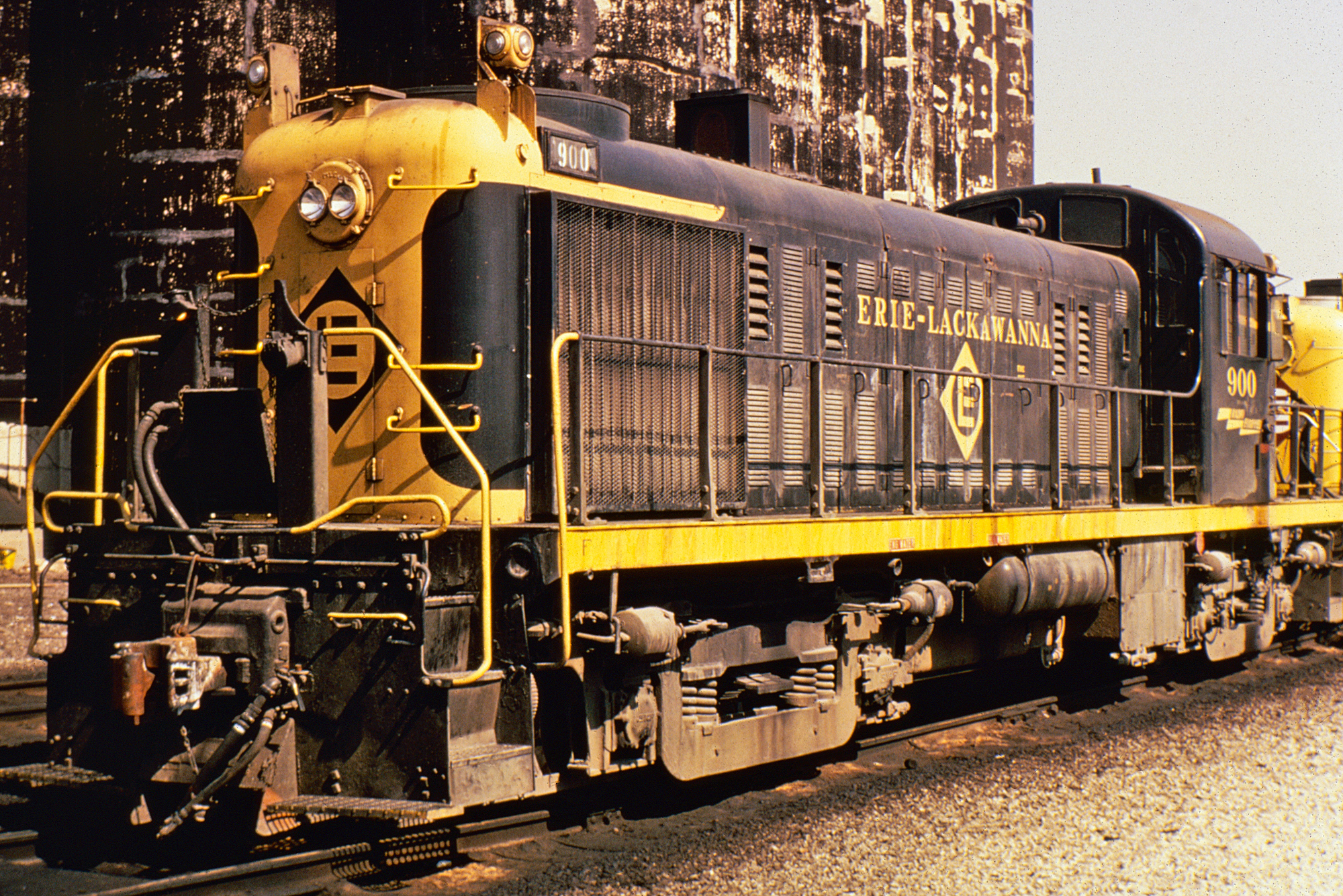 Erie Lackawanna RS2 #900 (ex-Erie #900) layover at the Normal & 51st Yard in Chicago during the 1960s. American-Rails.com collection.
Later that year, in October, the railroad formally agreed to acquire the entirety of Erie Lackawanna east of Sterling, Ohio for $155 million (west of that point the Baltimore & Ohio's line to Chicago would be utilized with the rest of EL sold or abandoned across western Ohio and Indiana).
The last hurdle to clear was negotiating contracts with EL's labor unions. As Mr. Loving's book points out labor had enjoyed lucrative contracts under their former company and would not agree to what was essentially a pay cut under Chessie System.
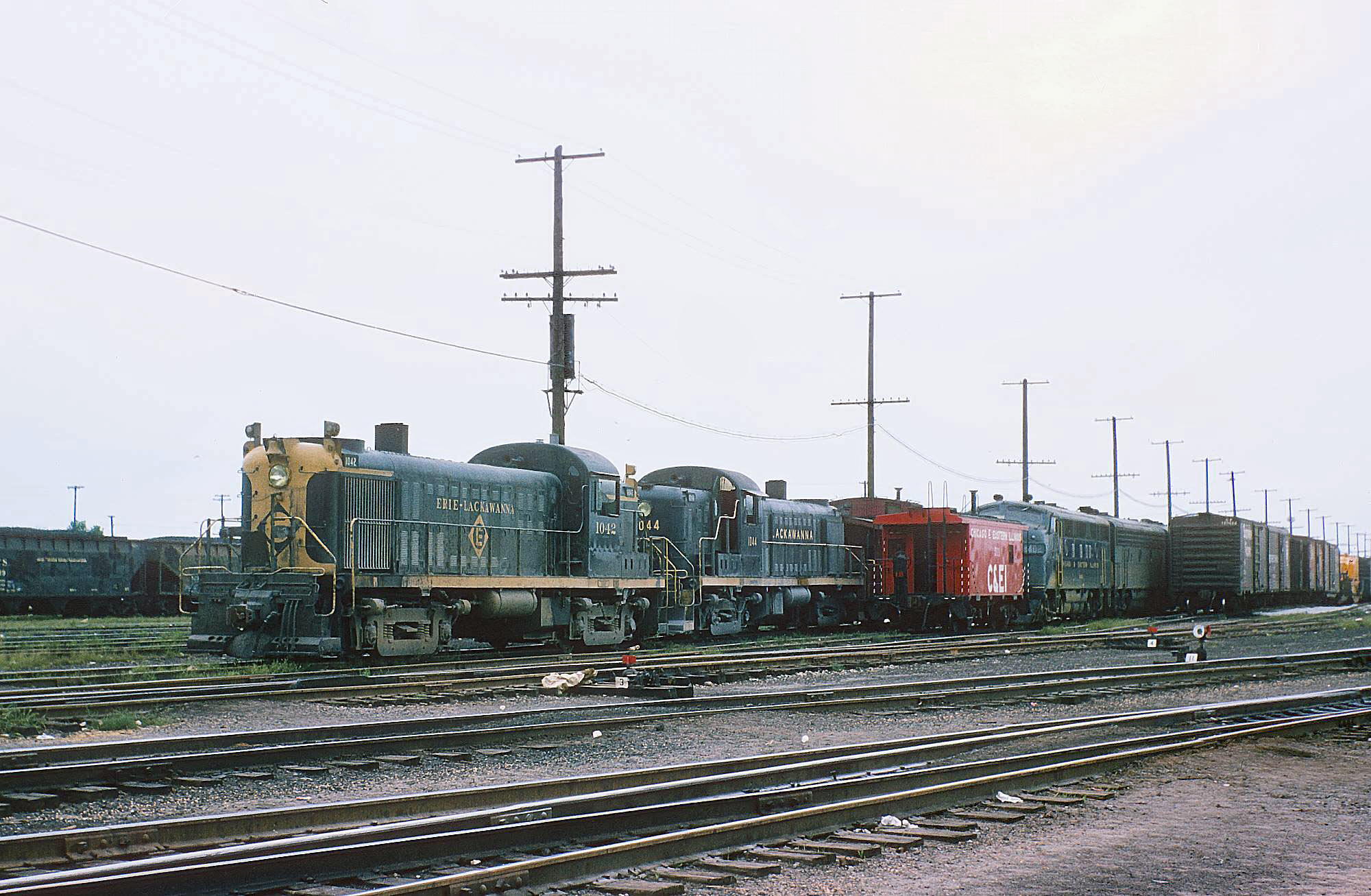 Erie Lackawanna RS3s #1042 and #1044 (ex-DL&W #904 and #906) are seen here at Clearing Yard in Chicago during September, 1963. Rick Burn photo.
Conrail
As a result, talks broke down and a deal was ultimately never reached. Time was running out to find a suitable place for the EL in the soon-to-be carved up Northeast as Congress had mandated Conrail launch operations during the first half of 1976.
Alas, with no takers, this proved the fate of EL which was eventually included in Big Blue upon its start date; April 1, 1976. What many had feared with a Conrail takeover happened as the old Erie Lackawanna lines played only a small role in the new conglomerate.
Conrail had no need for three main lines to Chicago and mothballed the EL west of Marion, Ohio during September of 1977.
The Erie Western Railway was formed soon afterwards to operate the ex-EL from Wren, Ohio into Chicago. However, the western extent of the old Erie had never generated much traffic and relied largely on agricultural movements.
The new short line soon realized this and entered bankruptcy during June of 1979. A new startup took over, named the Chicago & Indiana Railway, but failed so quickly that operations ceased before the end of the year.
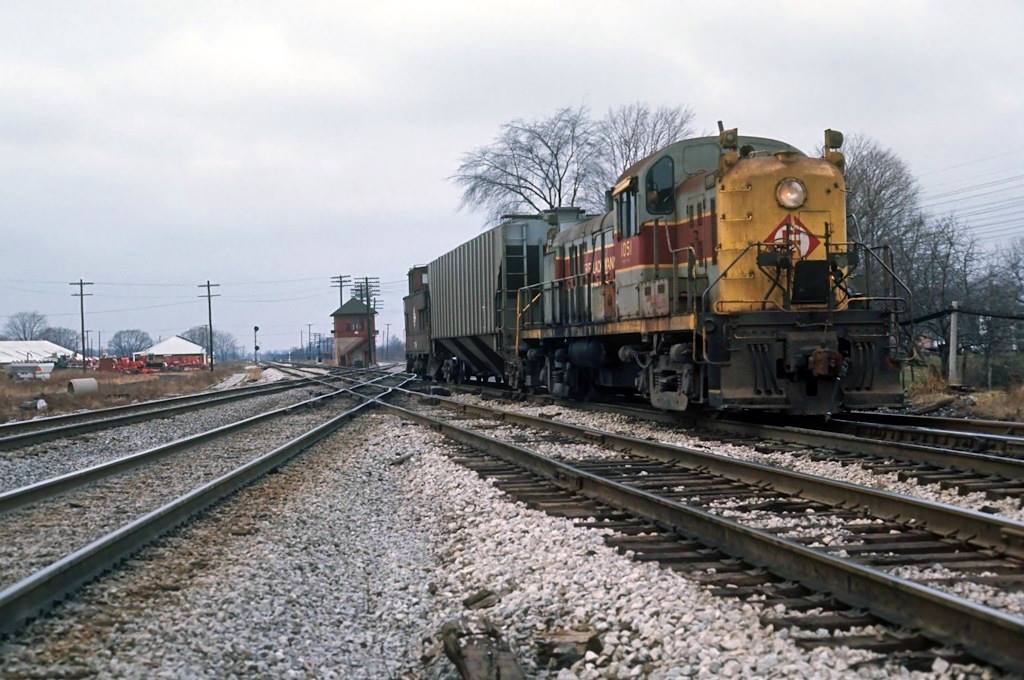 Erie Lackawanna RS3 #1051 totes a covered hopper and caboose heading east on the road's westbound main as it crosses the Baltimore & Ohio at Sterling, Ohio on December 27, 1975. Today, this area is quite different; the EL's Chicago main line is completely gone along with the tower. However, the B&O remains busy under CSX. Gary Morris photo.
Postscript
Perhaps a private report prepared by the affluent Atchison, Topeka & Santa Fe during May of 1975 best illustrates Erie Lackawanna's potential.
The Santa Fe had been a longtime interchange partner with EL via Chicago and noted that, "an extensive six-year rehabilitation plan would generate a net, after-tax income of $28 million annually" (in 2021 that figure would be $144 million).
Diesel Roster
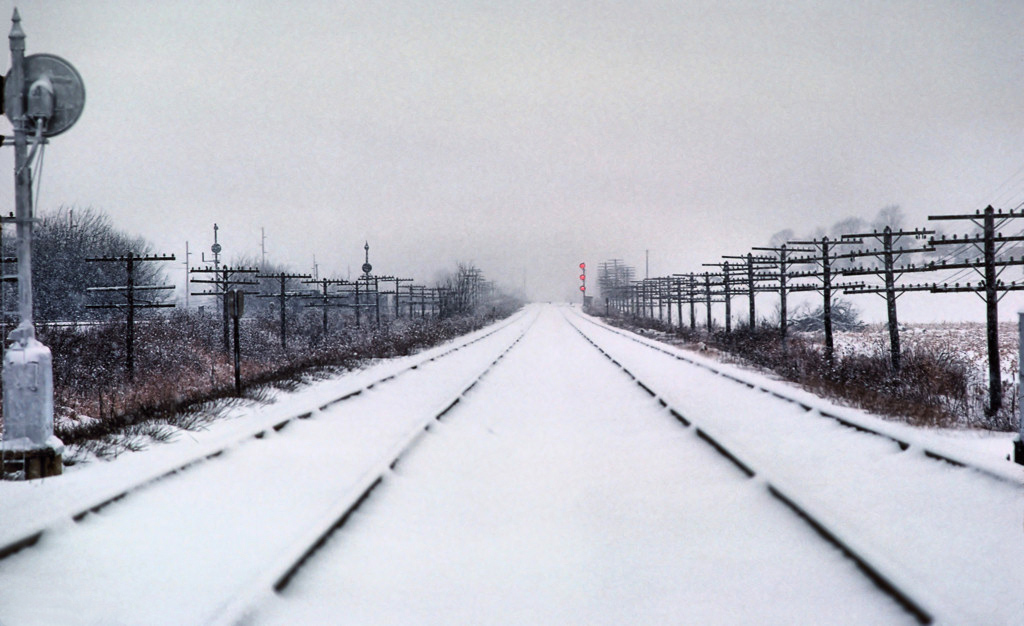 This was the Erie Lackawanna, a high and wide pike ideal for intermodal service. It still witnessed nearly 25 trains per day before Conrail but after its start fell largely silent, as seen here near Sterling, Ohio in December, 1976. Gary Morris photo.
Santa Fe's report went on to state that, "The E-L is the only Eastern railroad which has the right-of-way suitable for high-speed, long-haul service without superfluous, congested and expensive urban terminals every hundred miles."
"The absence of clearance restrictions, an extensive double track main line, and interdivisional crew districts are indicative of the physical resources which are presently being utilized at a level far below capacity."
In another words, the EL offered great potential and would certainly have blossomed during the intermodal revolution of the 1980s.
Alas, the political environment of the time (which saw railroads as an archaic mode of transportation) and strict regulation, coupled with EL's heavy debt, resulted in a near impossible situation for the carrier.
The government certainly had the ability and means to save the road by creating a second Conrail but believing the Northeast already held far too much excess trackage (a notion quite true in many respects) was not willing to do so.
Photo Gallery
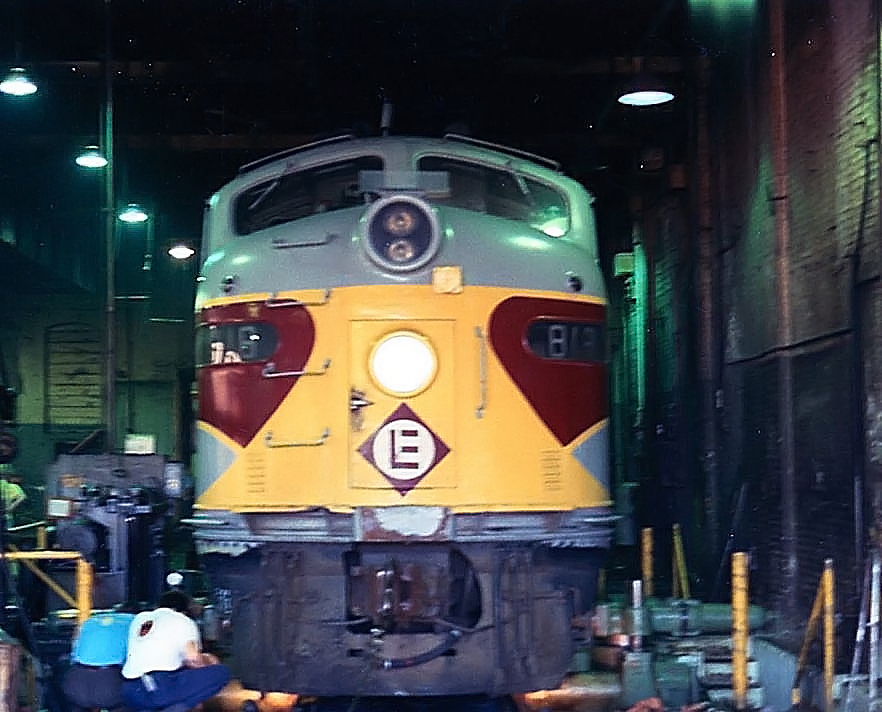 Erie Lackawanna E8A #818 is getting its wheels trued at the Hornell, New York shops on August 5, 1972. Doug Kroll photo.
 A pair of Erie Lackawanna SD45s, led by #3628, are in pool service on the joint Delaware & Hudson/Boston & Maine line at Ushers, New York on August 27, 1969. Carl Sturner photo.
 Erie Lackawanna C425 #2452 leads a long freight into Hammond, Indiana on September 17, 1967. Roger Puta photo.
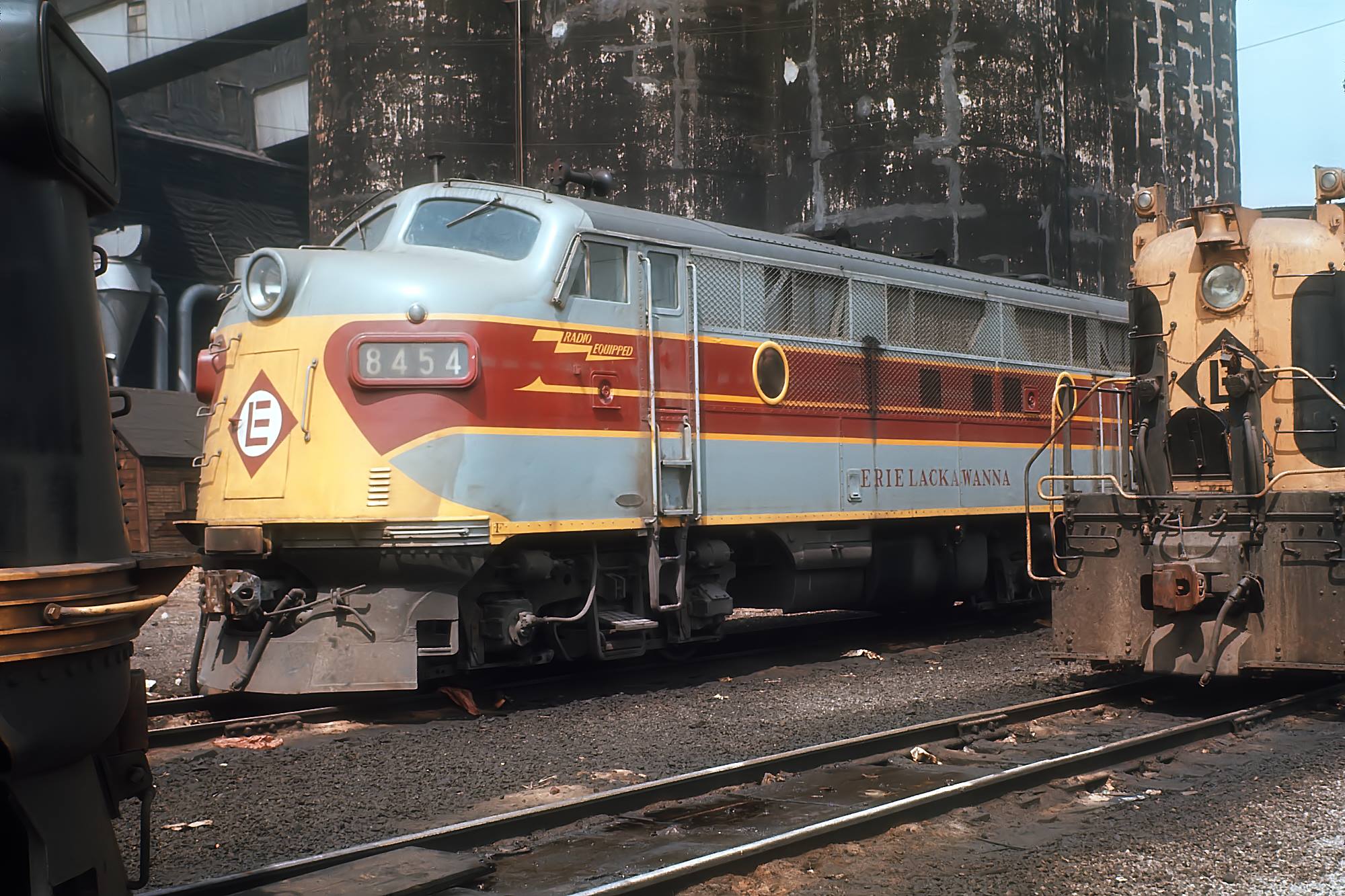 Erie Lackawanna F3A #8454, and other power, lays over at the Normal and 51st Street Yard in Chicago on April 21, 1965. Rick Burn photo.
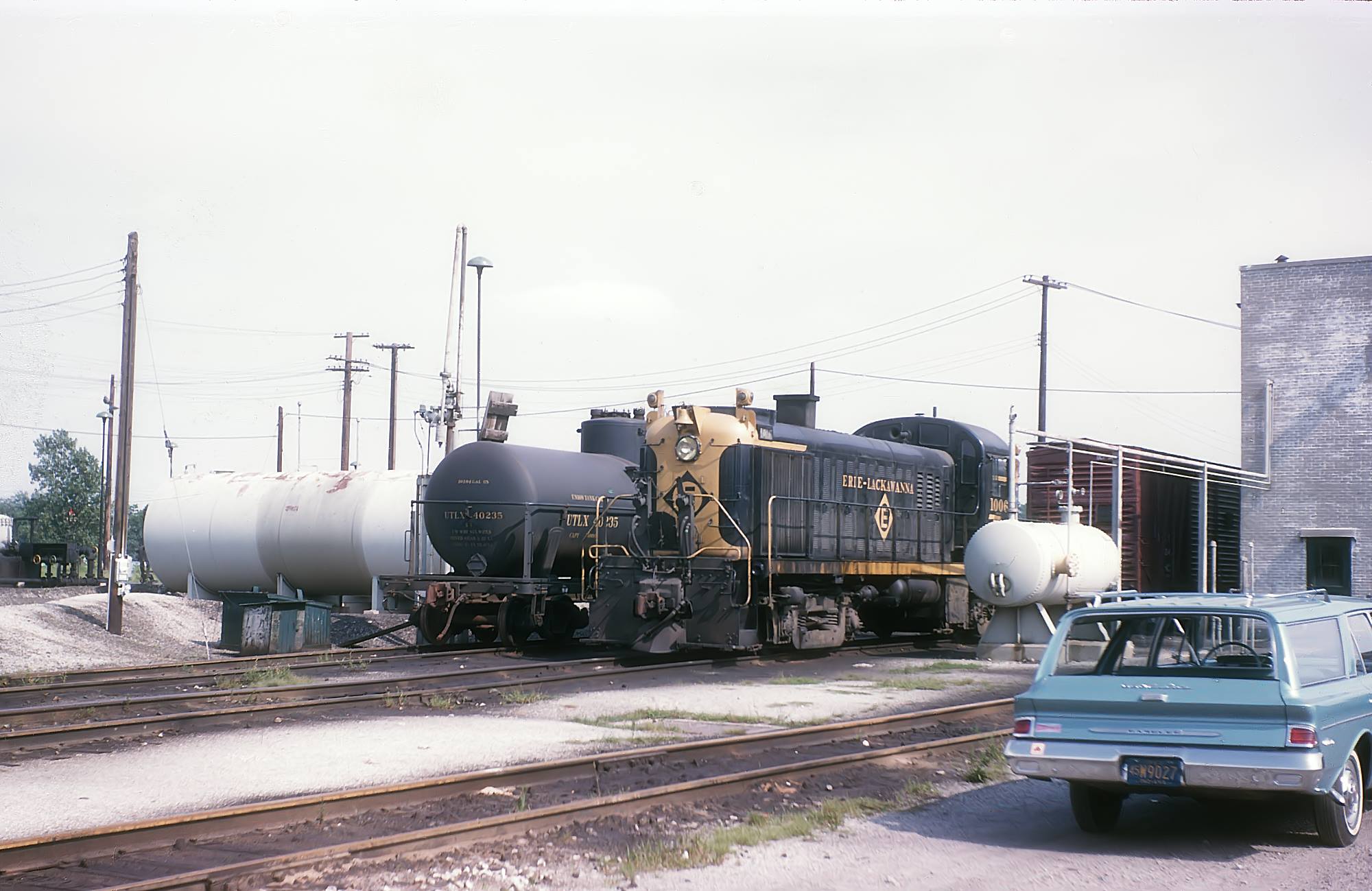 Erie Lackawanna RS3 #1006 is at the railroad's small engine terminal in Hammond, Indiana during the summer of 1961. Rick Burn photo.
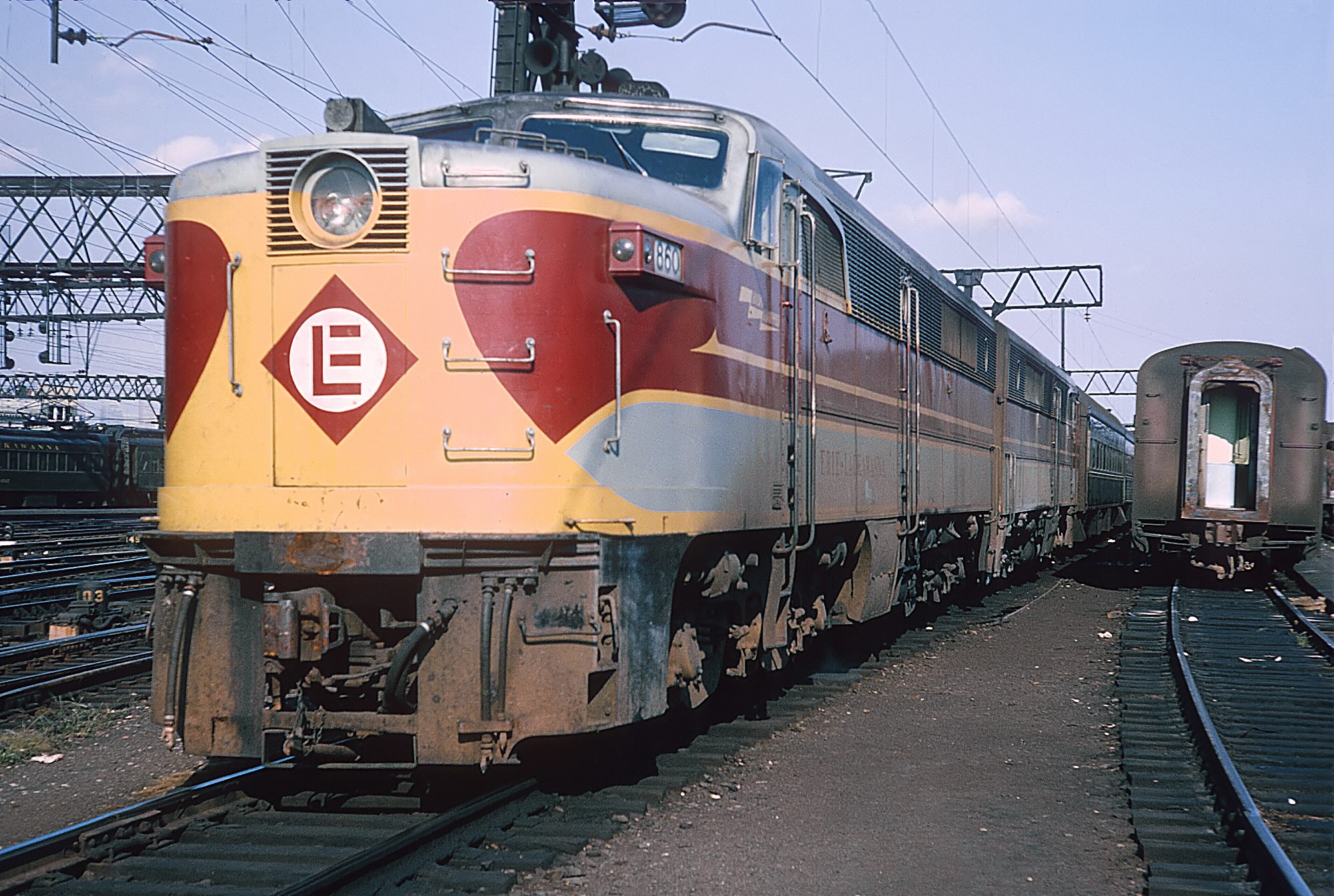 Erie Lackawanna PA-1 #860 readies to depart Hoboken Terminal with "The Twilight" (Hoboken - Buffalo) on September 3, 1965. Roger Puta photo.
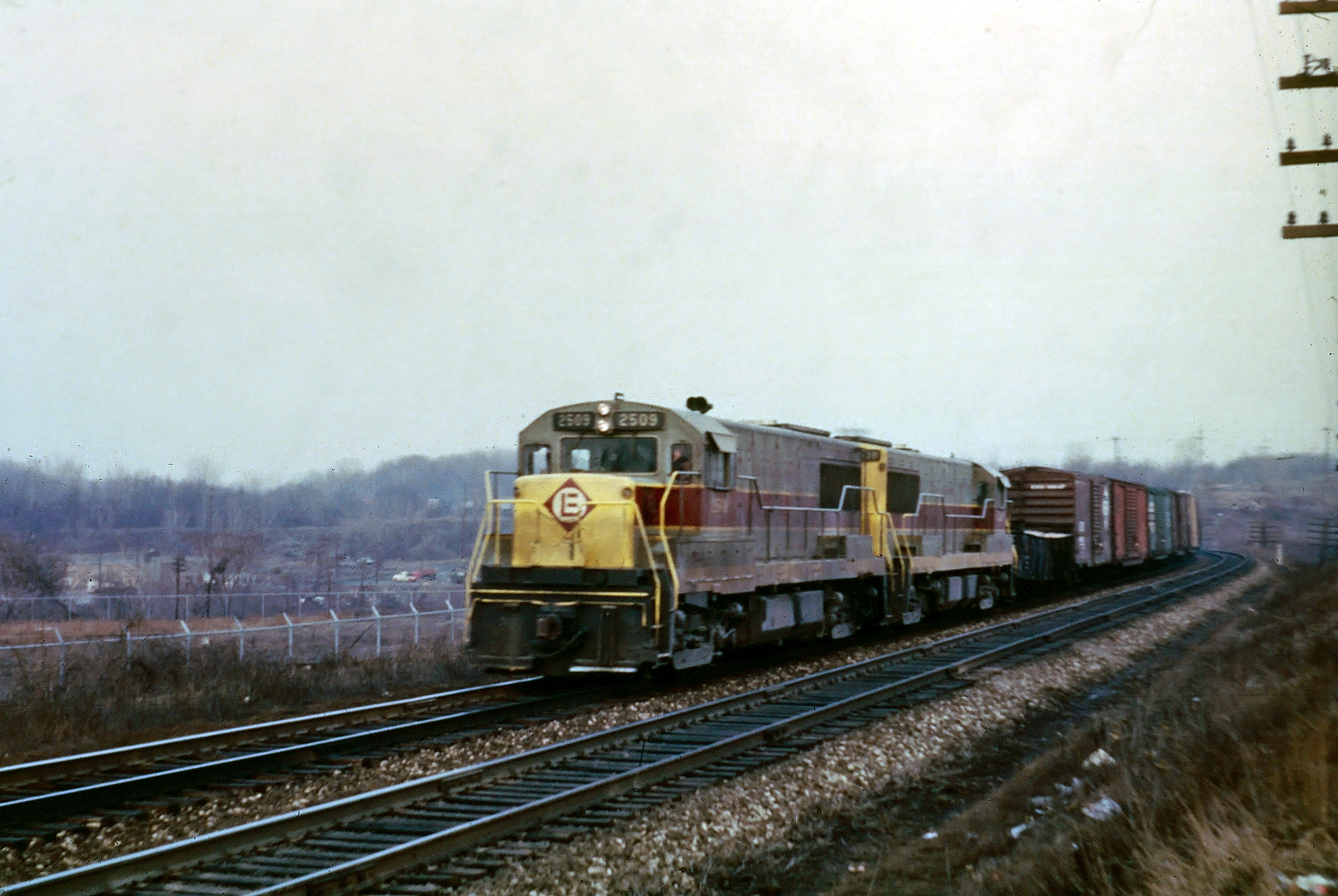 A pair of Erie Lackawanna U25Bs, led by #2509, are westbound near Akron, Ohio on a gloomy February 28, 1965. Photographer unknown. American-Rails.com collection.
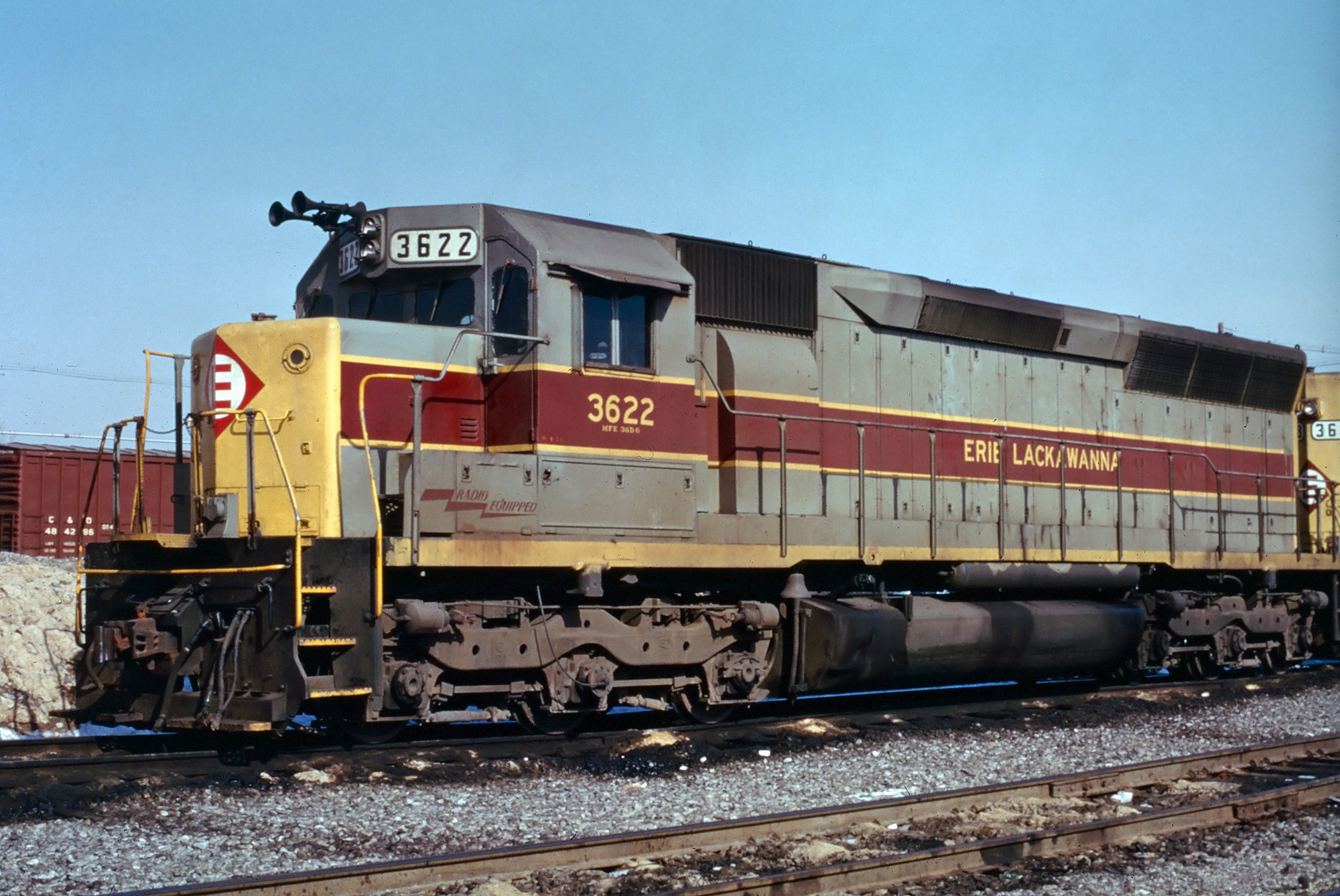 Erie Lackawanna SD45 #3622 was photographed here at Sloan, New York on February 18, 1974. Photographer unknown. American-Rails.com collection.
Recent Articles


-
Boston and Maine Railroad: "Route Of The Minute Man"
Sep 16, 26 11:30 AM
 Boston & Maine—Andover & Wilmington 1833, NH charter June 27 1835. Eastern, Boston & Lowell, Fitchburg/Hoosac, Concord & Montreal. Section 77 March 12 1970. Guilford June 30 1983. CSX June 1 2…
 -
Smoky Valley Limited Dinner Train (2026)
Sep 16, 26 11:24 AM
 2026 Abilene & Smoky Valley Smoky Valley Limited—two-hour dinner from the 1887 Rock Island Depot. Kansas catering, ~$72–$110. Confirm on asvrr.org.
 -
Canadian National Diesel Locomotives: History, Roster & Photos
Sep 16, 26 11:14 AM
 Canadian National diesel—CLC boxcabs 1929, GMD FP9 and GP9, MLW FPA-4 and RS-18, GMD1, wide-cab SD40-2W, Dash-9s, ES44AC and ET44AC. All-time roster.
 -
Canadian National Steam Locomotives: History, Roster & Photos
Sep 16, 26 10:07 AM
 Canadian National steam—CGR, Canadian Northern, Grand Trunk, GTP. 4-8-4 Confederations, U-1 Mountains, J and K Pacifics. Post-1900 class roster. Last scheduled steam April 25, 1960.
 -
Canadian National Railway: Map, Logo, History, Photos
Sep 16, 26 08:55 AM
 Canadian National—name Dec 20 1918, incorporated June 6 1919, Grand Trunk Jan 20 1923. Crown corporation, IPO Nov 17 1995. IC, Wisconsin Central, BC Rail, EJ&E. Class I, mark CN.
 -
Buffalo, Rochester and Pittsburgh Railway: "Safety and Service"
Sep 16, 26 12:12 AM
 Buffalo, Rochester & Pittsburgh—Rochester & State Line 1869, BR&P March 12 1887. Pennsylvania coal to Buffalo and Rochester. B&O January 1 1932. All-time steam roster, LL 2-6-6-2s, XX…
 -
Buffalo Creek & Gauley Railroad: Map, Roster, Logo, Photos
Sep 15, 26 11:55 PM
 Buffalo Creek & Gauley—Elk River Coal & Lumber, April 1 1904, Dundon–Widen. Last all-steam WV coal road, February 27 1965. All-time steam roster, #4 Baldwin 59472, Majestic and Elk River diesels…
 -
Buffalo and Susquehanna Railroad: Map & History
Sep 15, 26 11:42 PM
 Buffalo & Susquehanna—Goodyear hemlock railroad, Sinnemahoning Valley December 14 1885, 1893 merger, coal to Sagamore, Buffalo extension, bankruptcy May 6 1910, B&O 1932, WAG 1956.
 -
WMSR Allegheny Mountain Dinner Train (2026): Dates & Tickets
Sep 15, 26 11:36 PM
 2026 Western Maryland Scenic Allegheny Mountain Dinner Train—Cumberland, 3 hours, 21+, Saturday 7 p.m. Confirm on wmsr.com.
 -
Boston and Albany Railroad: Map & History
Sep 15, 26 11:28 PM
 Boston & Albany Railroad—Boston & Worcester June 23 1831, Western Railroad across the Berkshires, merger 1867–70. NYC 99-year lease July 1 1900. Berkshires, New England States, CSX and MBTA today.
 -
Grand Bellevue Dinner Train (2026): Portsmouth, Rhode Island
Sep 15, 26 11:14 PM
 2026 Grand Bellevue Rail Dining in Portsmouth, RI—2.5-hour seated dinner on Narragansett Bay. Fall/winter TBA after Aug. 29. Confirm on thegrandbell.com.
 -
The "John Bull": The C&A's First Locomotive (1831)
Sep 15, 26 11:01 PM
 John Bull locomotive—Stephenson Planet-type 0-4-0, 1831. Dripps assembly, 4-2-0 rebuild, cowcatcher. Specs, Camden & Amboy career, Smithsonian 1884, 1981 steam-up, 1939 replica.
 -
Napa Valley Wine Train Dining (2026): Lunch, Dinner & Vista Dome
Sep 15, 26 10:56 PM
 2026 Napa Valley Wine Train dining—downtown Napa, 36-mile round trip, gourmet lunch and dinner, Vista Dome. Confirm packages on winetrain.com.
 -
My Old Kentucky Dinner Train (2026): Dates, Tickets & What to Expect
Sep 15, 26 10:50 PM
 2026 My Old Kentucky Dinner Train in Bardstown—2.5 hours, 35-mile round trip, four-course dinner from $116. Confirm on kydinnertrain.com.
 -
LaSalle Street Station: One Of Chicago's Great Terminals
Sep 15, 26 10:42 PM
 LaSalle Street Station—Rock Island October 10, 1852. Frost & Granger July 1, 1903. 20th Century Limited, Rockets, Golden State. Headhouse razed 1981. Metra Rock Island District today.
 -
Charlie Russell Chew Choo (2026): Montana Dinner Train from Lewistown
Sep 15, 26 10:39 PM
 2026 Charlie Russell Chew Choo dinner train—Hanover/Lewistown, 4.5 hours, 56-mile round trip, prime rib. Adult $151. Remaining listed dates sold out. Confirm on montanadinnertrain.com.
 -
Central Pacific Railroad: Map, History, Facts, Logo
Sep 15, 26 10:30 PM
 Central Pacific—Judah, Big Four, June 28 1861. Sierra, Chinese labor, Donner Summit Tunnel. Ten-mile day April 28 1869. Promontory May 10. Southern Pacific lease April 1 1885. Dissolved June 30 1959…
 -
Bessemer & Lake Erie Railroad: "The Bessemer Road"
Sep 15, 26 05:20 PM
 Bessemer & Lake Erie—Bear Creek 1865, Carnegie 1897, U.S. Steel 1901. Ore south from Conneaut, coal north. 2-10-4s, Missabe sister road. CN May 10, 2004. Complete corporate history.
 -
Bangor and Aroostook Railroad: "Serving Northern Maine"
Sep 15, 26 05:05 PM
 Bangor & Aroostook—chartered February 13, 1891, first trains January 1, 1894. Potatoes, paper, Searsport, State of Maine reefers. MM&A 2003, Lac-Mégantic 2013, CP 2020, CPKC today. Complete co…
 -
Baltimore & Ohio Chicago Terminal Railroad: Map and History
Sep 15, 26 03:11 PM
 B&OCT—formed January 6, 1910 to buy Chicago Terminal Transfer. Grand Central, Barr Yard, 78 route-miles. Assigned B&O steam. Complete diesel roster. CSX paper subsidiary, mark BOCT.
 -
The "Alphabet Route" (Railroad): Photos and History
Sep 15, 26 02:53 PM
 Alphabet Route—eight railroads, not one company. P&WV to Connellsville February 11, 1931. Alpha Jets Chicago/St. Louis–New York/Boston. NKP, W&LE, P&WV, WM, Reading, CNJ, L&HR, New Hav…
 -
Milwaukee Road Livestock Operations: Cattle, Dakotas & Montana
Sep 15, 26 02:36 PM
 Milwaukee Road livestock traffic—Dakota and Montana cattle, Iowa hogs, Chicago markets, 28-hour law, head-end stock cars. By 1974 mostly Montana. Rick Burn’s Helena speech. Operations history, not the…
 -
Spirit of Jasper Ride & Dine (2026): Season Pause
Sep 15, 26 02:29 PM
 Spirit of Jasper Ride & Dine in Jasper, Indiana—seated meal on board. Operator: not running public trains for 2026. Depot remains open as a rental. Confirm on spiritofjaspertrain.com.
 -
South Carolina Canal & Rail Road Company: Map and History
Sep 15, 26 01:59 PM
 South Carolina Canal & Rail Road—chartered December 19, 1827. Best Friend of Charleston, 136 miles Charleston–Hamburg October 1833, Aiken inclined plane. South Carolina Railroad 1844, Southern 189…
 -
The Practice of Double-Heading: The Steam Era
Sep 15, 26 01:43 PM
 Doubleheading—two locomotives on the point, each with its own steam crew. Not a rear helper, not diesel MU. How it worked, PRR 1877, mountain grades, and what MU ended.
 -
Mohawk and Hudson Railroad: Map, Pictures, Locomotives
Sep 15, 26 01:20 PM
 Mohawk & Hudson Railroad—New York’s first railroad, chartered April 17, 1826. DeWitt Clinton, inclined planes, Albany & Schenectady 1847, first New York Central May 17, 1853. Complete corporat…
 -
Essex Clipper Dinner Train (2026): Dates, Tickets & What to Expect
Sep 15, 26 01:09 PM
 2026 Essex Clipper Dinner Train in Essex, CT—2.5 hours, four-course meal $129.99, 18+. Fall dates through Oct. 25. Confirm on essexsteamtrain.com.
 -
Camden & Amboy Railroad: Map, History, Photos
Sep 15, 26 12:53 PM
 Camden & Amboy Railroad—chartered February 4, 1830. Joint Companies monopoly with the Delaware & Raritan Canal, John Bull, T-rail. United New Jersey 1872, PRR 999-year lease 1871. Complete corpora…
 -
Cafe Lafayette Dinner Train (2026): Dates, Tickets & What to Expect
Sep 15, 26 12:47 PM
2026 Cafe Lafayette Dinner Train in North Woodstock, NH—2 hours, 20 miles, five-course meal from $125. May–October. Confirm on nhdinnertrain.com. -
Christmas Train Ride Locations (2026): A Complete Guide
Sep 15, 26 10:47 AM
 2026 Christmas train rides by state—Santa, North Pole Express, and holiday trains. Not Polar Express. State guides and product pages. Confirm dates on each railroad.
 -
Baltimore & Ohio Railroad: Linking 13 Great States With The Nation
Sep 15, 26 10:22 AM
 Baltimore & Ohio Railroad—first U.S. common carrier, chartered February 28, 1827. Wheeling 1853, Chicago 1874, C&O control 1963, Chessie 1973, into CSX April 30, 1987. Complete corporate history.
 -
Delaware & Hudson Railway: The Bridge Line
Sep 15, 26 09:59 AM
 Delaware & Hudson Railway—Wurts brothers canal 1823, gravity railroad 1829, Stourbridge Lion, Bridge Line to Montreal. Guilford 1984, CP 1991, NS south line 2015, CPKC north.
 -
Delaware & Hudson Diesel Roster (All-Time)
Sep 15, 26 12:17 AM
 All-time Delaware & Hudson diesel roster—Alco S-2s through C-628s and PA-4s, GE U-boats, Baldwin RF-16s, EMD SD45s and GP38-2/GP39-2s. Serials, dates, dispositions.
 -
Granite Railway, Our Country's First Railroad
Sep 14, 26 11:28 PM
 Granite Railway of Quincy, Massachusetts—chartered March 4, 1826, opened October 7, 1826. Gridley Bryant, 5-foot gauge, horses, Bunker Hill Monument stone. First commercial U.S. railroad.
 -
Milwaukee Road Skytop Lounges: History, Specs & Floor Plans
Sep 14, 26 11:09 PM
 Milwaukee Road Skytop observation cars—Brooks Stevens, 1948. Four Rapids parlor-lounges from Milwaukee Shops, six Creek sleeper-lounges from Pullman-Standard. Floor plans, roster, preservation.
 -
West Virginia Christmas Train Rides (2026): A Complete Guide
Sep 14, 26 11:02 PM
2026 West Virginia Christmas trains—Potomac Eagle North Pole Express in Romney and Christmas at Cass. Not Polar Express. Elkins Polar is not listed for 2026. -
Railroads Of Today: Class I Map, PSR & the 2026 Industry
Sep 14, 26 10:30 PM
U.S. freight rail in 2026—six Class I railroads on a nearly 140,000-mile network. PSR as everyday practice, how the STB works, traffic mix, short lines and regionals. -
Railroad History (USA): Timeline, Facts & How the Network Was Built
Sep 14, 26 10:03 PM
 Full U.S. railroad history hub—origins and inventors, Golden Age peak mileage, Civil War and transcontinental, streamliners, ICC regulation, Penn Central and Conrail, Staggers Act, PSR, and today’s Cl…
 -
Railroads In The 2020s: CPKC, East Palestine & the UP–NS Case
Sep 14, 26 09:51 PM
 U.S. railroads 2020–2026—Class I mileage 91,773 in 2020. COVID traffic drop, CPKC April 14 2023, East Palestine Feb. 3 2023, UP–NS $85 billion case still before the STB.
 -
Railroads In The 2010s: PSR, Coal’s Decline & Positive Train Control
Sep 14, 26 03:51 PM
 U.S. railroads 2010–2020—Class I mileage 95,573 to 91,773. Buffett closed BNSF Feb. 12 2010, Harrison at CP June 29 2012 and CSX 2017, PTC deadline Dec. 31 2018.
 -
Virginia Christmas Train Rides (2026): A Complete Guide
Sep 14, 26 03:46 PM
 2026 Virginia Christmas trains—Virginia Scenic Railway Santa Express from Staunton, about 60 minutes. Confirm dates. Not Polar Express.
 -
MARC Train: Maryland Commuter Rail History, Lines & Roster
Sep 14, 26 01:16 PM
 MARC Train history—Maryland Rail Commuter 1984, B&O and PRR corridors, Penn/Camden/Brunswick lines, Silver Spring 1996, all-time locomotive roster.
 -
Railroads In The 2000s: Merger Freeze, Wisconsin Central & Buffett
Sep 13, 26 07:57 AM
 U.S. railroads 2000–2010—Class I mileage 99,250 to 95,573. STB merger freeze March 17 2000, CN–WC Oct. 9 2001, BNSF Railway Jan. 24 2005, Buffett Nov. 3 2009.
 -
Railroads In The 1990s: Mega-Mergers, Conrail’s Split & the STB
Sep 13, 26 12:13 AM
 U.S. railroads 1990–2000—Class I mileage 119,758 to 99,250. BNSF Sept. 22 1995, UP–SP Sept. 11 1996, Conrail split June 1 1999, ICC Termination Dec. 29 1995.
 -
Railroads In The 1980s: Staggers, Mega-Mergers & Conrail’s IPO
Sep 12, 26 11:12 PM
 U.S. railroads 1980–1990—Class I mileage 164,822 to 119,758. Staggers Oct. 14 1980, CSX and Norfolk Southern, UP–Missouri Pacific–Western Pacific, Conrail IPO March 26 1987.
 -
Wabash Class O-1 4-8-4s: History, Roster & Specifications
Sep 12, 26 11:01 PM
 Wabash Class O-1 4-8-4s—Baldwin 1930–31, twenty-five engines 2900–2924. Fast freight, complete roster, specifications. None preserved.
 -
Staggers Rail Act of 1980: Statute, Contract Rates & the ICC
Sep 10, 26 11:23 PM
 Staggers Rail Act, Pub. L. 96-448, signed October 14, 1980. Harley Staggers, S.1946, contract rates, 180% variable-cost test, abandonments, short lines.
 -
Rock Island E8A 652: Bicentennial Independence Paint & History
Sep 10, 26 10:42 PM
 Rock Island E8A 652—EMD March 1952, serial 15199. 20th Century Railroad Club Independence bicentennial scheme, Peoria and Quad Cities Rockets, Midland Railway, Manly Junction Museum.
 -
Vermont Christmas Train Rides (2026): A Complete Guide
Sep 10, 26 10:37 PM
2026 Vermont Christmas trains—Okemo Valley Holiday Express from Chester Depot Dec. 19–20. Polar is Burlington Dec. 5–6 only. -
Railroads In The 1970s: Penn Central, Amtrak & Conrail
Sep 10, 26 10:18 AM
 U.S. railroads 1970–1980—196,479 miles at the decade’s start. Penn Central bankruptcy June 21 1970, Amtrak May 1 1971, 3R/4R Acts, Conrail April 1 1976, Rock Island 1975, Milwaukee 1977.


%20and%20%23443%20(ex-Delaware%2C%20Lackawanna%20%26%20Western%20%23463)%20layover%20at%20the%20former%20DL%26W's%20shops%20and%20roundhouse%20in%20Scranton%2C%20Pennsylvania%20during%20the%20early%201960s.%20%20American-Rails.com%20collection.)


%20works%20suburban%20service%20with%20train%20%231605%20(Hoboken%2C%20New%20Jersey%20-%20Spring%20Valley%2C%20New%20York)%20as%20it%20arrives%20at%20Hillsdale%2C%20New%20Jersey%20in%20August%20of%201971.%20Henry%20Butz%20photo.)
%20layover%20at%20the%20Normal%20%26%2051st%20Yard%20in%20Chicago%20during%20the%201960s.%20%20American-Rails.com%20collection.)


