
Railway Express Agency (REA): Signs, Trucks, Logo & History
Last revised: September 24, 2026
By: Adam Burns
Railway Express Agency was how a package moved when the passenger train was still the fast freight. It was not a railroad. Eighty-six Class I railroads owned it, put its cars on the head end, and took what was left after the bills were paid. The red diamond and the dark green truck were as ordinary as a depot. The company was incorporated on December 7, 1928, and it began work on March 1, 1929. Regular express stopped on November 7, 1975.
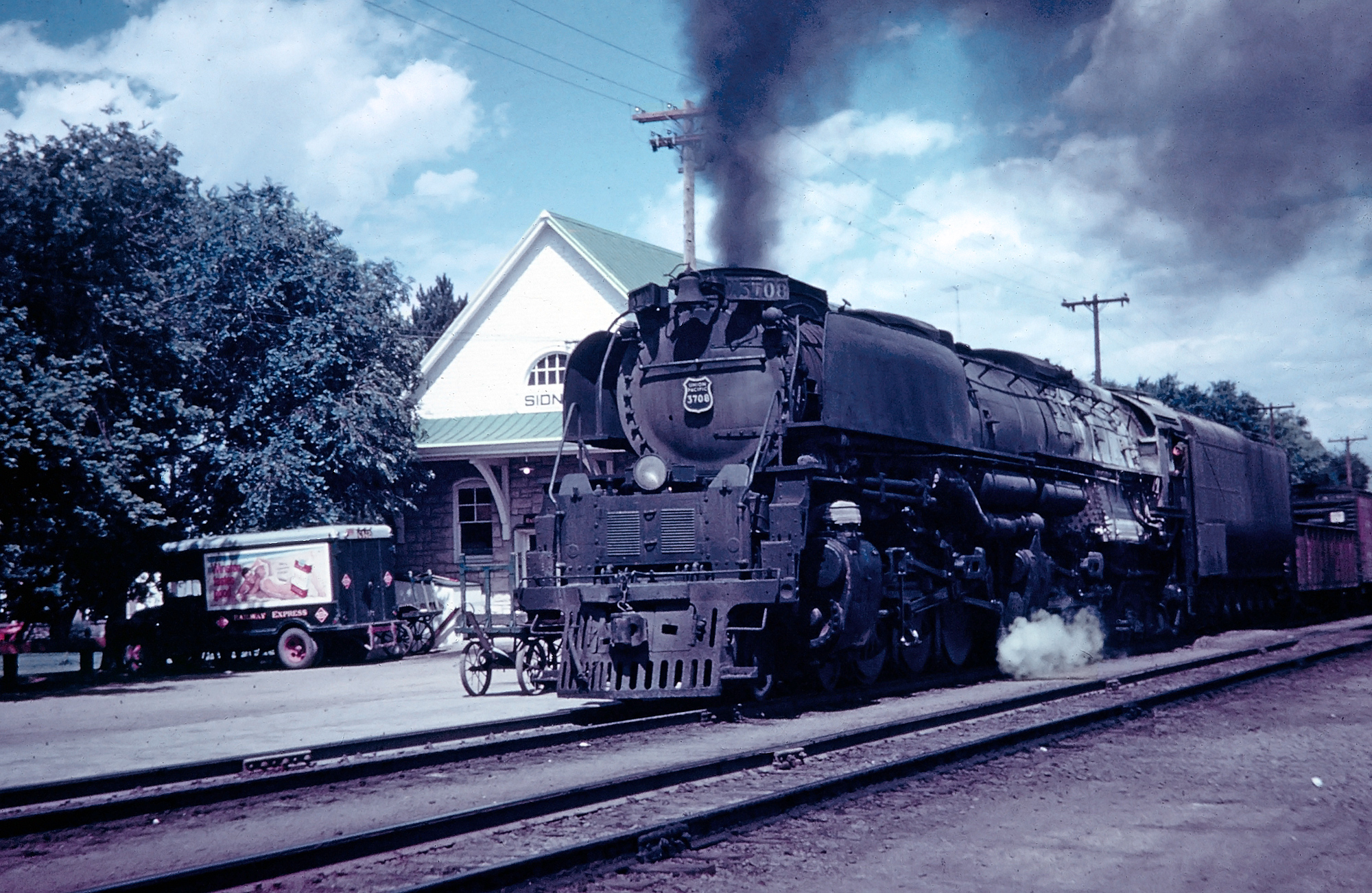
Union Pacific 4-6-6-4 #3708, formerly #3975, westbound past the depot at Sidney, Nebraska, about 1958. The truck at the platform is Railway Express. Richard Wallin photo. American-Rails.com collection.
On this page: At a glance · Before the Agency · American Railway Express · The railroads’ company · Signs and trucks · After the passenger train · Sources
At a glance
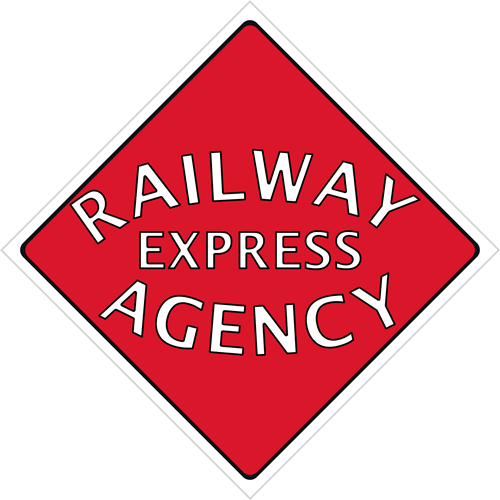
The red diamond. The words inside it stayed “Railway Express Agency” for the life of the railroad-owned company. Author’s work.
| Item | Detail |
|---|---|
| Company | Railway Express Agency, Inc. A joint facility of the railroads, not a carrier with its own main line |
| Headquarters | New York City. For years, 219 East 42nd Street |
| Incorporated | Delaware, December 7, 1928 |
| Operations | March 1, 1929, taking the property of American Railway Express |
| Owners | 86 Class I railroads. 1,000 shares, allotted by each road’s share of the express business |
| What moved | Parcels, money, produce, auto parts, animals, and the odd shipment, in baggage cars on passenger trains and in the green trucks |
| Trade name | REA Express, from November 1960. Corporate title became REA Express, Inc. in 1969 |
| Last express | Chapter XI on February 18, 1975. Adjudicated bankrupt November 6, 1975. Regular service stopped the next day |
Before the Agency
Express, as Americans came to mean it, is a man who will take a parcel farther and faster than the mail, and stand behind it. William F. Harnden started in Boston. In March 1839 he carried letters and packages to New York, part of the way on the railroad and the rest by steamboat, because there was still no through rail line between the two cities. The business became Harnden & Company. He died on January 14, 1845. Alvin Adams’s Adams Express, another Boston house of the early 1840s, grew into the large eastern company. Henry Wells, who had worked for Harnden, and William G. Fargo built the western house that still carries their names, though the bank and the express company parted long ago.
By the early twentieth century the national express business sat in four companies: Adams, American, Southern, and Wells Fargo. A few railroads ran their own express on the northern transcontinentals, among them the Great Northern, the Northern Pacific, and the Western Express. The Hepburn Act of 1906 put those companies under the Interstate Commerce Commission. Parcel post, which began on January 1, 1913, took the small shipments the express companies had lived on.
American Railway Express
When the United States Railroad Administration took the railroads at the end of 1917, William G. McAdoo would not keep a separate express contract on every line. On May 28, 1918, he approved one company. American Railway Express was organized in Delaware on June 22. June 30 was the last day the old houses employed their express clerks. On July 1, 1918, the new company took the wagons, the trucks, the horses, and the refrigerator cars. Adams, American, Wells Fargo, and Southern put in the property. So did the railroad-owned northern express companies. Wells Fargo kept its express business in Mexico and Cuba. The domestic map was one company, and for the duration the Director General set the service.
The Transportation Act, signed by Woodrow Wilson on February 28, 1920, handed the railroads back to their owners on March 1. The express business did not go back to four competing houses. American Railway Express kept running, owned by the old express companies, under contracts with nearly every railroad. Those contracts ran to midnight on February 28, 1929, and they gave the railroads an option to buy the property. On September 1, 1927, still under American Railway Express, the company opened an air-express service with the airlines. That business came with the rest of the property when the railroads took over. In 1921 the trucks and cars had gone to a deep green with red, the colors the later diamond made famous.
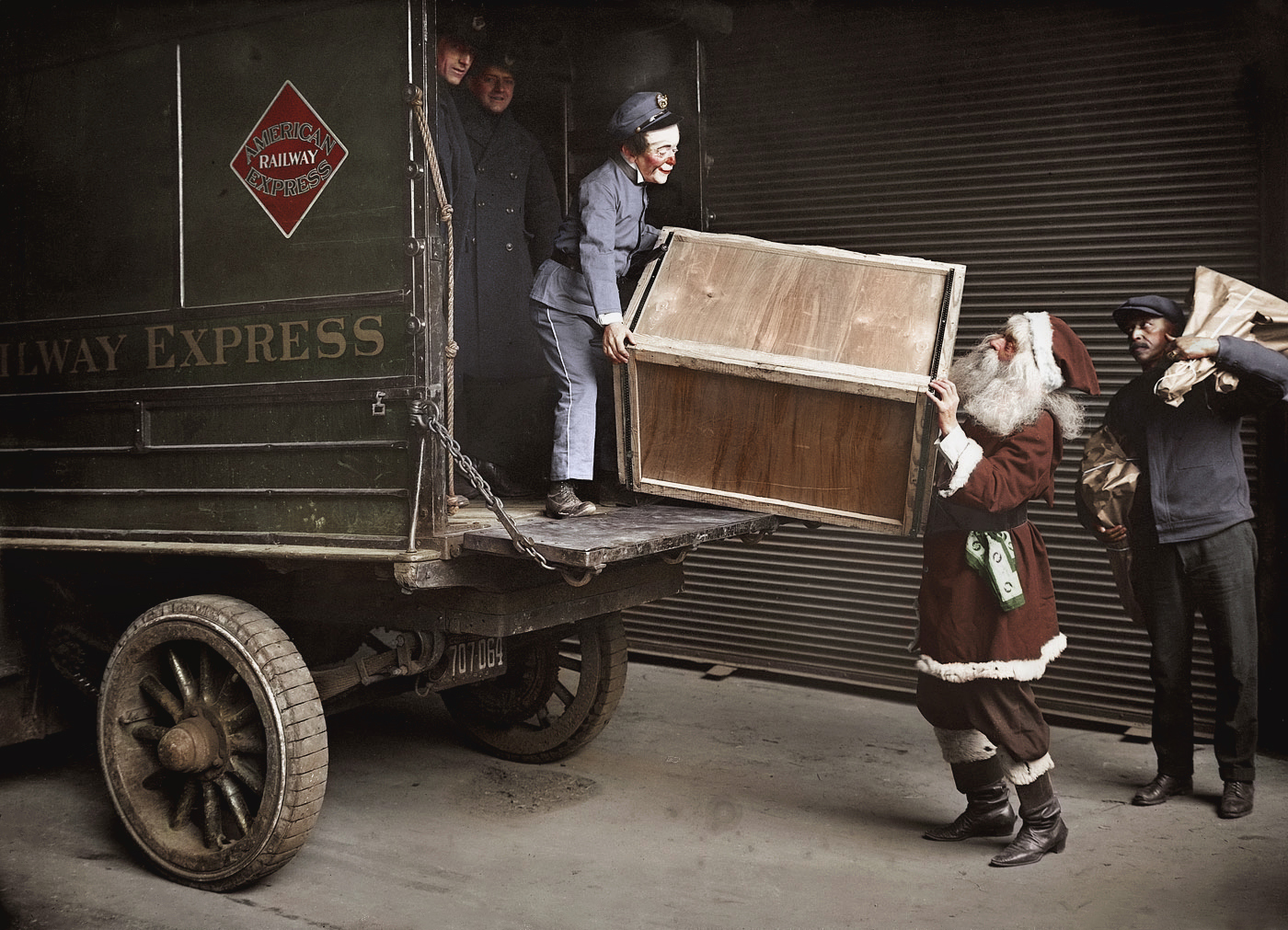
A colorized American Railway Express photograph from the 1920s, before the railroads’ agency took the business.
The railroads’ company
The railroads did not renew American Railway Express. On June 21, 1928, a committee of the Association of Railway Executives recommended a separate agency the carriers would own. Agents of the railroads incorporated Railway Express Agency, Inc., in Delaware on December 7, 1928. The Interstate Commerce Commission, in Finance Docket 7322, approved the control and the securities in February 1929. On March 1, 1929, the Agency took the express business of the country.
The capital stock was 1,000 shares, without par value, sold to the railroads at not less than $100 a share. Eighty-six Class I railroads took them, in proportion to the express business each had handled, using the average of 1923 through 1926. Together they did about 98 percent of the gross. Short lines signed the uniform operating contract and shared in the traffic. They did not hold the stock. The purchase of American Railway Express property was fixed at $30,313,000. The Agency sold $32 million of 5 percent serial gold bonds, through J. P. Morgan & Co. and Kuhn, Loeb & Co., to pay for it and for working capital.
The board had fifteen seats: six named by the eastern roads, five by the western, three by the southern, and one director at large. The largest holders sat closest to the votes. These are the opening allotments long published for the twelve biggest:
| Railroad | Shares |
|---|---|
| New York Central | 144 |
| Pennsylvania | 126 |
| Santa Fe | 45 |
| Southern Pacific | 45 |
| New Haven | 44 |
| Baltimore & Ohio | 39 |
| Chicago & North Western | 33 |
| Illinois Central | 29 |
| Burlington | 27 |
| Milwaukee Road | 26 |
| Erie | 25 |
| Union Pacific | 25 |
The point of the structure was in the money. Railway Express paid its own expenses out of the charges. What remained was paid to the owning railroads as rail transportation revenue, in proportion to the business each had handled. The Agency was not left with a profit of its own. The railroads furnished the baggage cars, the station rooms, and the trains. A head-end car lettered Railway Express Agency was ordinary on a passenger consist. The uniform agreements that opened the business ran to February 28, 1954.
Signs and trucks
The public face was simpler than the stock book. A red diamond, the words Railway Express Agency inside it, and a dark green truck. Almost any town with a depot had an express office, sometimes one man and a truck, sometimes, in New York, a building full of clerks. Shipments carried two labels, so one torn tag did not lose the parcel. The company would take produce, time-sensitive auto parts, animals, circus equipment, and freight that included explosives. The advertised standard was delivery anywhere in the country within about five days. An expressman would also drive out and pick the shipment up.
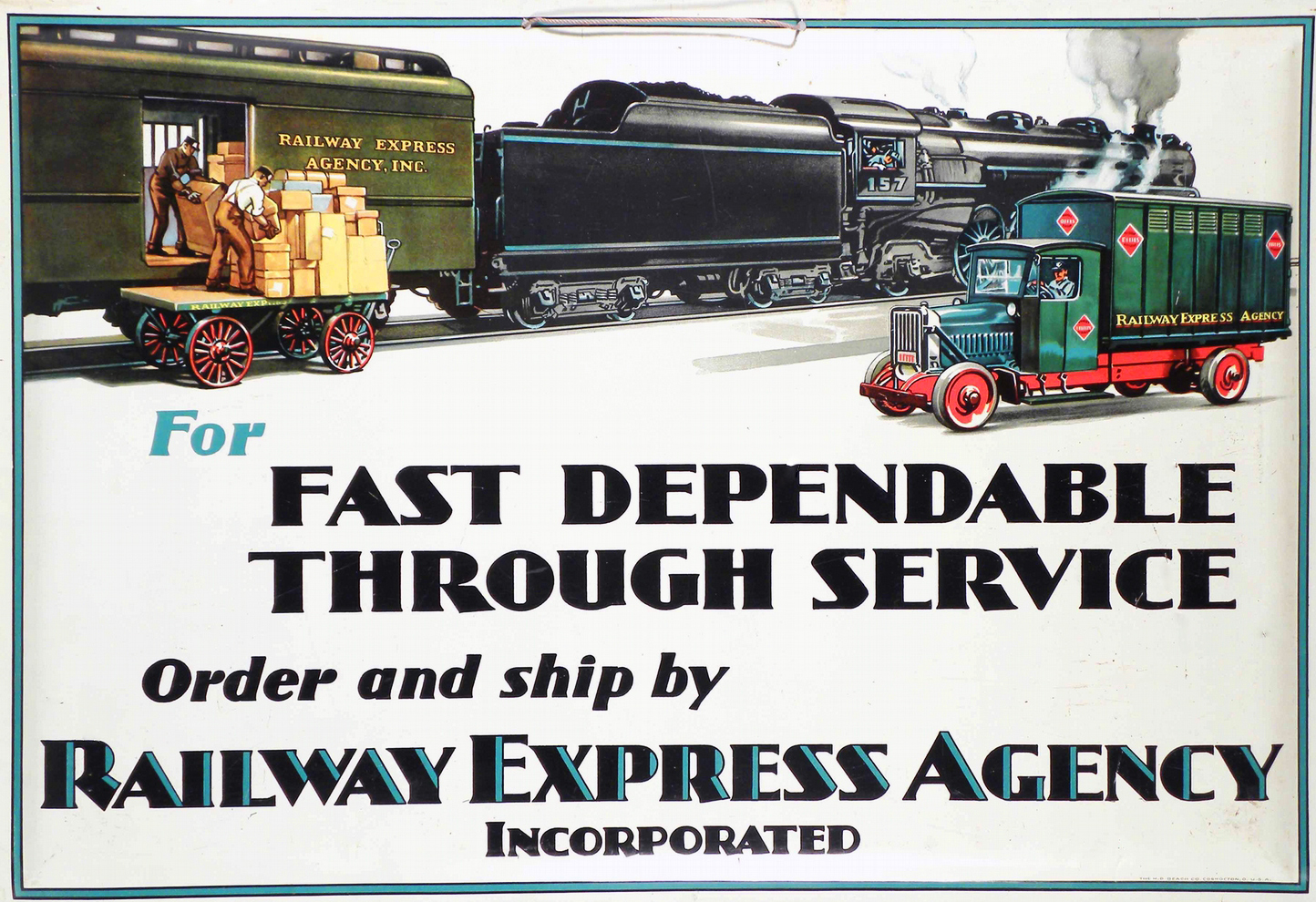
The dark green delivery truck. Author’s collection.
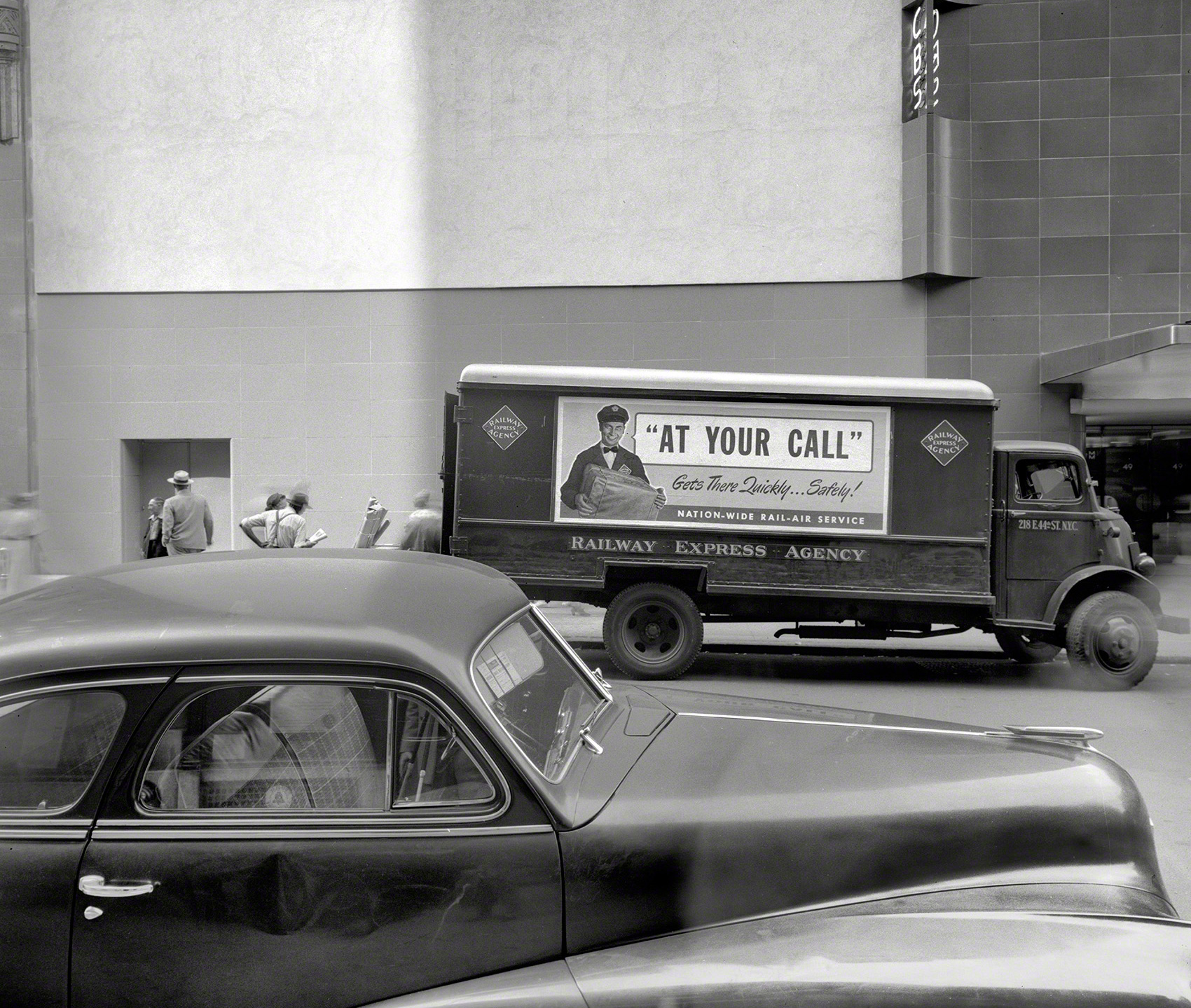
More of the green fleet. The side often carried a monthly advertisement as well as the diamond.

A depot placard. Author’s work.

Another version of the same placard. Author’s work.
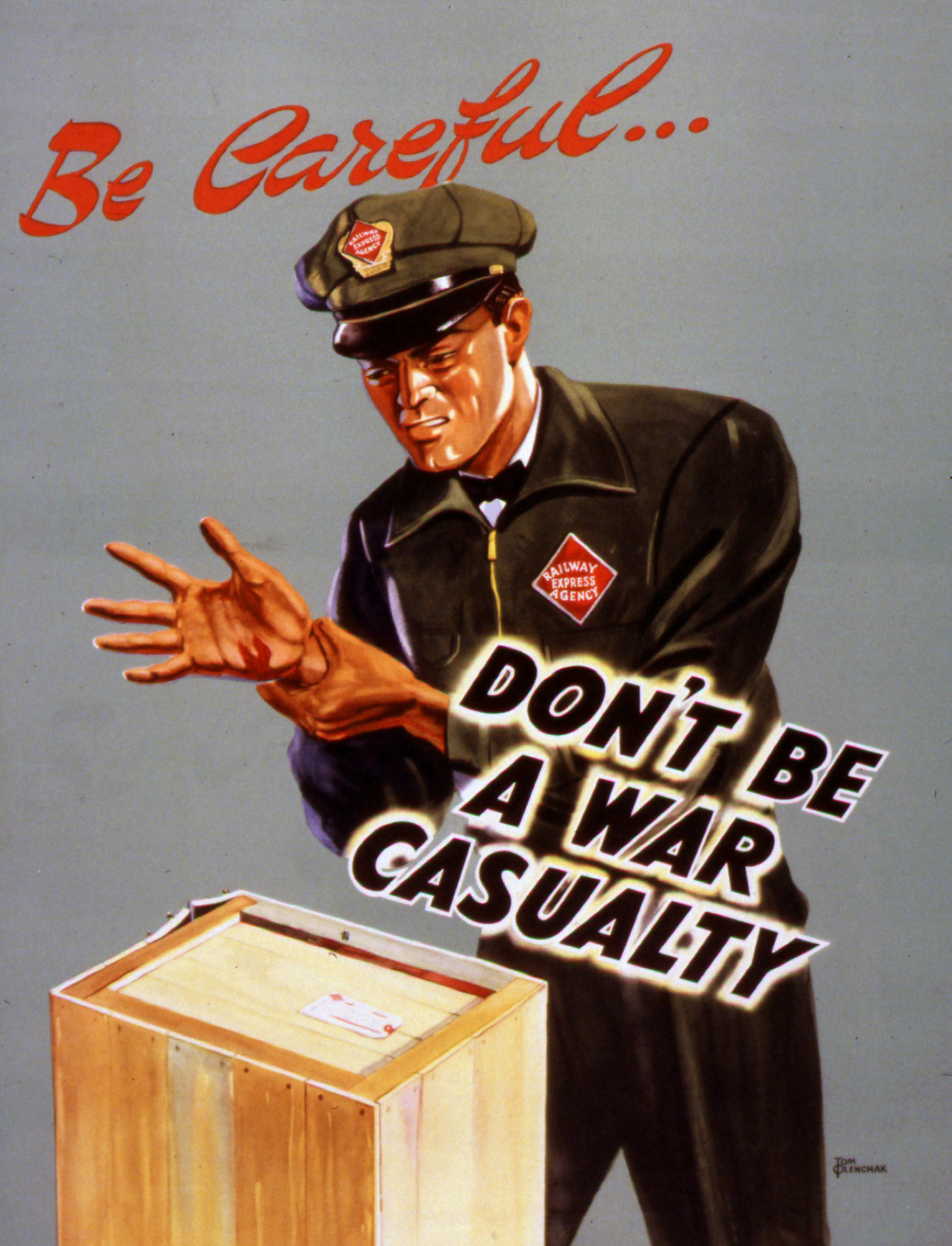
A safety poster from the years when the diamond was on every platform.
The country was divided into four territories, Northeastern, Southeastern, Central, and Pacific, each under a vice president, with the headquarters in Manhattan. Air express, inherited from American Railway Express, stayed in the business. It thinned as the airlines built their own freight.
After the passenger train
The original operating agreements ended on February 28, 1954. A new term was written. Fewer railroads were willing to keep a business whose traffic was leaving the passenger trains. United Parcel Service, in business since 1907, and the Post Office parcel service were taking the ordinary package. The head-end car depended on a passenger train still running.
In 1960 the New York Central, the largest shareholder, sold its shares. Alfred E. Perlman, the Central’s president, called the express arrangement an outdated way to move a parcel. That November the Agency took REA Express as its working name and kept the corporate title, a way of stepping back from the words “railway” on the door. William B. Johnson, the president in those years, cut the company hard enough to show a profit in the early 1960s. He later left for the Illinois Central.
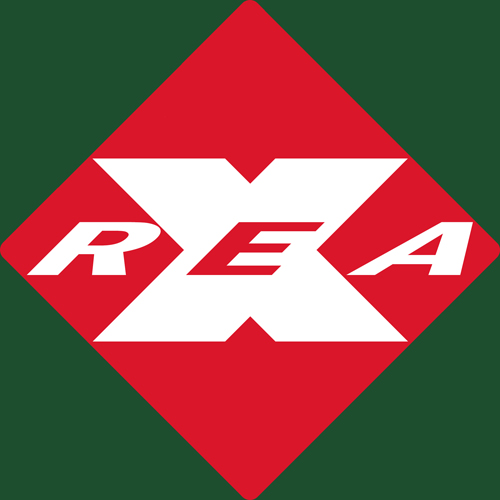
The later mark, REA Express. Author’s work.
In 1968 the railroads sold the stock. The company was no longer their joint facility. In the summer of 1969 the corporate name became REA Express, Inc. Trucks and cars carried a red diamond with the letters REA and a large white X, and an arrow pointing up at an angle. By then most of the traffic was on the highway. Amtrak took the intercity passenger trains on May 1, 1971, and only a small share of REA’s remaining business was still in a baggage car. Federal Express, started in 1971, was in the air-parcel market before the older company failed.
On February 18, 1975, REA Express filed a Chapter XI petition in the Southern District of New York and kept operating as debtor in possession. The losses continued. On November 6, 1975, Judge John J. Galgay adjudicated the company bankrupt and ordered it liquidated. C. Orvis Sowerwine was appointed trustee. Regular express stopped the next day. The trustee later sold the operating authorities. Judge Galgay’s order of July 16, 1976, accepted the Alltrans bid for those rights, the customer lists, and the names. The green trucks and the diamond signs are what is left on depots, in collections, and in photographs like the one at Sidney.
Sources
- Interstate Commerce Commission, Finance Docket 7322, Securities and Acquisition of Control of Railway Express Agency, Inc., 150 I.C.C. 423 (1929). Delaware incorporation December 7, 1928. Eighty-six railroads, 1,000 shares, operations March 1, 1929. Joint facility. Purchase price and the bond issue, as reported with the Commission’s approval in February 1929.
- Wells Fargo corporate history, for June 30, 1918, as the last day of its domestic express employment, and July 1 as the morning American Railway Express took the property. Director General McAdoo approved the consolidation May 28, 1918. The Delaware company was organized June 22, 1918.
- In re REA Express, Inc. The railroads held the stock from 1929 until the 1968 sale. Chapter XI petition February 18, 1975. Adjudicated bankrupt November 6, 1975. Regular express ceased November 7. Alltrans order July 16, 1976.
- Klink Garrett and Toby Smith, Ten Turtles to Tucumcari: A Personal History of the Railway Express Agency, and V. S. Roseman, Railway Express: An Overview (1992), for the life of the offices, the trucks, and the men who ran them.
Related reading
- New York Central · Pennsylvania · Baltimore & Ohio · New Haven
- Santa Fe · Union Pacific · Milwaukee Road · Illinois Central · Erie
- Amtrak · Passenger car types · Freight car types
Recent Articles


-
Montana Railroad Museums (2026): A Complete Guide
Oct 14, 26 12:17 AM
 Montana railroad museums—the Livingston depot, Fort Missoula’s Willamette, the Harlowton Milwaukee depot, and the Whitefish station. Confirm hours on each site.
 -
"Jawn Henry" Locomotive: Specs, Diagram, Photos
Oct 14, 26 12:03 AM
 Norfolk & Western No. 2300, class TE-1, the steam turbine-electric Jawn Henry. Baldwin-Lima-Hamilton, Westinghouse, and Babcock & Wilcox, May 1954. Specifications, the road tests, and the Dece…
 -
Atlantic and Danville Railway: Serving Southern VA
Oct 13, 26 04:32 PM
 Atlantic and Danville Railway, chartered in 1882, incorporated September 1883. Three-foot line to Claremont, then Norfolk to Danville. Southern lease from September 1, 1899, to July 1, 1949. Alco RS2s…
 -
Norfolk, Franklin and Danville Railroad: Map, Roster, History
Oct 13, 26 04:26 PM
 Norfolk, Franklin and Danville Railway, chartered October 2, 1962, and operating from November 1, 1962. Norfolk to Danville, 210.8 miles. Two Alco RS36s and four RS11s. Merged into the N&W on December…
 -
Norfolk & Western Diesel Roster (All-Time)
Oct 12, 26 11:59 PM
 Norfolk & Western diesel roster, all-time. 1,464 locomotives built new for the railroad, from the 1955 GP9s and RS-3s through the C36-7s, plus the merger fleets.
 -
Norfolk & Western Steam Roster (Post 1900)
Oct 12, 26 11:52 PM
 Norfolk & Western steam since 1898. The Roanoke grid: 1,266 locomotives, the J, the A, and the Y, and the last road steam on May 7, 1960.
 -
Norfolk & Western Railway: Map, Logo, Rosters, History
Oct 12, 26 11:45 PM
 The Norfolk & Western, from the City Point Railroad of 1838 to Norfolk Southern. Pocahontas coal, Roanoke steam, and the 1964 expansion.
 -
Louisiana Railroad Museums (2026): A Complete Guide
Oct 12, 26 11:24 PM
 Louisiana railroad museums—the DeQuincy depot, the Long Leaf sawmill, Jackson’s model railroad, and Southern Pacific 745. Confirm hours on each site.
 -
Michigan Railroad Museums (2026): A Complete Guide
Oct 12, 26 11:14 PM
 Michigan railroad museums—Pere Marquette 1225 at Owosso, Durand Union Station, The Henry Ford, and the Mount Clemens depot. Confirm hours on each site.
 -
Mississippi Railroad Museums (2026): A Complete Guide
Oct 12, 26 10:52 PM
 Mississippi railroad museums—McComb’s rebuilt Illinois Central depot and Illinois Central 2542, and the Casey Jones museum at Water Valley. Confirm hours on each site.
 -
The "E2b": PRR's Experimental Freight Electrics
Oct 12, 26 10:33 PM
 PRR class E2b: six GE B-B freight electrics, 4939–4944, 2,500 hp, 11 kV AC. Specifications, roster, and the 1964 scrap.
 -
Alaska Railroad Museums (2026): A Complete Guide
Oct 12, 26 10:10 PM
 Alaska railroad museums—the Museum of Alaska in Wasilla, Tanana Valley No. 1 at Pioneer Park, and the Engine 557 shop. Confirm hours on each site.
 -
Western and Atlantic Railroad: Map, History, Timetables
Oct 12, 26 09:55 PM
 The Western & Atlantic Railroad of the State of Georgia, authorized December 21, 1836, from Atlanta to Chattanooga. The state still owns the 137.33-mile line. CSX leases it. The through railroad opene…
 -
Nashville, Chattanooga & St. Louis Steam Roster (Post 1900)
Oct 12, 26 09:52 PM
 Nashville, Chattanooga & St. Louis steam since 1900. Drury's class grid: Consolidations, 51 Mikados, three 2-8-8-2s, Pacifics, and 25 4-8-4s. Last steam was January 4, 1953.
 -
Nashville, Chattanooga & St. Louis Diesel Roster (All-Time)
Oct 12, 26 09:27 PM
 Nashville, Chattanooga & St. Louis diesel roster, all-time. Switchers from 1941, 37 GP7s, and the F3s and F7s. The quantity column totals 132 locomotives.
 -
Nashville, Chattanooga and St. Louis Railway: Map, History, Logo
Oct 12, 26 08:41 PM
 The Nashville, Chattanooga & St. Louis, the Dixie Line. Charter of December 11, 1845, the Cumberland tunnel, and the Louisville & Nashville merger of August 30, 1957.
 -
Idaho Railroad Museums (2026): A Complete Guide
Oct 12, 26 02:44 PM
 Idaho railroad museums—Nampa’s 1903 depot, Wallace’s Northern Pacific depot, and Boise’s 1925 Union Pacific depot. Confirm hours on each site.
 -
Hawaii Railroad Museums (2026): A Complete Guide
Oct 12, 26 12:50 PM
Hawaii railroad museums—the Hawaiian Railway Society at Ewa Beach and the Laupahoehoe Train Museum on the Big Island. Confirm hours on each site. -
Marietta and Cincinnati Railroad: Map, History, Timetable
Oct 12, 26 11:44 AM
 Marietta and Cincinnati Railroad, chartered March 8, 1845 as the Belpre & Cincinnati. Opened in April 1857, sold under foreclosure December 9, 1882, and succeeded by the Baltimore & Ohio Southwestern…
 -
Tennessee Railroad Museums (2026): A Complete Guide
Oct 12, 26 11:39 AM
 Tennessee railroad museums—TVRM and Southern 4501 in Chattanooga, the Tennessee Central museum in Nashville, Casey Jones in Jackson, and the depots at Cookeville, Cowan, and Townsend.
 -
Virginia Railroad Museums (2026): A Complete Guide
Oct 12, 26 09:40 AM
 Virginia railroad museums—Roanoke’s Virginia Museum of Transportation and the O. Winston Link Museum, the C&O center at Clifton Forge, and the depots in Richmond, Fairfax Station, Suffolk, Parksley, a…
 -
Louisville & Nashville Diesel Roster (All-Time)
Oct 12, 26 12:15 AM
 Louisville & Nashville diesel roster, all-time. Switchers from 1939, the cab units, and EMD, Alco, and GE hoods through the SD50s. The quantity column totals 1948 locomotives, plus 29 yard slugs.
 -
Louisville & Nashville Steam Roster (Post 1900)
Oct 11, 26 05:44 PM
Louisville & Nashville steam since 1900. Drury's class grid: Consolidations, 165 heavy Mikados, 42 Big Emma 2-8-4s, Pacifics, and 22 Mountains. Last steam January 1957. -
Louisville and Nashville Railroad: Map, Rosters, History
Oct 11, 26 05:39 PM
 Louisville & Nashville, the Old Reliable. Charter of March 5, 1850, Milton H. Smith, the 921-mile main line, Big Emma, and the December 29, 1982 merger. Steam and diesel rosters are companion pages.
 -
Oregon Railroad Museums (2026): A Complete Guide
Oct 11, 26 05:19 PM
 Oregon railroad museums—the Oregon Rail Heritage Center, Brooks trolleys, Canby’s 1891 depot, Medford’s Willamette, and Train Mountain. Confirm hours on each site.
 -
Texas Railroad Museums (2026): A Complete Guide
Oct 11, 26 05:15 PM
 Texas railroad museums—Frisco’s Big Boy 4018, Galveston’s Santa Fe depot, Temple’s 1911 station, Plano’s interurban, and Fort Worth & Denver 304. Confirm hours on each site.
 -
Wisconsin Railroad Museums (2026): A Complete Guide
Oct 10, 26 11:51 PM
Wisconsin railroad museums—Green Bay’s Big Boy 4017 and Eisenhower’s A4, Mid-Continent at North Freedom, East Troy’s interurban, and the Riverside & Great Northern. Confirm hours on each site. -
Interstate Railroad (Virginia): Map, Roster, Logo, History
Oct 10, 26 11:22 PM
 Interstate Railroad, a Virginia coal road chartered February 18, 1896. Andover shops. Ten Alco RS3s, 30–39. Southern control in 1961. The company ended October 31, 1985.
 -
North Carolina Railroad Museums (2026): A Complete Guide
Oct 10, 26 11:16 PM
North Carolina railroad museums—Spencer Shops, Wilmington’s Atlantic Coast Line 250, Hamlet’s Seaboard depot, and the New Hope Valley Railway. Confirm hours on each site. -
New Mexico Railroad Museums (2026): A Complete Guide
Oct 10, 26 10:54 PM
 New Mexico railroad museums—Santa Fe 2926 in Albuquerque, the Clovis depot, Alamogordo’s Toy Train Depot, and Belen. Confirm hours on each site.
 -
New York Railroad Museums (2026): A Complete Guide
Oct 10, 26 09:33 PM
 New York railroad museums—Phoenicia, Medina’s New York Central freight house, the Transit Museum, Long Island 35 and 39, and GG1 4933. Confirm hours on each site.
 -
Columbia, Newberry & Laurens Railroad: History, Timetable, Roster
Oct 10, 26 09:08 PM
 Columbia, Newberry & Laurens Railroad, Columbia to Laurens, 75 miles. Chartered in 1885. Five Atlantic Coast Line GP7s, 100–104. Merged into the Seaboard System on April 30, 1984.
 -
New Haven Diesel Roster (All-Time)
Oct 10, 26 06:35 PM
 New Haven diesel roster, all-time. 558 road numbers: 60 DL-109s, 30 FA-1s, 27 PA-1s, 60 FL9s, and the switchers from HH600 0900. Serials and order numbers.
 -
New Haven Steam Roster (Post 1900)
Oct 10, 26 06:31 PM
 New Haven steam since 1900. Drury's class grid: 226 Moguls, 33 Mikados, 50 Santa Fes, 70 Mountains, 141 Pacifics, and 10 Hudsons. Last fan trip July 19, 1953.
 -
New Haven Railroad: Rosters, Map, Logo, History, Trains
Oct 10, 26 06:26 PM
 New York, New Haven and Hartford. The Shore Line, Hell Gate, the 1952 map at 1,838.89 miles, and the railroad Penn Central took at 11:59:59 p.m. on December 31, 1968.
 -
C&O's 4-6-4 "Hudson" Locomotives (Class L): Specs, Roster, History
Oct 10, 26 05:36 PM
 Chesapeake & Ohio Class L 4-6-4 Hudsons. Eight L-2s, five L-1 rebuilds, five L-2-As. Specs, Baldwin works numbers, and the roster. No. 490 survives.
 -
Alton Railroad: Map, History, Timetables
Oct 09, 26 10:31 PM
 Alton Railroad, chartered February 27, 1847 as the Alton & Sangamon. Chicago, St. Louis, and Kansas City, the 1937 Official Guide, and the May 31, 1947 merger into the Gulf, Mobile & Ohio.
 -
Mobile & Ohio Steam Roster (Post 1900)
Oct 09, 26 12:26 PM
 Mobile & Ohio steam since 1900. Drury's class grid: 48 six-wheel switchers, 107 Ten-Wheelers, 15 Consolidations, 58 Mikados, and 14 Pacifics. Last revenue steam October 7, 1949.
 -
Mobile & Ohio Railroad: History, Map, Timetable
Oct 09, 26 11:31 AM
 Mobile & Ohio Railroad, chartered in 1848. Columbus on April 22, 1861, the Cairo & St. Louis, the March 1940 Official Guide, and the September 13, 1940 merger into the Gulf, Mobile & Ohio.
 -
Gulf, Mobile & Northern Steam Roster (Post 1900)
Oct 09, 26 10:42 AM
 Gulf, Mobile & Northern steam since 1900. Drury's class grid: Ten-Wheelers, Mikados, Russian Decapods, Pacifics 425 and 426, and three light 4-8-2s. Last revenue steam October 7, 1949.
 -
Gulf, Mobile & Ohio Diesel Roster (All-Time)
Oct 09, 26 10:41 AM
 Gulf, Mobile & Ohio diesel roster, all-time. The 1935 boxcab, DL-107s, 55 FA-1s, F3s and F7s, the Ingalls 4-S, GP30s through GP38-2s, and 21 SD40s. Serials and order numbers.
 -
Gulf, Mobile & Northern Railroad: History, Rebel Route
Oct 09, 26 10:36 AM
 Gulf, Mobile & Northern, from the 1890 Mobile, Jackson & Kansas City to the Rebel and the September 13, 1940 merger into the Gulf, Mobile & Ohio. Steam roster is the companion page.
 -
Gulf, Mobile & Ohio Railroad: Map, Photos, Trains, History
Oct 08, 26 11:48 PM
 Gulf, Mobile & Ohio, chartered in 1938 and merged September 13, 1940. The Mobile & Ohio, the Alton on May 31, 1947, the Rebel Route, and Illinois Central Gulf on August 10, 1972.
 -
New Jersey Railroad Museums (2026): A Complete Guide
Oct 08, 26 11:37 PM
 New Jersey railroad museums—Whippany, Maywood, Pine Creek, Mahwah’s Erie depot, Phillipsburg, and Boonton. Confirm hours on each site.
 -
New Hampshire Railroad Museums (2026): A Complete Guide
Oct 08, 26 11:34 PM
 New Hampshire railroad museums—North Conway, the Flying Yankee, Ashland, Gorham, Raymond, and Sandown. Confirm hours on each site.
 -
Missouri Railroad Museums (2026): A Complete Guide
Oct 08, 26 11:00 PM
 Missouri railroad museums—the National Museum of Transportation, Patee House, Frisco 4524, the Chicago & Alton depot, and Marceline. Confirm hours on each site.
 -
Milwaukee Road X3800: Deer Lodge’s Shop Goat
Oct 08, 26 04:28 PM
 Milwaukee Road X3800, the a home-built shop goat that served the Deer Lodge, MT yard. It was a 220-volt DC switcher, powered through an extension cord that moved electrics into a roundhouse where the…
 -
Key West Extension (Overseas Railroad): History, Construction, Decline
Oct 08, 26 03:59 PM
 Henry Flagler's Overseas Railroad, Miami to Key West, 1905–1935. The Seven Mile Bridge, the 1935 Labor Day Hurricane, and the road that became U.S. 1.
 -
Florida East Coast Steam Roster (Post 1900)
Oct 08, 26 02:34 PM
 Florida East Coast steam since 1897. Seventeen Ten-Wheelers, twenty Atlantics, eighty-seven Pacifics, ninety Mountains, fifteen Mikados, and the switchers.
 -
Florida East Coast Diesel Roster (All-Time)
Oct 08, 26 02:12 PM
 Florida East Coast diesel roster, all-time. E units from 1939, F3s, BL2s, GP7s and GP9s, the GP40-2 orders, 22 SD40-2s, and 24 ES44C4s. Serials and EMD order numbers.


