
Pennsylvania Railroad: Map, Logo, History, Rosters
Last revised: September 22, 2026
By: Adam Burns
The Pennsylvania Railroad was an institution for more than a century. Wall Street treated the stock as a promise, and that reputation was strong enough that the later Penn Central could still borrow money after the marriage had already gone wrong. The company’s own story would fill a shelf: charter, engineering, Lines West, the passenger fleet, the electrification, the locomotives. What follows is the company. Steam built after 1906 can be found at the steam roster. Finally, diesels, with serials, are detailed on the diesel roster. The GG1 has its own page.
Pennsylvania was late to the trunk-line race. The Baltimore & Ohio, the Erie, and the New York Central could trace themselves to the 1820s and early 1830s. The Pennsylvania was chartered on April 13, 1846, because the state had spent a generation on canals and then watched Baltimore gain on Philadelphia. It built a carefully graded railroad from Harrisburg to Pittsburgh, bought the rest of the state’s Main Line of Public Works, and then grew by lease, purchase, and construction until the map ran from New York and Washington to Chicago, St. Louis, and Mackinaw City. At its peak it was the largest American railroad by revenue, by traffic, and by the miles of railroad it operated. Fortune called it a nation unto itself. The last day it operated under its own name was January 31, 1968.
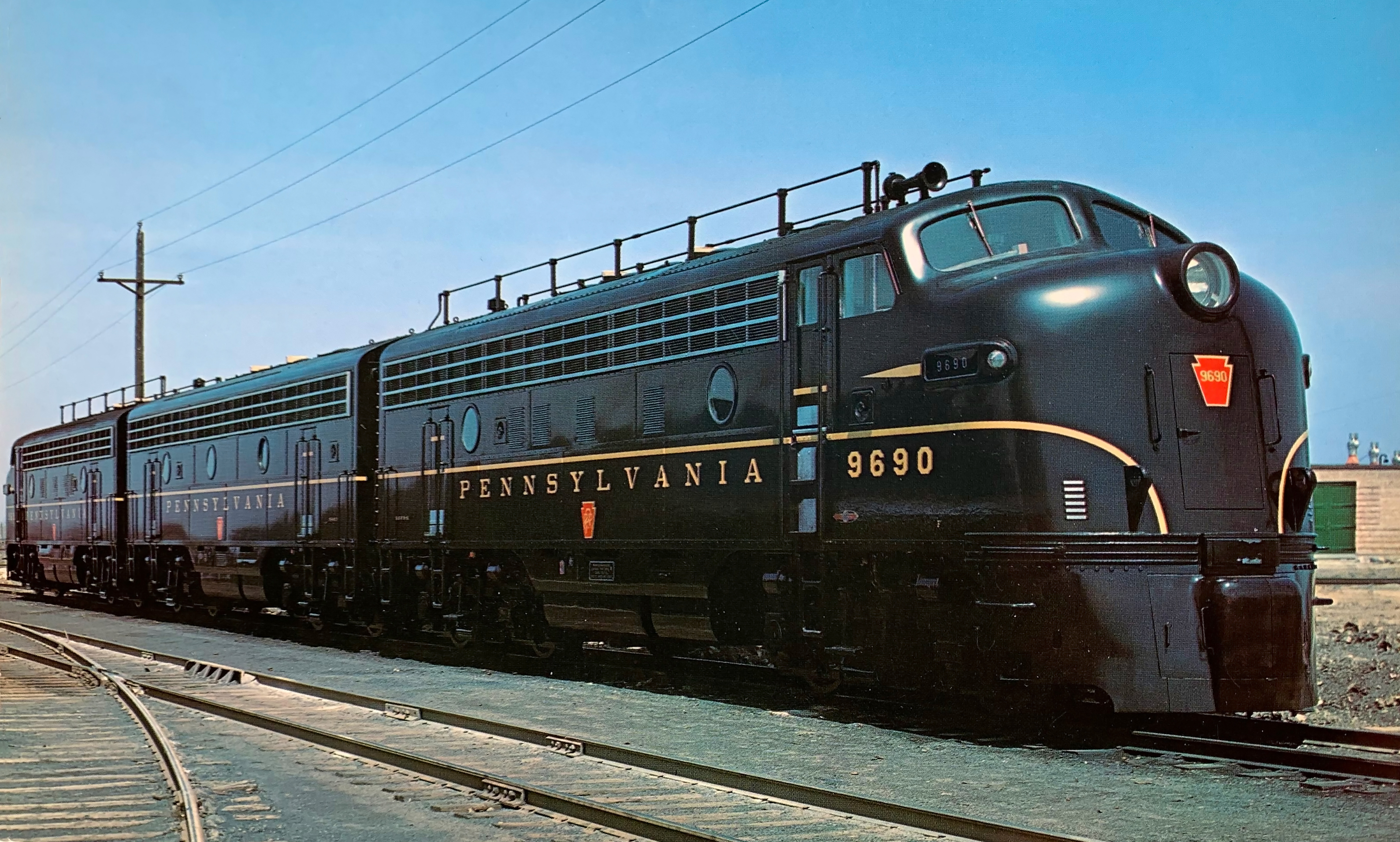
New Pennsylvania F7s, led by #9690-A, in April 1949. The antenna along the cab roof is the railroad’s Trainphone, an inductive carrier system used before conventional radio. Electro-Motive photograph. Author’s collection.
On this page: At a glance · Charter and the Main Line · Horseshoe Curve · Chicago, St. Louis, Michigan · Baltimore, Washington, New York · Delmarva, the Long Branch, the shore · Cassatt, Penn Station, the Broadway · Electrification and the GG1 · Steam, and the K4s · Diesels · Penn Central · What remains
At a glance
| Item | Detail |
|---|---|
| Railroad | Pennsylvania Railroad. Mark PRR. The Pennsy. Slogan: Standard Railroad of the World |
| Charter | April 13, 1846. Governor Francis R. Shunk. The House had passed the bill on March 19 and the Senate on March 26. Authority to build from Harrisburg to Pittsburgh |
| First president | Samuel Vaughan Merrick |
| Chief engineer, then president | John Edgar Thomson. The mountain alignment, Horseshoe Curve, and the push to Chicago are his |
| Headquarters | Broad Street Station, Philadelphia, and from 1927 the Pennsylvania Railroad Office Building at 32nd and Market. That building is now addressed 3175 John F. Kennedy Boulevard |
| Dates of operation | 1849–January 31, 1968. Penn Central began February 1, 1968 |
| States served | Pennsylvania, New York, New Jersey, Delaware, Maryland, Virginia, West Virginia, Ohio, Michigan, Indiana, Kentucky, Illinois, and Missouri |
| Gauge | 4 feet, 8½ inches |
| Route miles | About 10,000 in 1950. 9,756 in 1962. Peak track mileage was on the order of 28,000 |
| Equipment, 1963 | 2,402 diesels. 254 electric locomotives. 139,356 freight cars. 3,546 passenger cars |
| Notable president | Alexander Johnston Cassatt, from 1899. Pennsylvania Station and the Long Island Rail Road |
| Flagship | Broadway Limited, New York–Chicago, from November 24, 1912. About 16 hours |
| Steam | Post-1906 roster. Last steam officially November 30, 1957 |
| Diesel | All-time roster. First diesel: EMD SW 3908, June 1937 |
| Successor | Penn Central Transportation Company, February 1, 1968. Conrail, April 1, 1976 |
The keystone in Tuscan red. Author’s work.
The Pennsylvania Railroad keystone. Author’s work.
A railroad the state chartered after the canal
On October 26, 1825, New York opened the Erie Canal. Virginia’s Chesapeake & Ohio Canal followed, and every large eastern port studied a water route of its own. Philadelphia’s answer was the Pennsylvania Canal, authorized February 25, 1826, from Harrisburg toward Pittsburgh, later tied east to the city by a mix of canal and railroad that the state called the Main Line of Public Works. It moved freight. It also froze in winter, and it was already obsolete as a through route while it was still being finished. The Baltimore & Ohio ran its first train in 1830 and was headed for the Ohio River. The Mohawk & Hudson opened Albany–Schenectady on August 9, 1831. The New York & Erie began construction in 1836.
Baltimore was the worry. If the Baltimore & Ohio reached the interior first, Philadelphia’s merchants believed the port would follow the railroad. Mike Schafer and Brian Solomon, in Pennsylvania Railroad, date the legislative steps: the state House passed the organizing bill on March 19, 1846, the Senate on March 26, and Governor Francis R. Shunk signed the charter on April 13. The new company was authorized to build from the capital at Harrisburg to Pittsburgh. Samuel Vaughan Merrick was the first president. John Edgar Thomson was the first chief engineer.
Thomson’s line followed the Susquehanna and the Juniata, held the grades down, and aimed at a summit just west of the place that became Altoona. Construction started at Harrisburg in 1847. Rails reached Lewistown in 1849 and Duncansville, near Altoona, in 1850. Work east from Pittsburgh met the mountain section at Cresson late in 1852, which completed the charter. The first train from Pittsburgh to Philadelphia ran on December 10, 1852. East of Harrisburg that train used the state’s Philadelphia & Columbia as far as Columbia, and the Harrisburg, Portsmouth, Mount Joy & Lancaster, which the Pennsylvania had acquired in 1848, from there into Harrisburg.
Horseshoe Curve, and a railroad the state sold
The 1852 route over the Alleghenies was a railroad. It was not yet the railroad Thomson wanted. In 1851 the company began the Mountain Division, about 40 miles of new summit crossing. The famous piece is Horseshoe Curve, west of Altoona, opened February 15, 1854. With that curve in service the Pennsylvania had a grade it could live with, a shop town at the bottom of the mountain, and a route across its own state that no longer depended on inclined planes.
The state drew the same conclusion New York eventually drew about the Erie Canal. In 1857 it sold the Main Line of Public Works to the Pennsylvania, and the eastern segments became a wholly owned line from Philadelphia to the western state line. Thomson, by then president, wanted the company to own what it ran. Leases were a tool. Ownership was the policy.
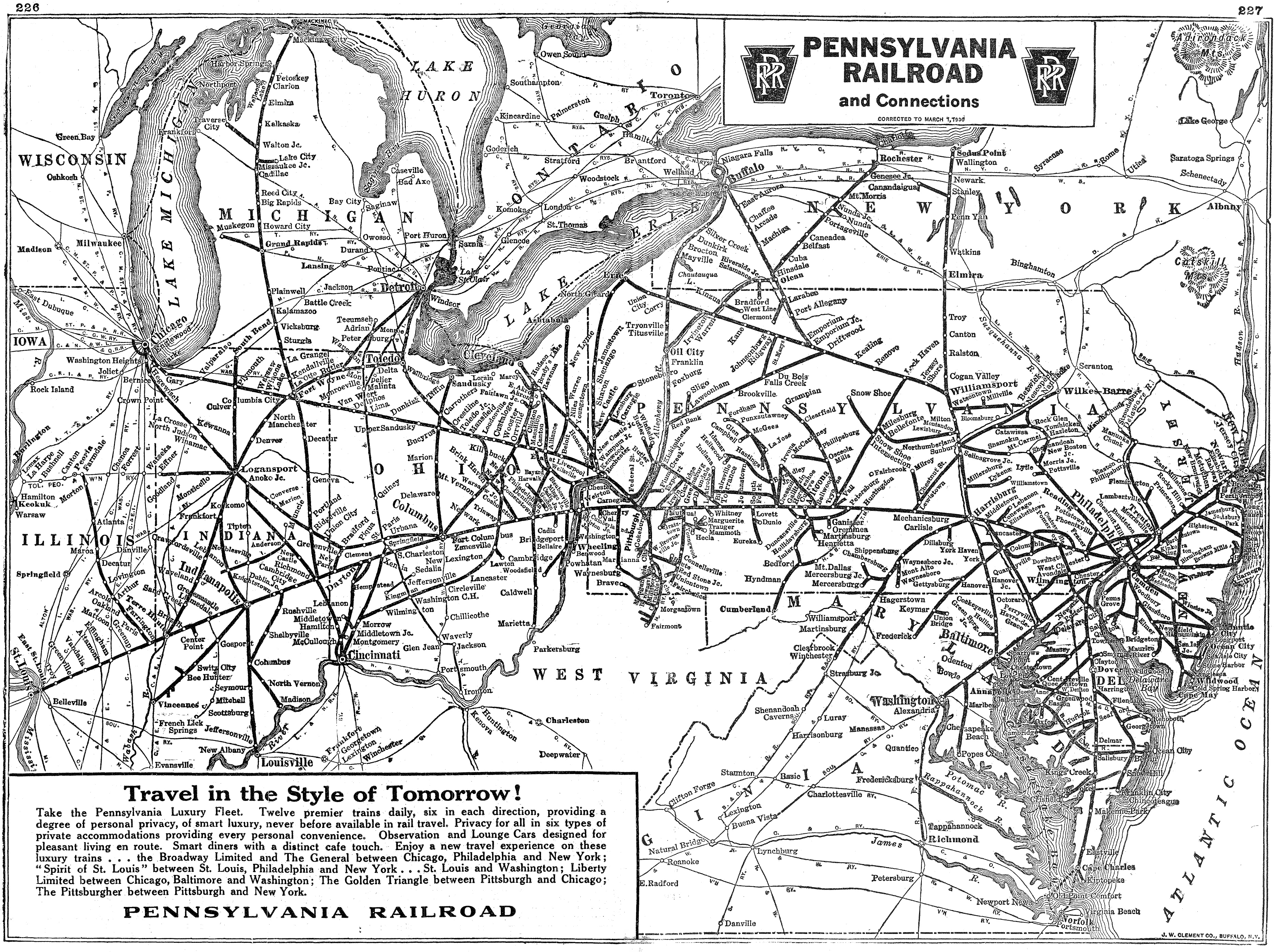
An official system map of the Pennsylvania Railroad, 1930. Author’s collection.
Chicago in 1859, the Panhandle, and a thin hold on Michigan
West of Pittsburgh the railroad was a different corporation for a long time. Those lines were held by the Pennsylvania Company and operated as Lines West, on their own number blocks and often their own locomotive classes, until the 1920s brought the system under one operating management. The two properties that mattered most were the Pittsburgh, Fort Wayne & Chicago and the Pittsburgh, Cincinnati & St. Louis.
The Fort Wayne road was three stalled charters. The Ohio & Pennsylvania, 1848, was to link Pittsburgh with Crestline, Ohio. The Ohio & Indiana, 1850–51, was to continue from Crestline to Fort Wayne. The Fort Wayne & Chicago, 1852, was to finish the line to Lake Michigan. They combined as the Pittsburgh, Fort Wayne & Chicago in 1856. Thomson, already influential in the merged company, saw it opened to Chicago on January 1, 1859. The Pennsylvania was the first of the great eastern trunk lines into the city. The Baltimore & Ohio arrived in 1874, the New York Central in 1877 by control of the Lake Shore & Michigan Southern, and the Erie in 1883.
St. Louis was the second gateway. In the spring of 1868 the Pennsylvania created the Pittsburgh, Cincinnati & St. Louis to gather the Pittsburgh & Steubenville, the Steubenville & Indiana, and the Hollidays Cove Railroad. The Steubenville & Indiana had been chartered February 24, 1848, to run from the Ohio River at Steubenville to the Indiana line, and the Pennsylvania was buying its stock by the mid-1850s. The Pittsburgh & Steubenville, chartered March 24, 1849, had to cross the northern panhandle of Virginia, which became West Virginia on June 20, 1863. Virginia fought the crossing because it competed with the Baltimore & Ohio at Wheeling. Congress required a separate company, the Hollidays Cove Railroad, to build that segment. In the end the Hollidays Cove property was used for the bridge across the Ohio. Service from Pittsburgh to Columbus opened in 1865. The lines still struggled. In January 1868 the Panhandle Railway was formed to operate the route, and that May the Pittsburgh, Cincinnati & St. Louis took them under the Pennsylvania.
The rest of the St. Louis corridor was a list of smaller companies. The Little Miami, incorporated March 11, 1836, connected Cincinnati and Columbus. The Columbus, Chicago & Indiana Central, assembled in 1868, reached Indianapolis and a second Chicago connection by way of Logansport. The last push used the Terre Haute & Indianapolis and the St. Louis, Vandalia & Terre Haute. The Terre Haute company had been chartered as the Terre Haute & Richmond and opened Terre Haute–Indianapolis in 1851. It took the Indianapolis name in March 1865. The Pennsylvania leased it, through the Vandalia subsidiary, as early as 1868, and bought it on August 18, 1893. The Vandalia line itself was the Pennsylvania’s own extension, Terre Haute–Vandalia–Highland–East St. Louis, opened in 1870. Whatever the corporate names on the deeds, operating men called the whole St. Louis road the Panhandle. It stayed busy into the Conrail years.
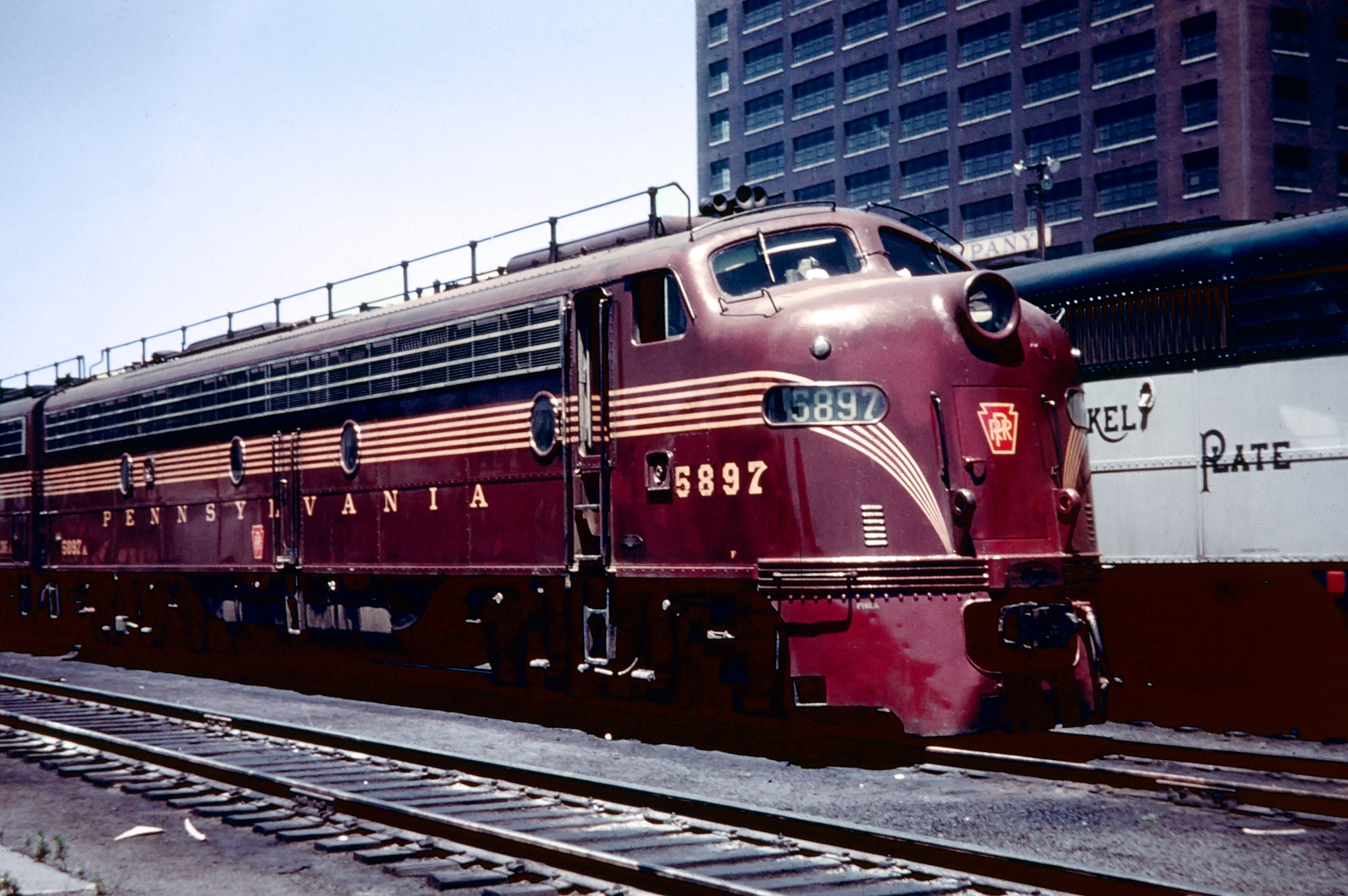
E8A #5897-A at St. Louis Union Station, circa 1955. Fred Byerly photo. American-Rails.com collection.
The last large midwestern extension was the Grand Rapids & Indiana, chartered in 1854 and 1855 to run from Fort Wayne to Mackinaw City by way of Grand Rapids. The promoters wanted Michigan timber and a ferry across the Straits of Mackinac. The company was bankrupt by 1869. That year the Pennsylvania came in through the Continental Improvement Company and finished the line to Traverse City in 1870. In 1873 the Fort Wayne road acquired most of the stock, and rails reached Petoskey late that year. The last link, into Mackinaw City, opened July 3, 1882.
That was the Pennsylvania’s real Michigan railroad. Detroit came late. Toledo had been reached in 1879 by lease of the Northwestern Ohio Railway. The Pennsylvania-Detroit Railroad, created in 1917, built north from Toledo, and the Motor City line opened in 1922. The New York Central and the Baltimore & Ohio were already entrenched there. Michigan was never a Pennsylvania stronghold.
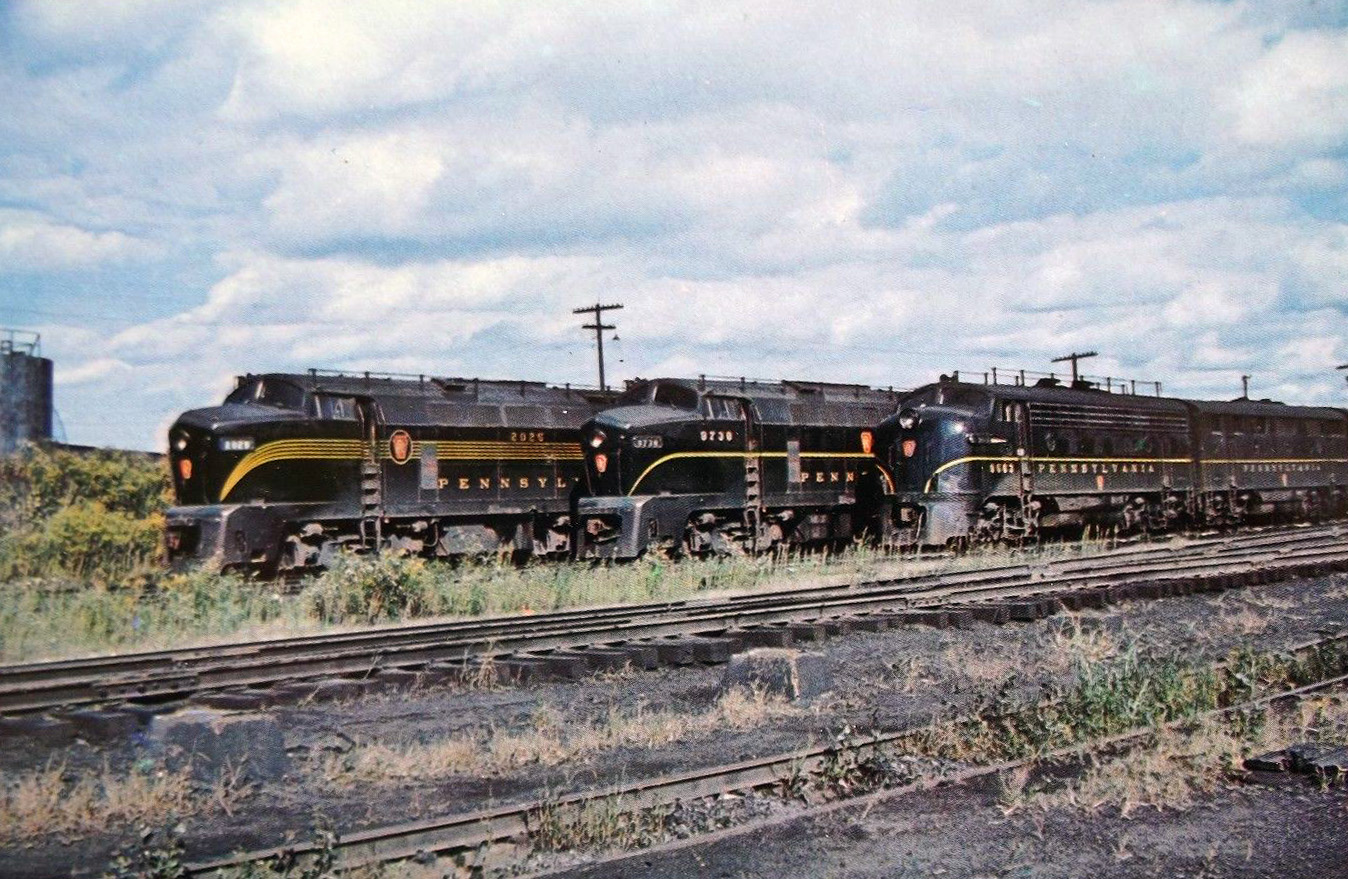
RF16 sharks and an F7A–F3B set at Erie, Pennsylvania, in October 1958. William Volkmer photo.
The Northern Central, the corridor, and Washington
Four eastern projects completed the system people mean when they say Pennsylvania: a line toward Buffalo, the Delmarva peninsula, a terminal at New York, and a railroad of its own into Baltimore and Washington.
The road into Baltimore was the Northern Central. Its oldest piece was the Baltimore & Susquehanna, chartered in 1828, which had reached Harrisburg by 1851 and then collapsed under the cost of building farther. On December 4, 1854, Maryland and Pennsylvania approved articles of union combining the Baltimore & Susquehanna, the York & Maryland Line, the York & Cumberland, and the Susquehanna Railroad. The Northern Central Railway took those properties on January 1, 1855, and was completed to Sunbury in 1858. The Pennsylvania bought a controlling interest in 1861, to have a Baltimore connection the Baltimore & Ohio did not own, and the Northern Central remained a subsidiary for the rest of the Pennsylvania’s life. Much of the Maryland trackage was wrecked by Hurricane Agnes in 1972 and was not put back.
New York was Thomson’s other unfinished door. During and after the Civil War the Pennsylvania leased its way across New Jersey. In 1871 it leased the Philadelphia & Trenton and the United New Jersey Railroad and Canal Companies, a bundle that included the Camden & Amboy, the New Jersey Railroad, the Belvidere Delaware, the West Jersey, the Cape May & Millville, and the Delaware & Raritan Canal. Together they offered a through route to Jersey City. On the Hudson the Pennsylvania opened Exchange Place, with ferries to downtown Manhattan, one of a row of terminals between Edgewater and Jersey City. Those New Jersey lines became the north end of what is now the Northeast Corridor: a four-track railroad that, in the Pennsylvania years, carried both the premier passenger trains and a heavy freight business.
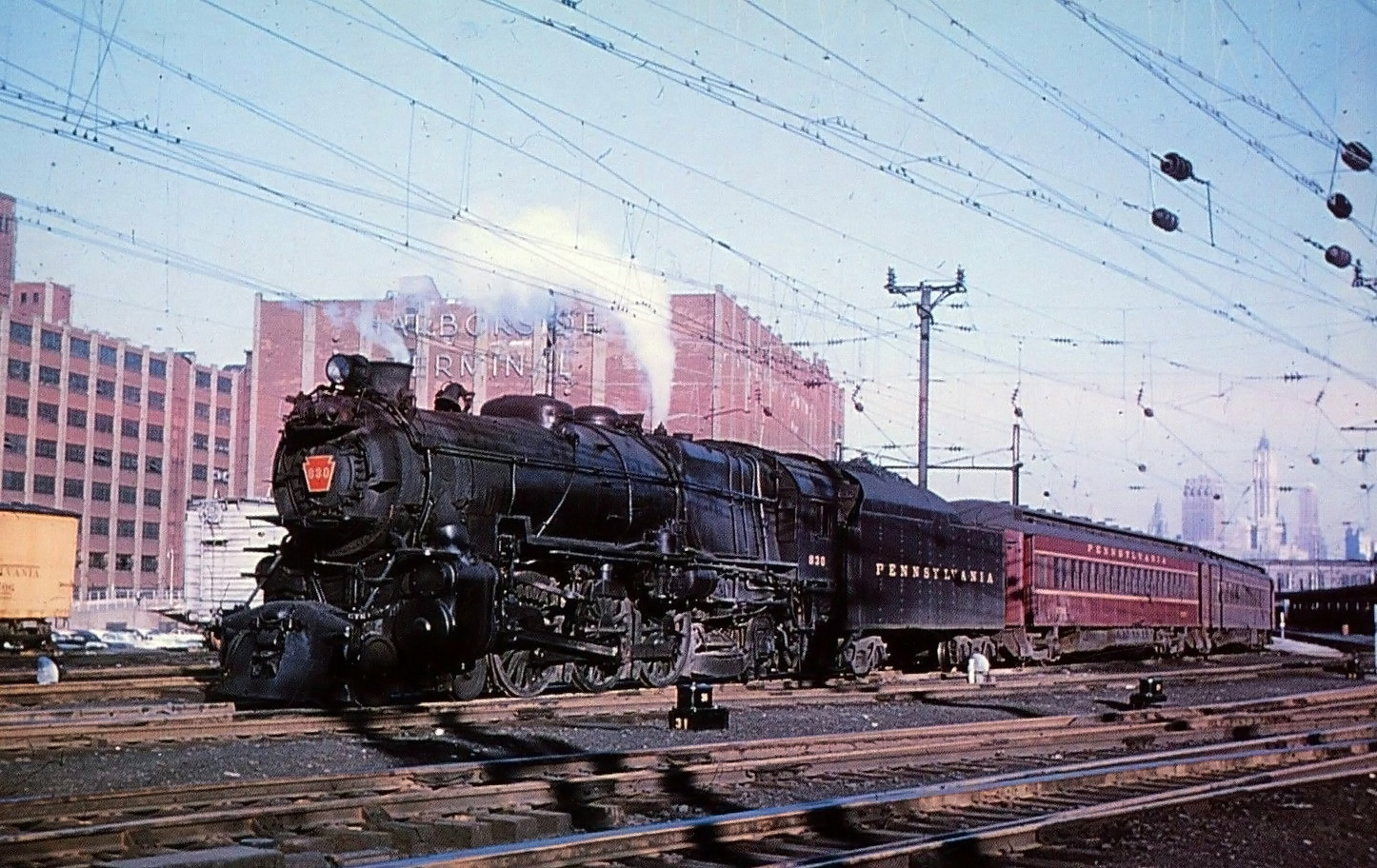
K4s #830 in suburban service at Exchange Place, Jersey City, in the 1950s. The Manhattan skyline is across the Hudson. Exchange Place was the Pennsylvania’s New York terminal before Pennsylvania Station. Mac Owen collection.
The south end of the corridor was the Philadelphia, Wilmington & Baltimore. Chartered April 2, 1831, as the Philadelphia and Delaware County Rail-Road, it took the longer name in March 1836, opened Baltimore–Wilmington in 1837, and was essentially complete to Philadelphia in 1838. The Baltimore & Ohio wanted it. The Pennsylvania won control in 1880.
Washington required a second company and a careful reading of its charter. The Baltimore & Potomac was chartered in 1853 to connect Baltimore with a point near the meeting of the Potomac and the Anacostia. The Pennsylvania began buying in during 1867. Construction had started in 1859. The line opened to Washington on July 2, 1872, and a spur to Popes Creek, Maryland, opened January 1, 1873. Popes Creek was the terminus the charter actually named. A branch was not to exceed 20 miles, so the engineers put the Washington connection at Bowie and stayed inside the limit. The Pennsylvania met the Richmond, Fredericksburg & Potomac at the Potomac, and through trains for the South changed there for decades.
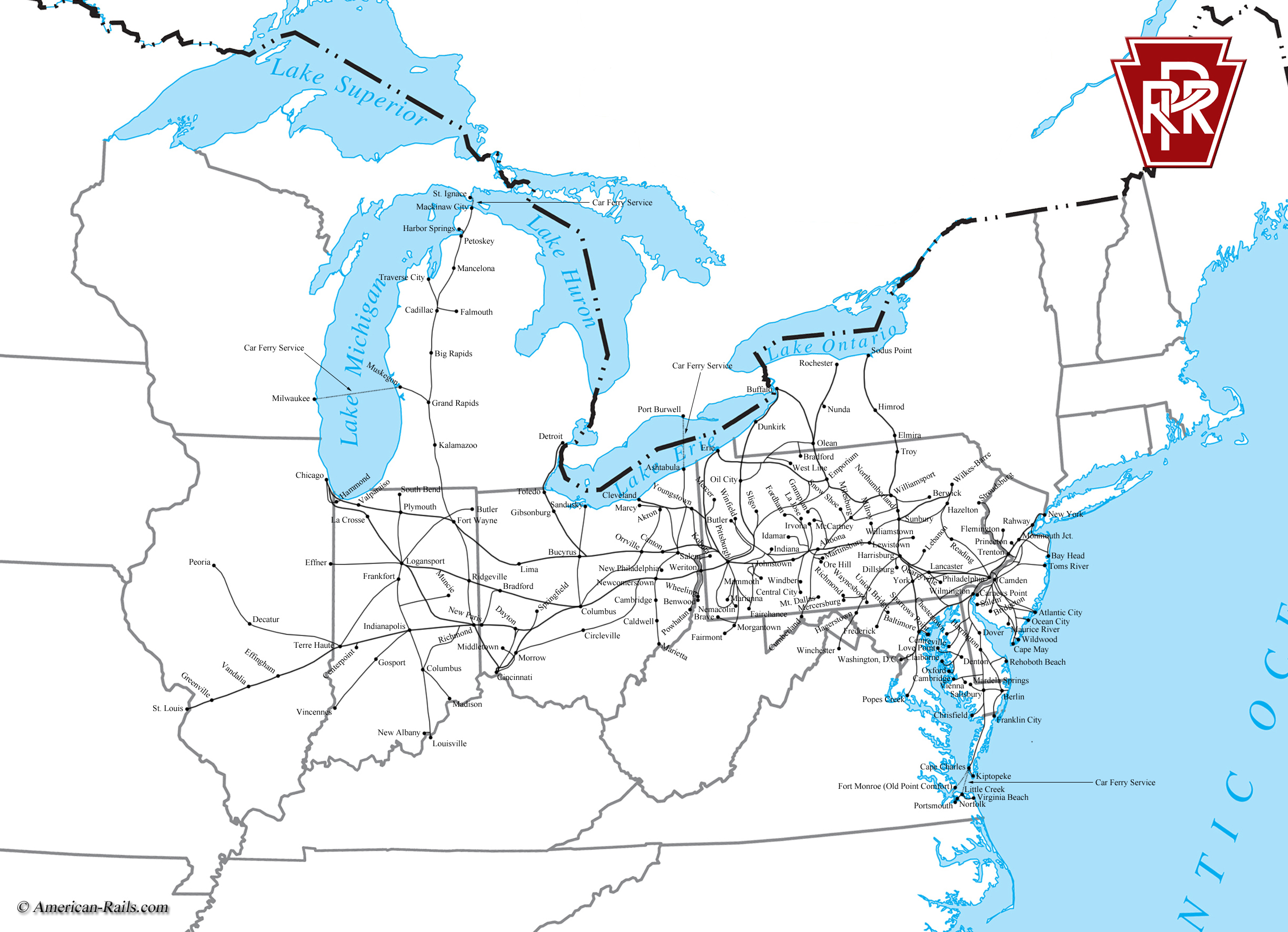
A system map of the Pennsylvania Railroad, circa 1950. Author’s work.
Delmarva, the New York & Long Branch, and the shore lines
South of Wilmington the Delmarva lines ran the length of Delaware, across Maryland’s Eastern Shore, and down to Cape Charles, Virginia. The New York, Philadelphia & Norfolk opened that route in 1884. The freight was agriculture and seafood, plus a car-float across the lower Chesapeake to the Norfolk roads: the Virginian, the Chesapeake & Ohio, and the Norfolk & Western.
The New Jersey seashore was two systems. In the north, the New York & Long Branch opened in 1875 from Perth Amboy through Long Branch and Sea Girt to what became Bay Head Junction. The Central Railroad of New Jersey had built it. From January 1882 the Pennsylvania operated trains over it under agreements with the Jersey Central, and a second agreement followed in 1888. The Jersey Central owned the capital stock. The Pennsylvania did not buy half the company in 1930. What the two railroads shared was the operation: Pennsylvania trains from the New York terminal, Jersey Central trains from Jersey City, and an engine change at South Amboy once the Pennsylvania’s catenary arrived there in 1936. The Long Branch owned the track and rostered no locomotives of its own.
The southern New Jersey lines were older local companies, among them the Camden & Atlantic and the West Jersey, gathered in 1896 as the West Jersey & Seashore and leased by the Pennsylvania in 1930. They connected Philadelphia and Camden with Atlantic City, Ocean City, Cape May, and Wildwood, and with branches to Bridgeton, the Maurice River, and Salem. In 1933 the Pennsylvania and the Reading put their southern New Jersey properties into the Pennsylvania-Reading Seashore Lines, which operated them as one railroad.
Closer to home, the Cumberland Valley, chartered in 1831, had opened Harrisburg–Hagerstown in 1841 and was later extended to Winchester, Virginia. The Pennsylvania acquired it just before the Civil War. The Philadelphia & Erie, leased in 1862, was the old Sunbury & Erie of 1837. Renamed in 1861, it was completed in the fall of 1864 between Sunbury and Erie. The New York Central already owned the better route to that port. The Pennsylvania’s Erie line lived on coal, ore, and local freight. The Western New York & Pennsylvania, incorporated in 1887 out of the Buffalo, New York & Philadelphia, gave the system Buffalo and Rochester, splitting at Olean, more than 500 miles in all. The Pennsylvania bought it in 1900. It never built a New England railroad of its own. East of New York it handed passengers and freight to the New Haven.
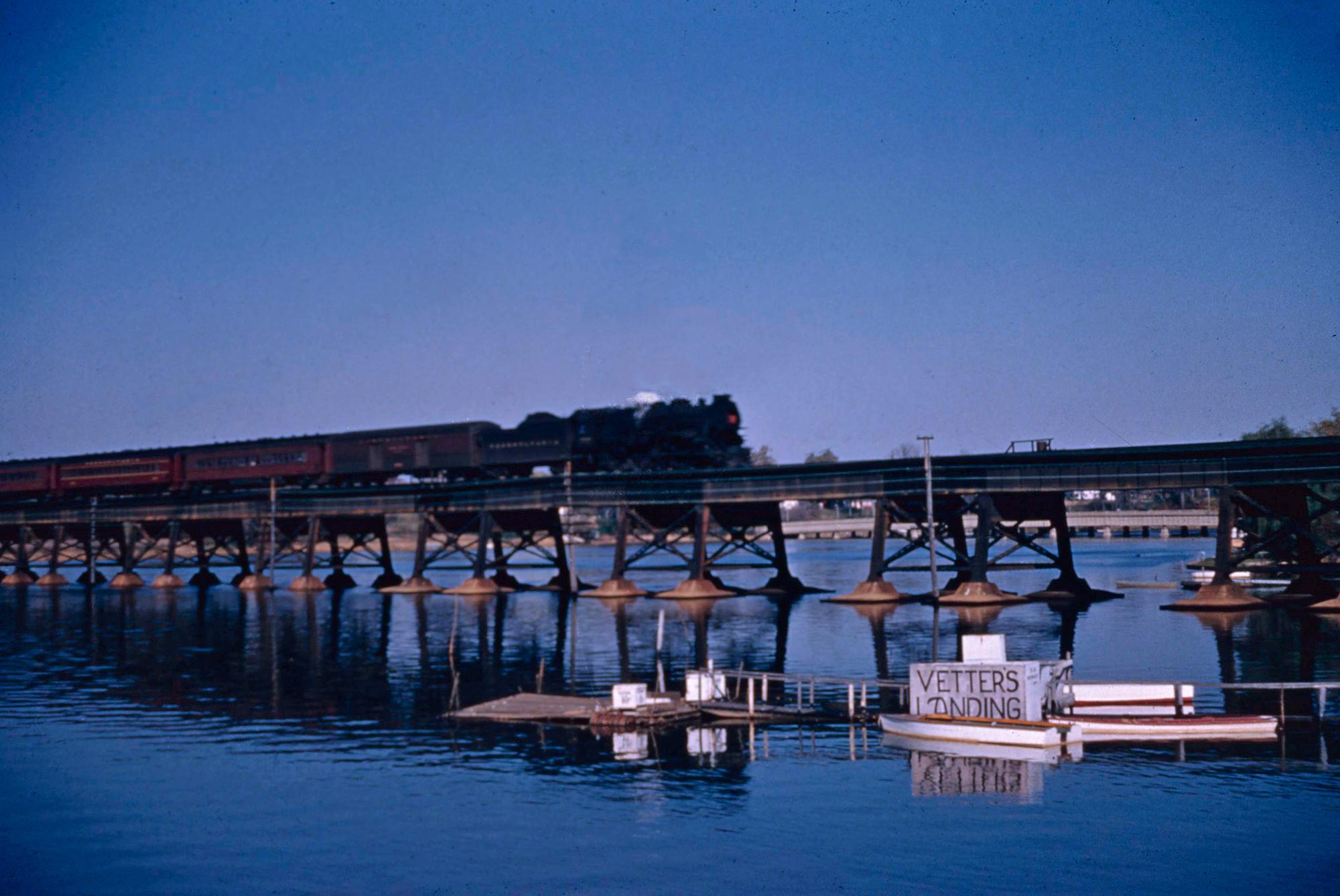
K4s #3755 southbound over the Navesink River at Red Bank, New Jersey, on the New York & Long Branch, November 10, 1950. Author’s collection.
Cassatt, Pennsylvania Station, and the Broadway Limited
By 1900 the Pennsylvania was already one of the largest corporations in the country. The predecessors above are a selection, not the whole corporate tree. Alexander Johnston Cassatt became president in 1899 and spent his presidency on the gap that still embarrassed the railroad: its New York passengers got off in New Jersey and took a ferry.
In 1900 the Pennsylvania bought the Long Island Rail Road, a purchase the company’s own accounting put at $6 million, as the suburban half of the same plan. The terminal project began in 1901. Two tunnels under the Hudson connected the main line at Newark. Four tunnels under the East River connected the Long Island. Pennsylvania Station opened in two steps in 1910. Long Island trains began using it on September 8. The station opened for all rail traffic on November 27. It was the railroad’s monument, and it was torn down. Demolition of the 1910 headhouse began on October 28, 1963. The tracks and the platforms remained. In Philadelphia, 30th Street Station opened on September 28, 1933, and Broad Street Station closed on April 27, 1952.
The flagship on the New York–Chicago run was the Broadway Limited, named on November 24, 1912, in succession to the Pennsylvania Special. The name came from the railroad’s “broad way,” the four-track main line, not from the street in Manhattan. The schedule was about 16 hours for a little over 900 miles. Where the New York Central’s 20th Century Limited presented itself in gray and black, the Broadway was Tuscan and pulled its shade. On June 15, 1938, the Pennsylvania put four streamlined trains in service at once and called them the Fleet of Modernism: the Broadway Limited, the General, the Liberty Limited, and the Spirit of St. Louis. The longer passenger story is the passenger-train page. The earlier Chicago flagship is the Pennsylvania Limited.
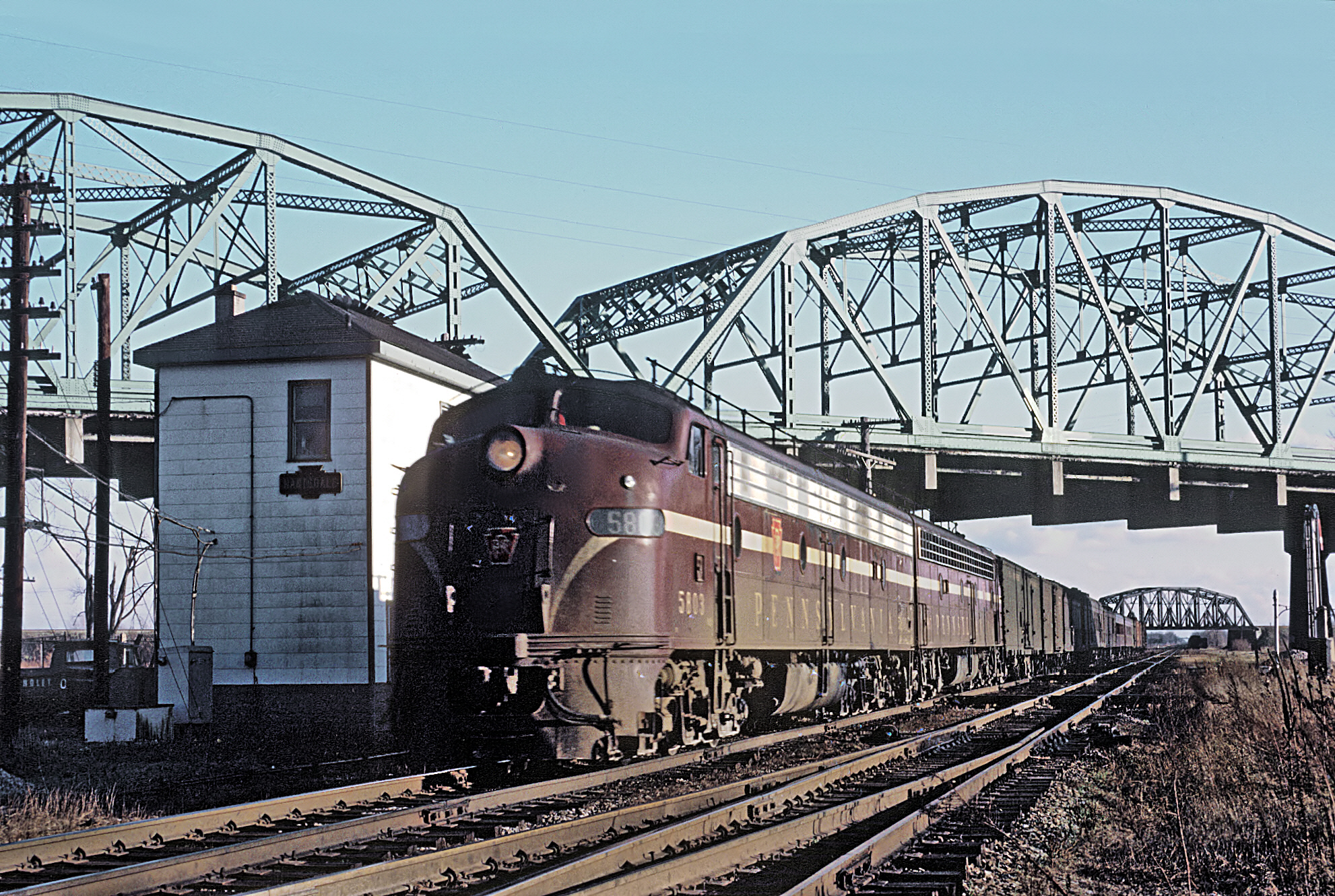
E8As led by #5803 on train 72, the eastbound “Red Bird” (Chicago–Cincinnati), at Hartsdale, Indiana, crossing the New York Central and the Elgin, Joliet & Eastern, November 26, 1965. That Pennsylvania corridor is gone. Roger Puta photo.
Wires to Harrisburg, and the GG1
No other large American railroad electrified as much of its main line. The Hudson tunnels required electric locomotives from the day Pennsylvania Station opened, and the DD1s handled that job. Suburban electrification out of Philadelphia reached Paoli in 1915. The long-distance project came later: New York to Washington was finished on February 10, 1935, and electric passenger service reached Harrisburg on January 15, 1938. West of Harrisburg the railroad stayed with steam, and then with diesel. The company talked for years about carrying the catenary over the Alleghenies to Pittsburgh. It never did. That decision, made while the wires were still new, is one reason steam development paused in the 1930s and why the duplex locomotives of the 1940s arrived so late.
The locomotive of that electrification is the GG1. The mechanical arrangement followed a New Haven electric. Raymond Loewy’s office shaped the shell, welded the production bodies, and drew the cat-whisker stripes that spread from the GG1 to the diesel fleet. The Pennsylvania built 139 of them, 4800–4938, counting the riveted prototype, 4800, which had been numbered 4899 and which crews called Old Rivets. They were rated for better than 100 miles an hour, they ran either end first, and they outlived the company. The last GG1 in revenue service was a New Jersey Transit locomotive in 1983.

GG1s ready for duty at Sunnyside Yard, Queens, circa 1954.
Belpaire boilers, five standard types, and the K4s
The Pennsylvania built more of its own locomotives than any other American railroad. Between 1891 and 1946 the Juniata Shops at Altoona were the fastest way the company had to get a new engine, and Altoona had a stationary test plant where a locomotive could be run under load without leaving the building. When the company did go outside, it usually went to Baldwin, in its own city. The things a railfan still uses to recognize a Pennsylvania steam locomotive were policy: the Belpaire firebox, the keystone number plate, the centered headlight, the vertical-bar pilot on the older power, and a classification system so regular that the same letters covered electric locomotives. A B1 was a six-wheel electric boxcab. An “s” on a steam class meant the engine was superheated.
The Belpaire firebox, named for the Belgian engineer Alfred Belpaire, has a flat crown and flat sides, so the crown sheet and the outer wrapper are parallel. The stays between them are straight, and a man can see them. That is the maintenance advantage, and it is why the Pennsylvania stayed with the design when almost everyone else used a radial-stay wagon-top. The firebox still has staybolts. What it does not have is a curved crown with stays of a dozen different lengths. Juniata could build Belpaire boilers in quantity, and the shape became as much a trademark as the keystone.
Grades on the main line were civilized by the standards of a mountain railroad, Horseshoe included. The Pennsylvania tested articulated locomotives and almost never repeated them. The freight fleet was Consolidations, then Mikados, then Decapods, then Mountains for the fast trains, and only at the end a class of 125 Texas-type 2-10-4s. George H. Drury’s chapter in the revised Guide to North American Steam Locomotives is the grid on the steam roster. The short version of his argument is that between 1910 and 1923 the company settled on five types and then built them in hundreds: the E6s Atlantic, the K4s Pacific, the L1s Mikado, the I1s Decapod, and, just at the end of that period, the M1 Mountain.
The L1s and the K4s shared a boiler. Juniata, Baldwin, and Lima built 574 L1s Mikados between 1914 and 1919: 344 at Juniata, 205 at Baldwin, and 25 at Lima. They were the standard road freight engine until the I1s Decapods, 598 of them, took the coal and ore trains. The M1 of 1923 was an I1 boiler on a 4-8-2, built for fast freight, and some of them were dressed for passenger trains that the electrification then made unnecessary. In the war the company was short of modern freight power, the War Production Board had frozen new designs, and Altoona built 125 class J1 2-10-4s from a Chesapeake & Ohio drawing, with 70-inch drivers, a drop-coupler pilot, and a keystone number plate. The duplex freight engine, the Q2 4-4-6-4, was more powerful and more complicated. Every Q2 was retired before any J1.
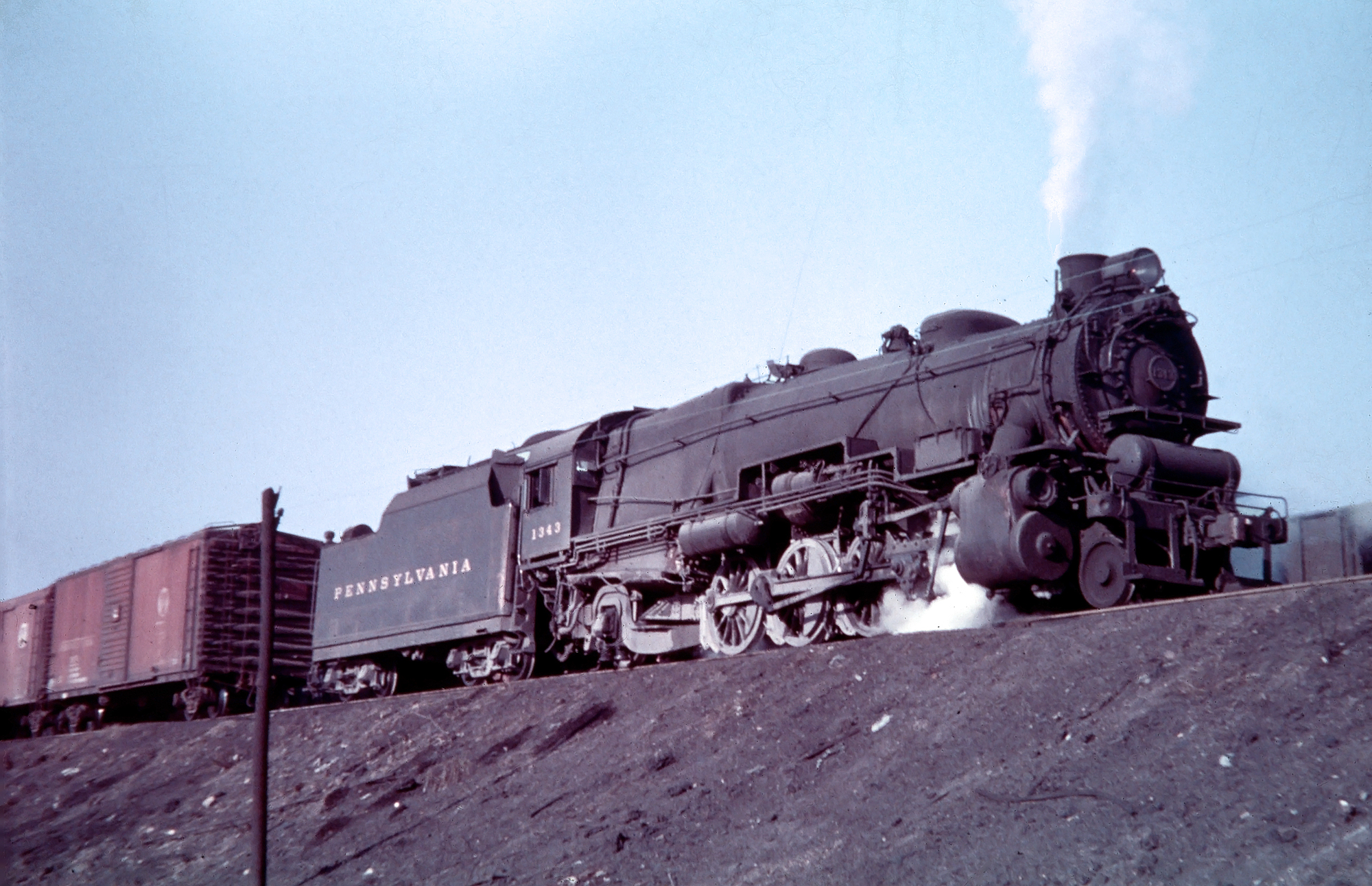
L1s #1343 at Enola, circa 1952. Juniata built 344 of the 574 L1s Mikados, Baldwin 205, and Lima 25, all between 1914 and 1919. Fred Byerly photo. American-Rails.com collection.
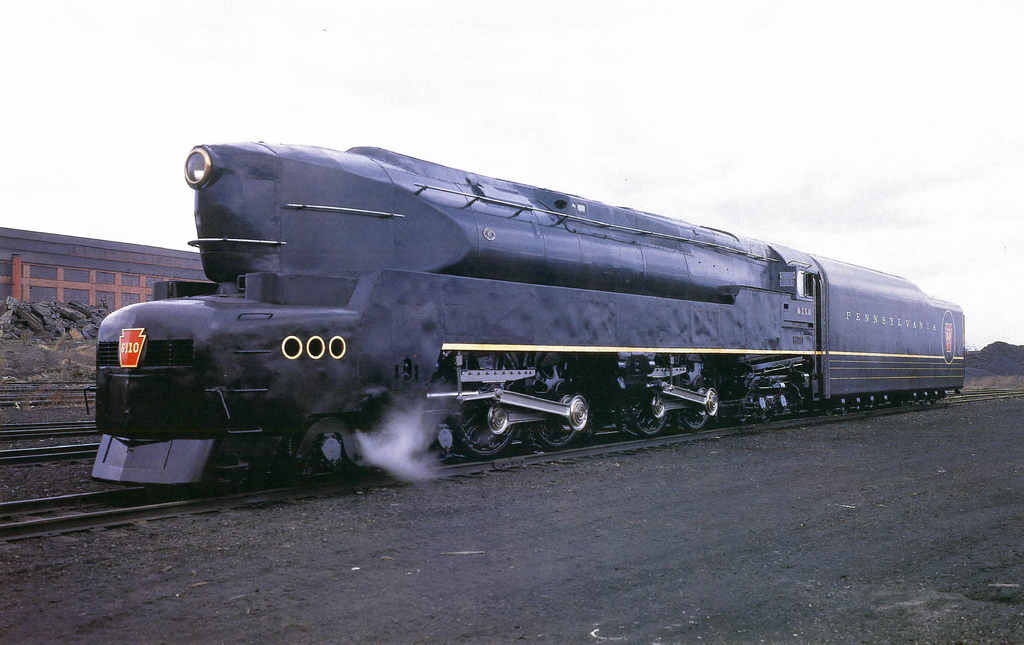
T1 #6110, a 4-4-4-4 duplex, at Baldwin’s Eddystone plant in 1942. Baldwin photograph. Author’s collection. The two prototypes, 6110 and 6111, were followed by 5500–5549 in 1945–46. The class is on the steam roster.
The K4s
The Pacific the railroad is remembered for was not its first. Alco’s Pittsburgh works and the Pennsylvania built an experimental 4-6-2 in 1907, engine 7067, class K28, with 80-inch drivers. It was scrapped in 1933. Between 1910 and 1913 the company acquired 227 class K2 Pacifics, most of them later superheated. In 1913 Baldwin delivered 30 larger K3s Pacifics to Lines West, with mechanical stokers, a device the Pennsylvania adopted only when it had to. The K2 was not quite the engine the passenger department wanted. In 1910 the company went back to the Atlantic and produced the E6, a middleweight machine with two pairs of drivers, 80-inch wheels, and a boiler close to the H8 Consolidation’s. Superheating let the cylinders grow to 23½ inches. Juniata built two in 1912 and 80 in 1914, most of them for New York–Philadelphia–Washington.
The K4s was the synthesis. In 1911 Alco delivered one experimental Pacific, class K29, engine 3395: 27-by-28-inch cylinders, 80-inch drivers, 317,000 pounds. The Pennsylvania took the K29’s size, the E6’s proportions, and the L1s boiler, and classed the result K4s. The “K” was the Pacific series, the “4” the class within it, and the “s” superheat. A single engine was tested for three years. Between 1917 and 1927 Altoona built 324. In 1927 and 1928 the company ordered 100 more, 25 from Juniata and 75 from Baldwin, still hand-fired, and still doubleheaded when the train was heavy. With the 1914 prototype, the class table totals 425 locomotives, built from 1914 to 1928. Two further Pacifics, class K5, engines 5698 and 5699, were built in 1929, one at Juniata and one at Baldwin. They had M1-size cylinders, Worthington feedwater heaters, and, on the Baldwin engine, Caprotti poppet valves that came off in 1937. They were about 10,000 pounds stronger than a K4s and about 6,000 pounds heavier on the drivers. They slipped. The Depression removed any reason to build another.
For suburban trains the company put the E6 boiler on 68-inch drivers and called it a G5s Ten-Wheeler. Juniata built 90 for the Pennsylvania and 31 for the Long Island. Those Long Island engines are on the Long Island steam roster.
K4s locomotives later received disk drivers, smoke lifters, solid pilots, and, on a few, streamlining. In later years the headlight and the generator traded places, the generator moving to the smokebox front ahead of the stack. It was a small change and it spoiled the face of the engine. The class still finished the steam era. The railroad declared steam finished on November 30, 1957. The year-end report to the Interstate Commerce Commission still listed 319 steam locomotives, and 21 remained on the roster at the end of 1958. Some of the last passenger steam ran on the New York & Long Branch.
Two K4s survived. Number 3750 is at the Railroad Museum of Pennsylvania. Number 1361, built at Juniata in 1918, stood for years as the display engine at Horseshoe Curve. The Railroaders Memorial Museum in Altoona took it down in 1986, returned it to excursion service on April 12, 1987, and lost it again to a main-bearing and drive-axle failure. A second restoration, part of it at Steamtown, ran out of money and direction. The present campaign dates from 2021, with the museum, FMW Solutions, former Norfolk Southern chairman Wick Moorman, and preservationist Bennett Levin. On July 10, 2026, the Altoona Mirror quoted museum executive director Joe DeFrancesco: the remaining work was about $2.5 million, of which $1 million had been raised and $750,000 pledged, and if the rest of the money were in hand the work might take about two years. The boiler barrel was finished, the firebox was about half done, and the tender was complete. Strasburg Rail Road had already inspected the drivers and found them fit to use.
An L1s survived as well. Mikado 520 is at the Railroad Museum of Pennsylvania, with 3750.
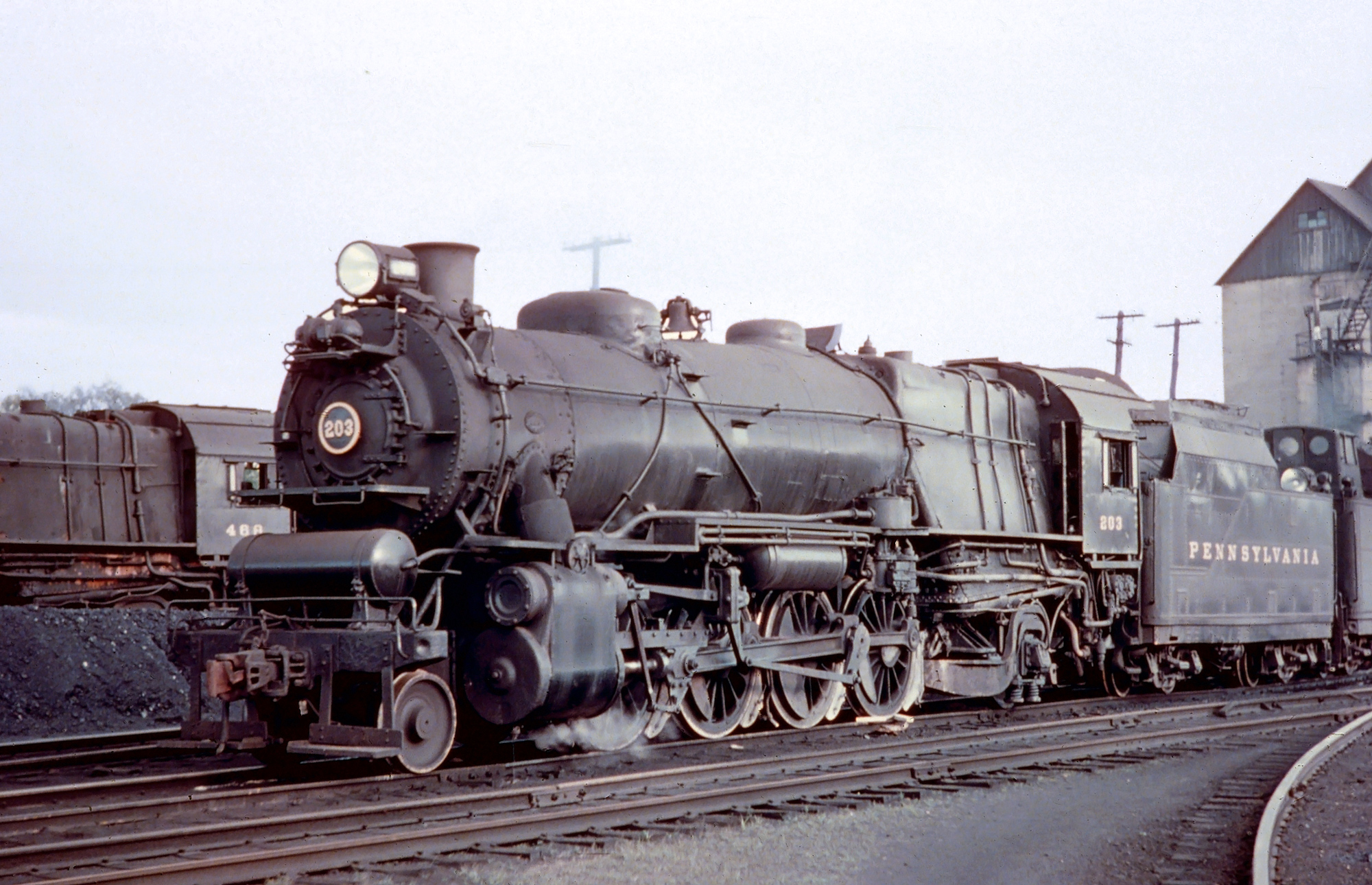
Mikado #203 at Blairsville, Pennsylvania, the same day, September 24, 1955. Homer Newlon, Jr. photo. American-Rails.com collection.
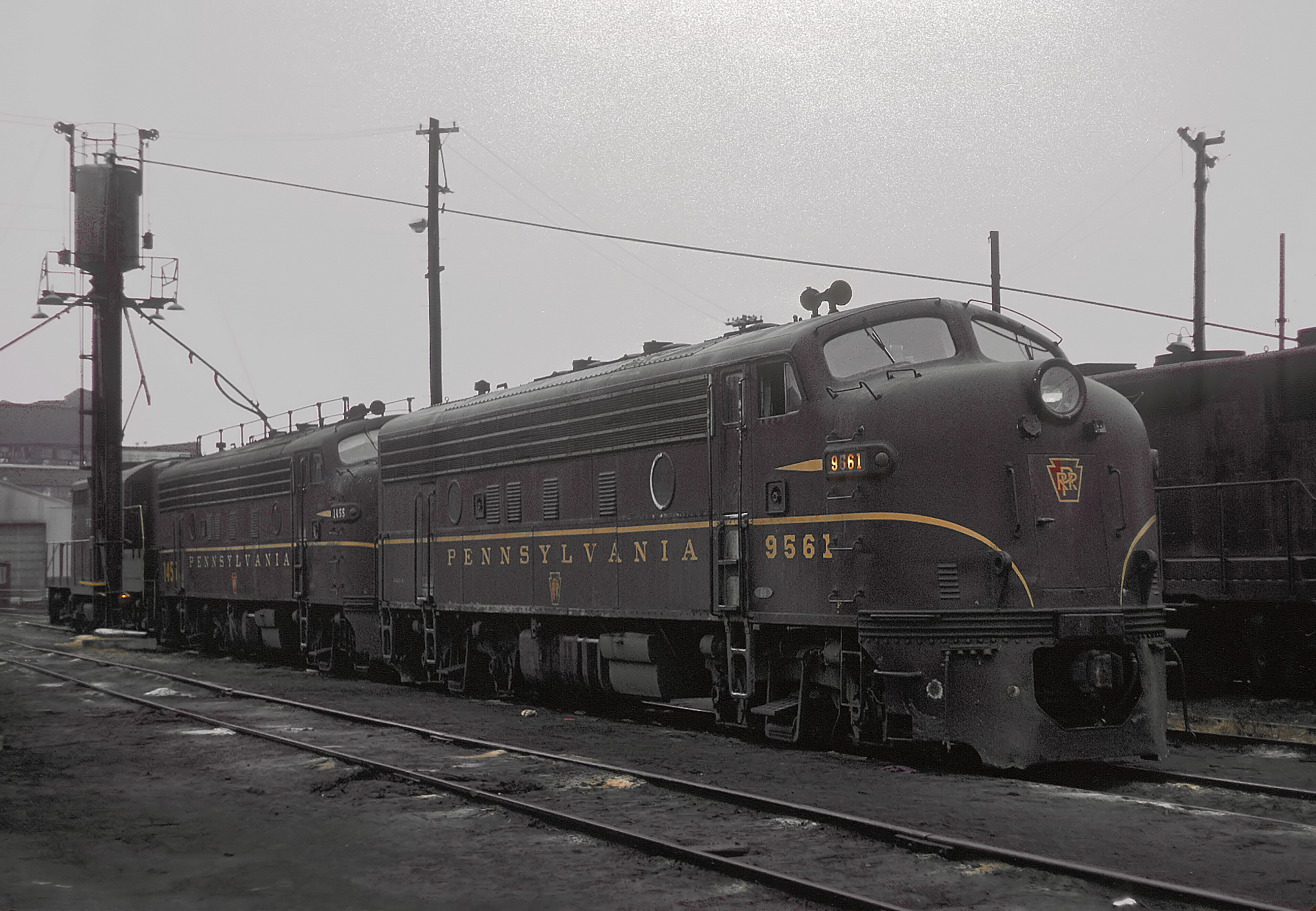
Pennsylvania F3A #9561 and F7A #1455 layover at the small engin terminal in Logansport, Indiana on November 25, 1966. Roger Puta photo.
Diesels, bought late and bought from everybody
The Pennsylvania was late to the diesel and then bought from the whole catalog. The first was an Electro-Motive 600-horsepower SW switcher, 3908, in June 1937, serial 680, later renumbered 5911. It did not convert the mechanical department. Road freight cab units waited until the F3s of 1947. The company skipped the FT. By the mid-1950s the company owned EMD switchers, E7s and E8s, F3s and F7s, GP7s and GP9s, and then the second-generation GP30s, GP35s, and SD40s and SD45s; Alco switchers, FA and PA cab units, and Centuries; Baldwin switchers, Centipedes, and sharks, because Baldwin’s Eddystone plant sat in the railroad’s own city; Fairbanks-Morse road switchers, Erie-builts, and Train Masters; a handful of Lima transfer units; and, after 1960, General Electric U-boats. Penn Central kept buying from GE. The class-by-class list, with construction numbers, is the diesel roster.
Steam was declared finished on November 30, 1957. The diesel fleet that replaced it was large, mixed, and, on the passenger trains of the middle 1960s, often visibly tired. One experiment stayed an experiment: EMD’s Aerotrain, locomotive 1000, an LWT12 classed EP12.

The Aerotrain westbound at Altoona, July 18, 1956, under the tell-tales for the Seventh Street bridge. Jim Kelly photo.
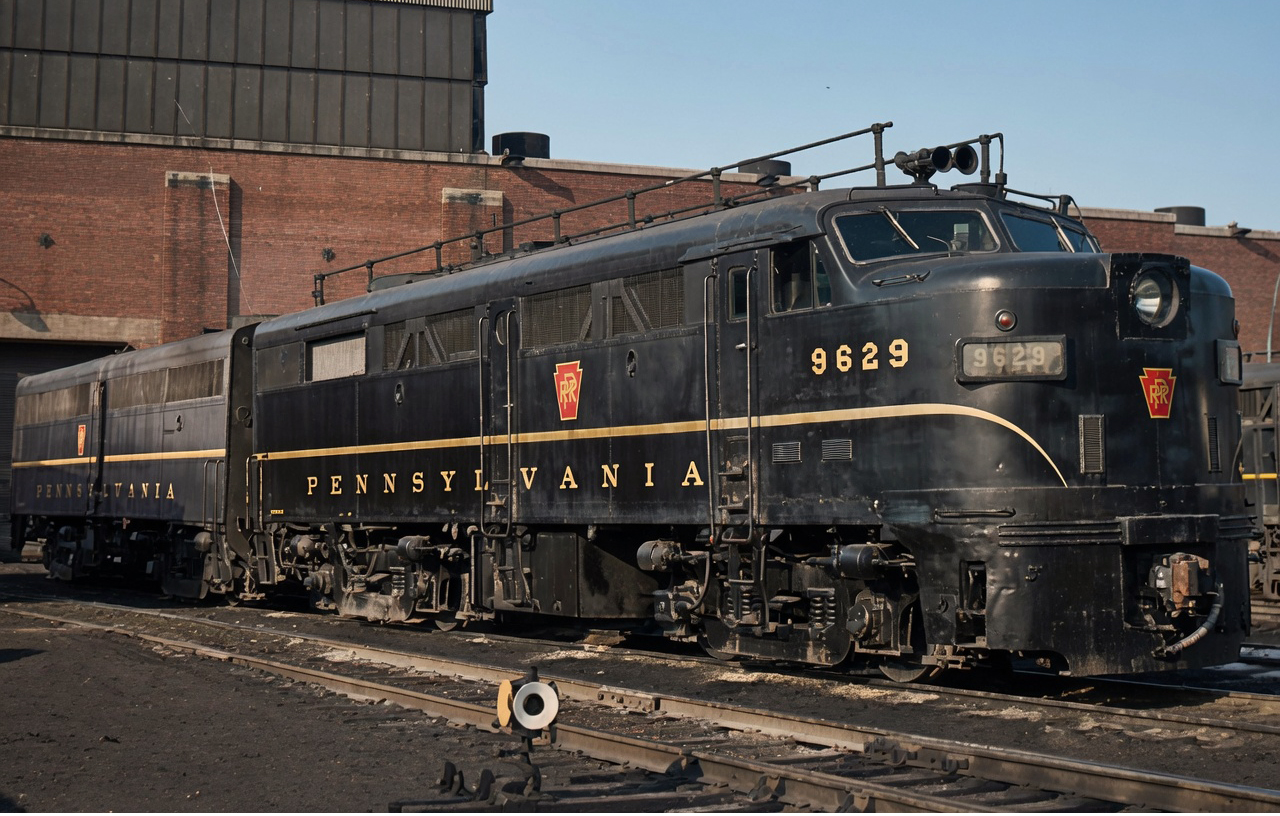
FA-2 #9629-A at Enola, June 1956. Don Wood photo.
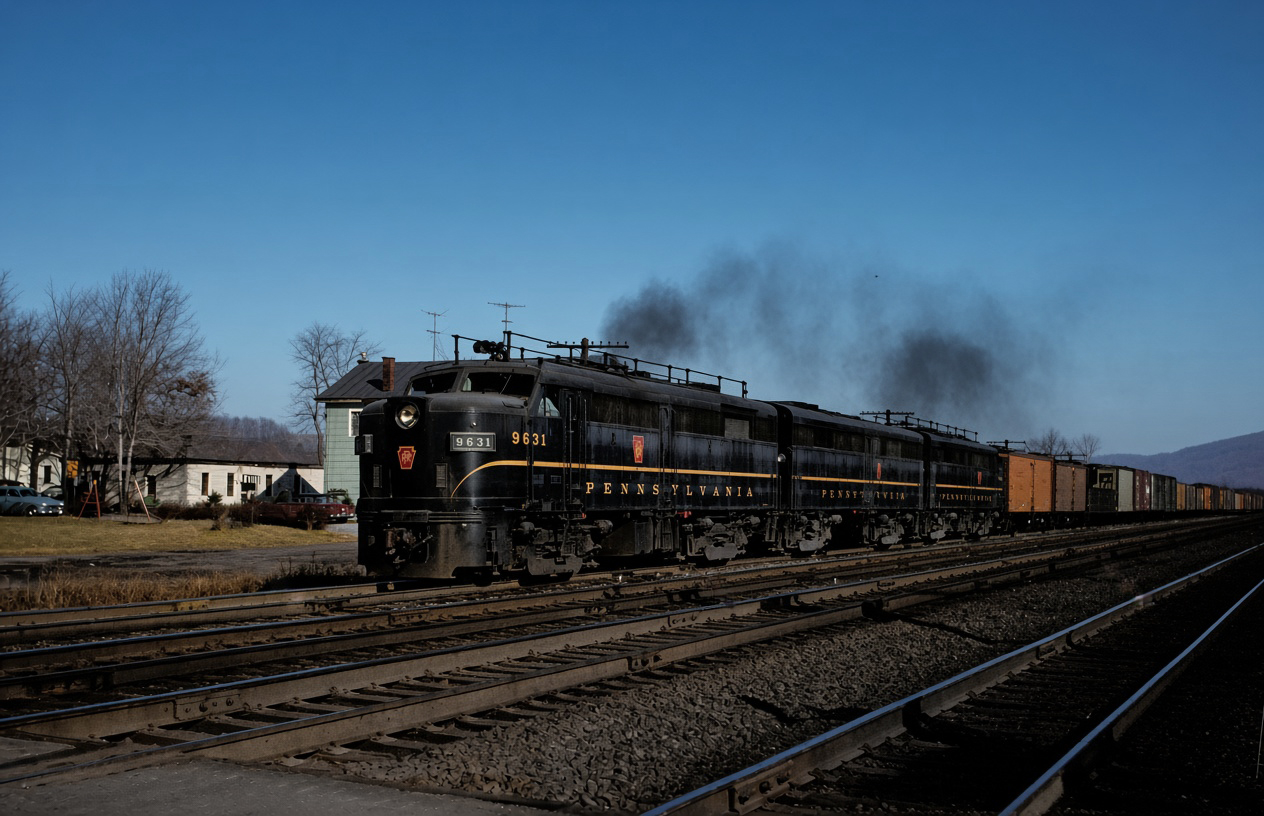
An FA-2 / FB-2 / FA-2 set led by #9631 on a westbound merchandise train at Tipton, Pennsylvania, fall 1961. David Sweetland photo.
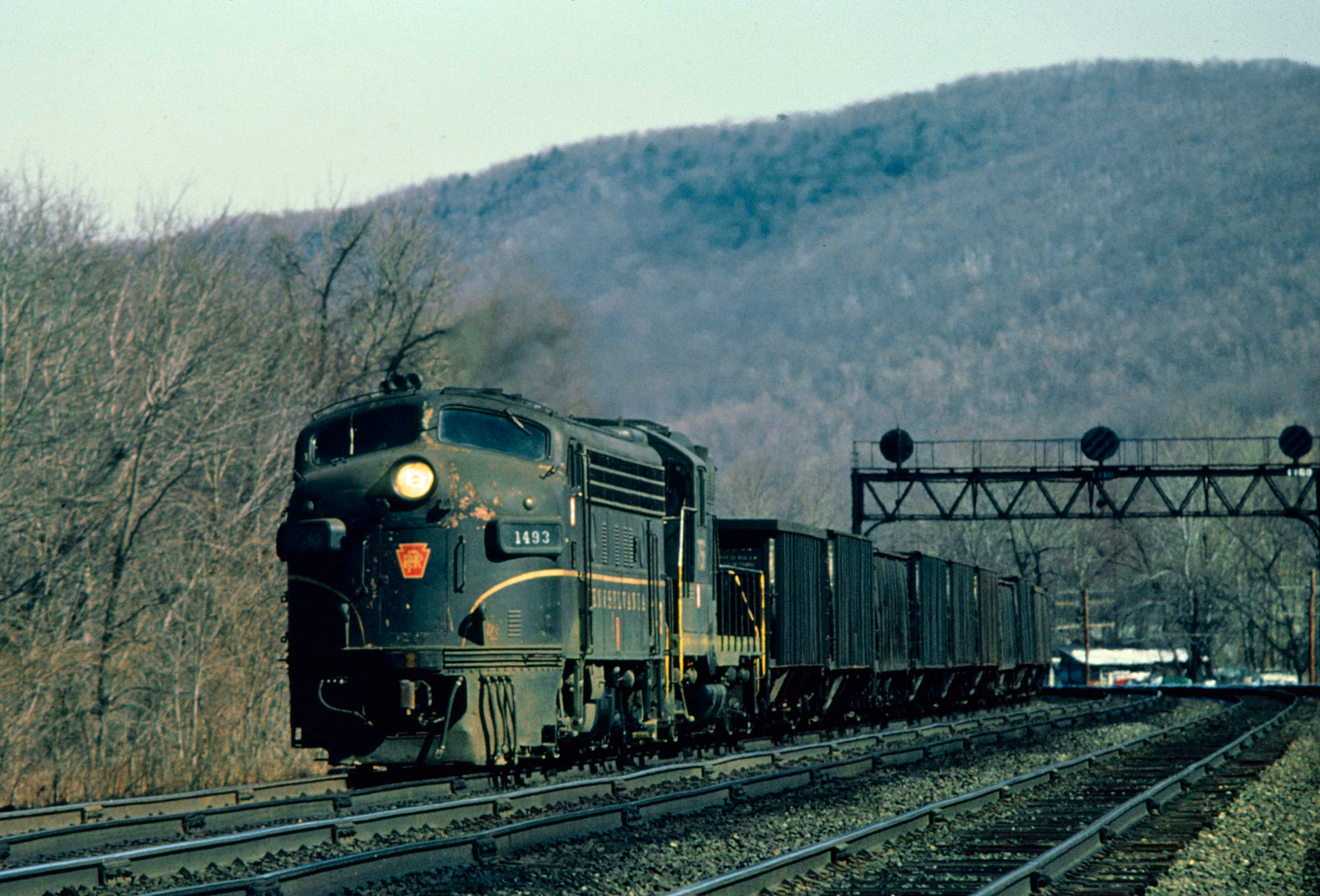
F7A #1493 with westbound empties at Cove, Pennsylvania, in the 1960s. American-Rails.com collection.
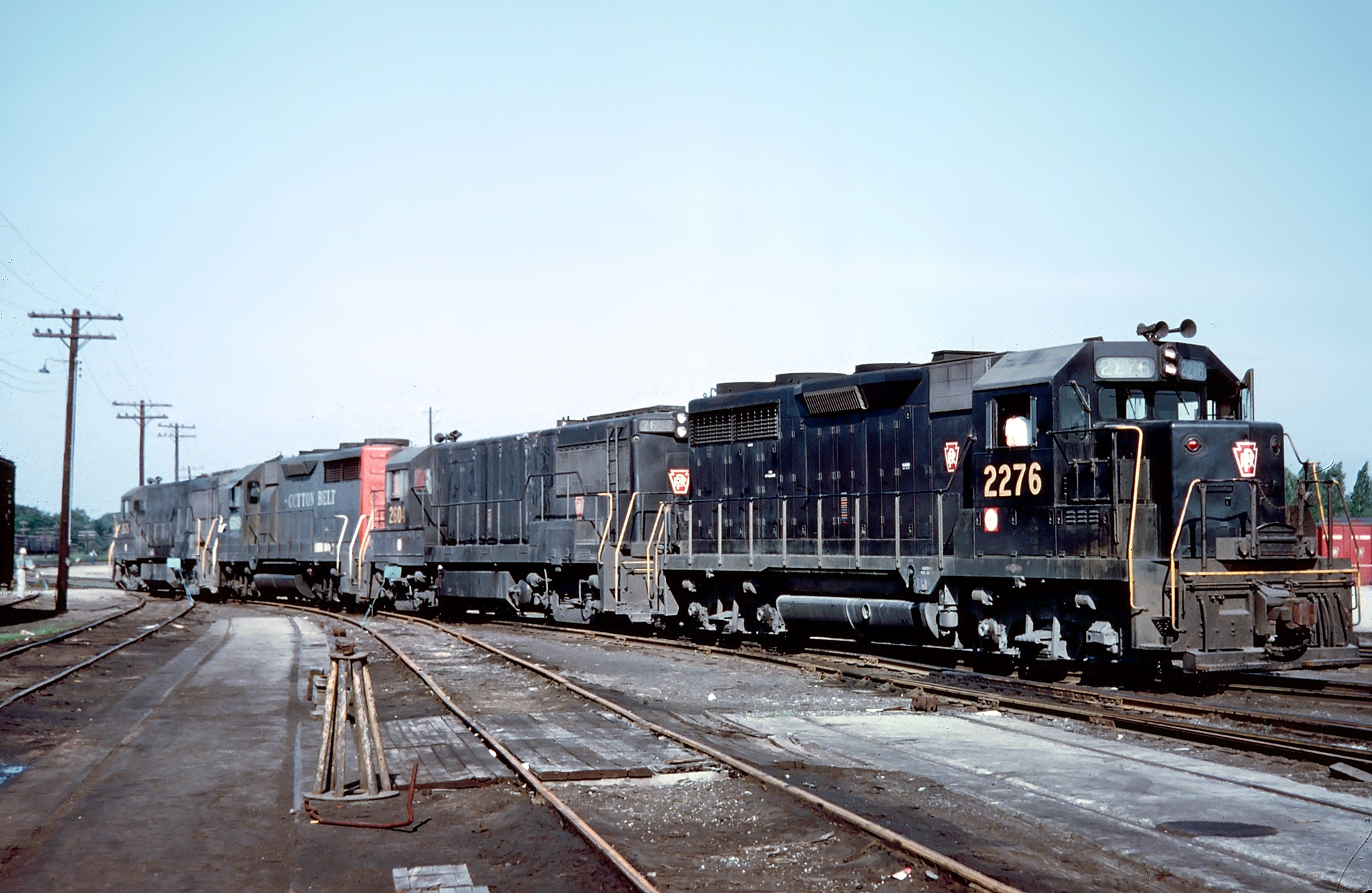
GP35 #2276, U25B #2604, Cotton Belt GP35 #6509, and a second Pennsylvania U25B at East St. Louis, circa 1967. U25B 2604 is the former 2504, serial 34532, renumbered into the 2600s. American-Rails.com collection.
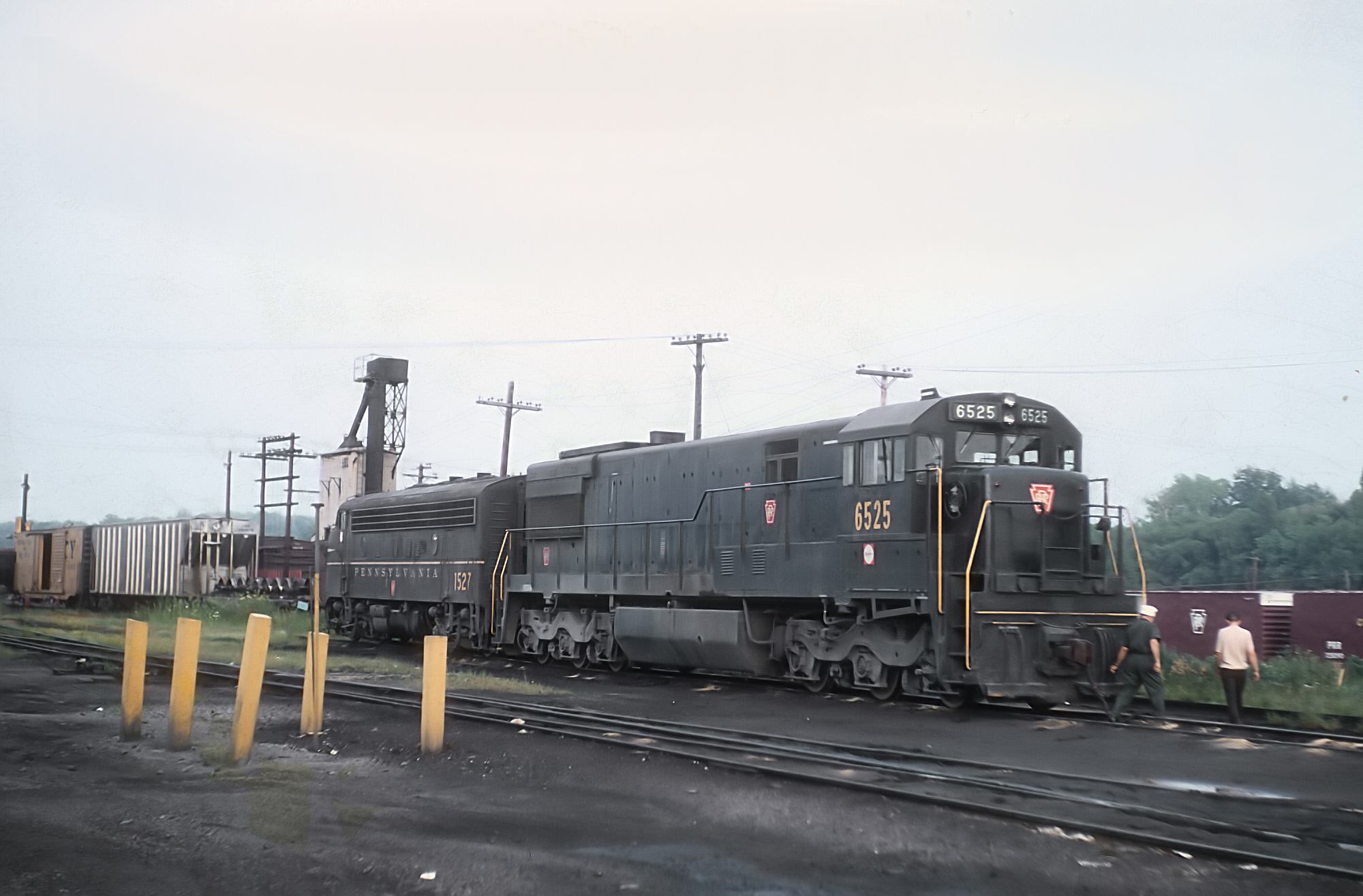
U28C #6525 and F7A #1527 at Richmond, Indiana, August 1967. Rick Burn photo.
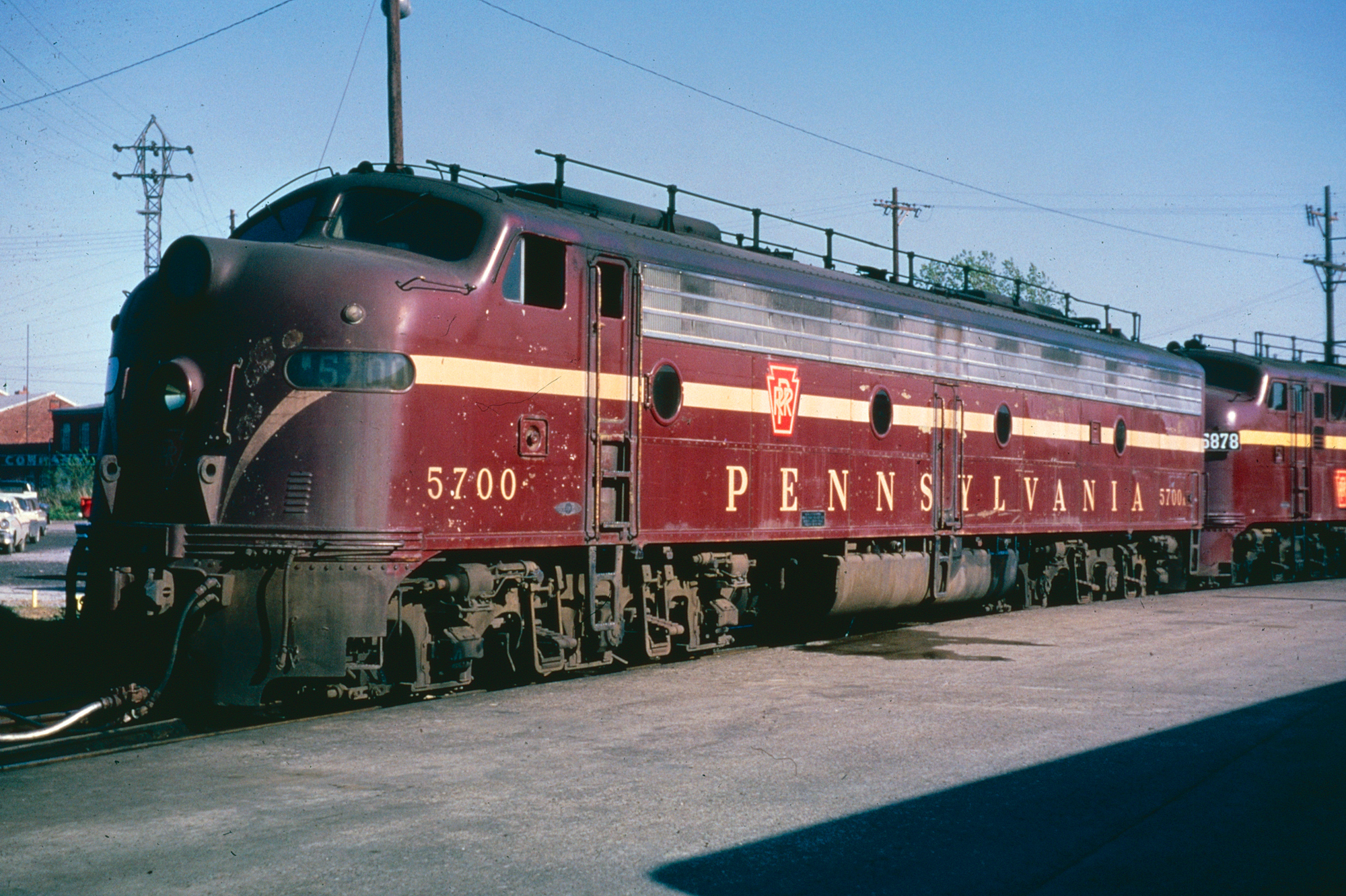
E8A #5700 and E7A #5878 between assignments at Louisville, May 1, 1965. The paint tells the financial story as clearly as the ledger. Author’s collection.
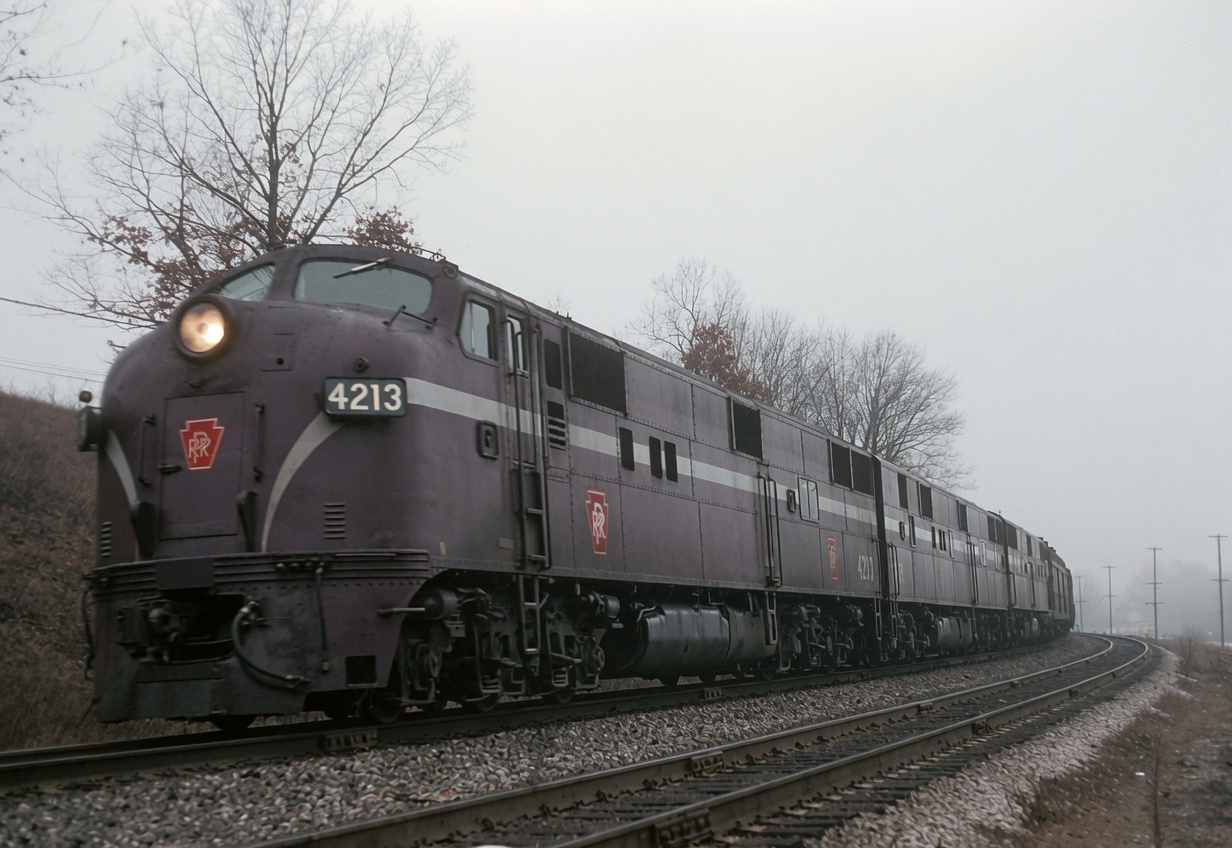
E7A #4213 on train 70, north of Logansport, Indiana, November 25, 1966. Roger Puta photo.
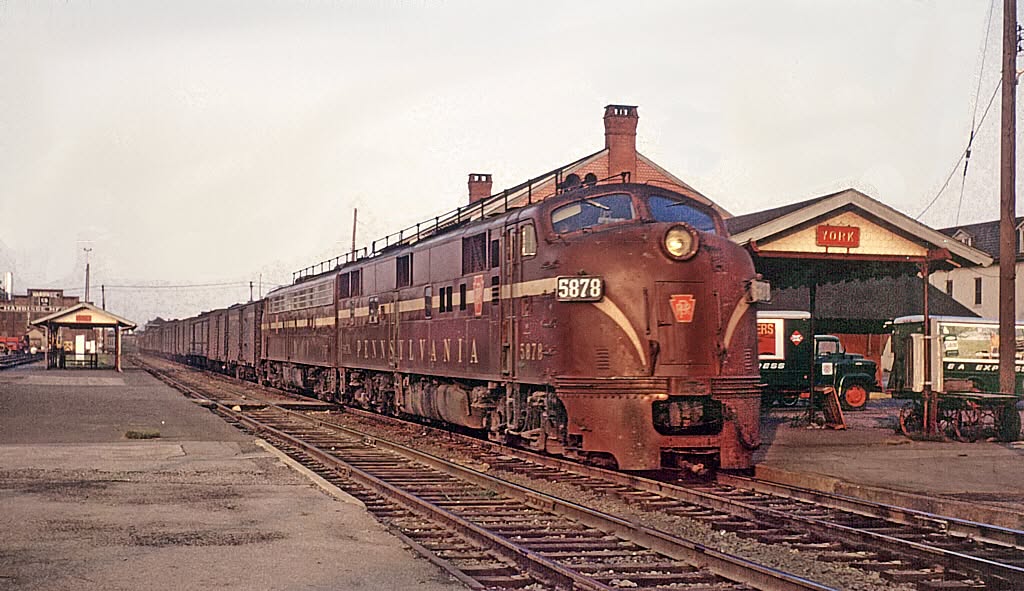
E7A #5878 with the “Baltimore Day Express” at York, Pennsylvania, September 1964. Rick Burn photo.
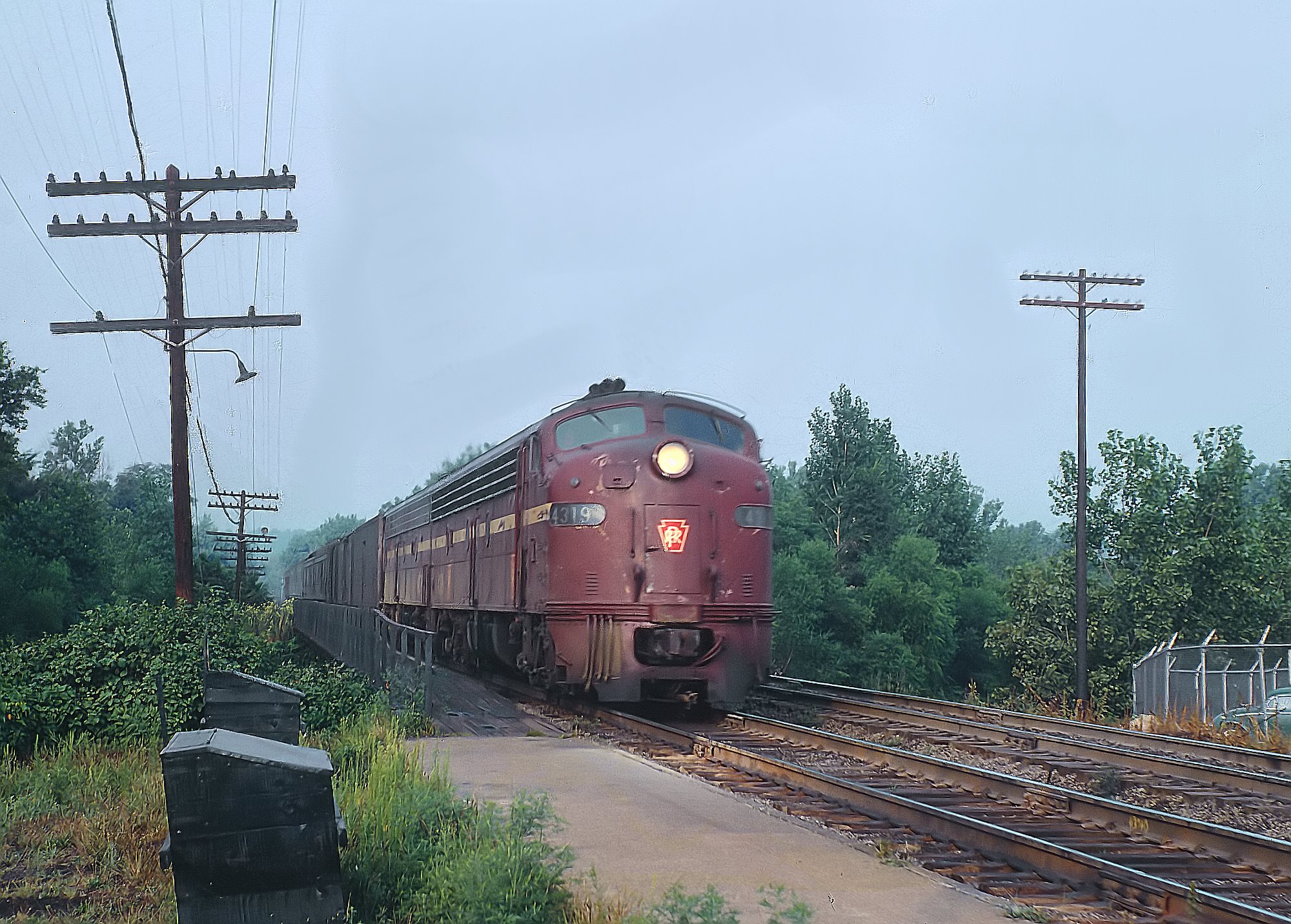
Train 71, the railroad’s Chicago–Cincinnati service via Logansport, at Winton Place Station, Cincinnati, August 1967. Rick Burn photo.
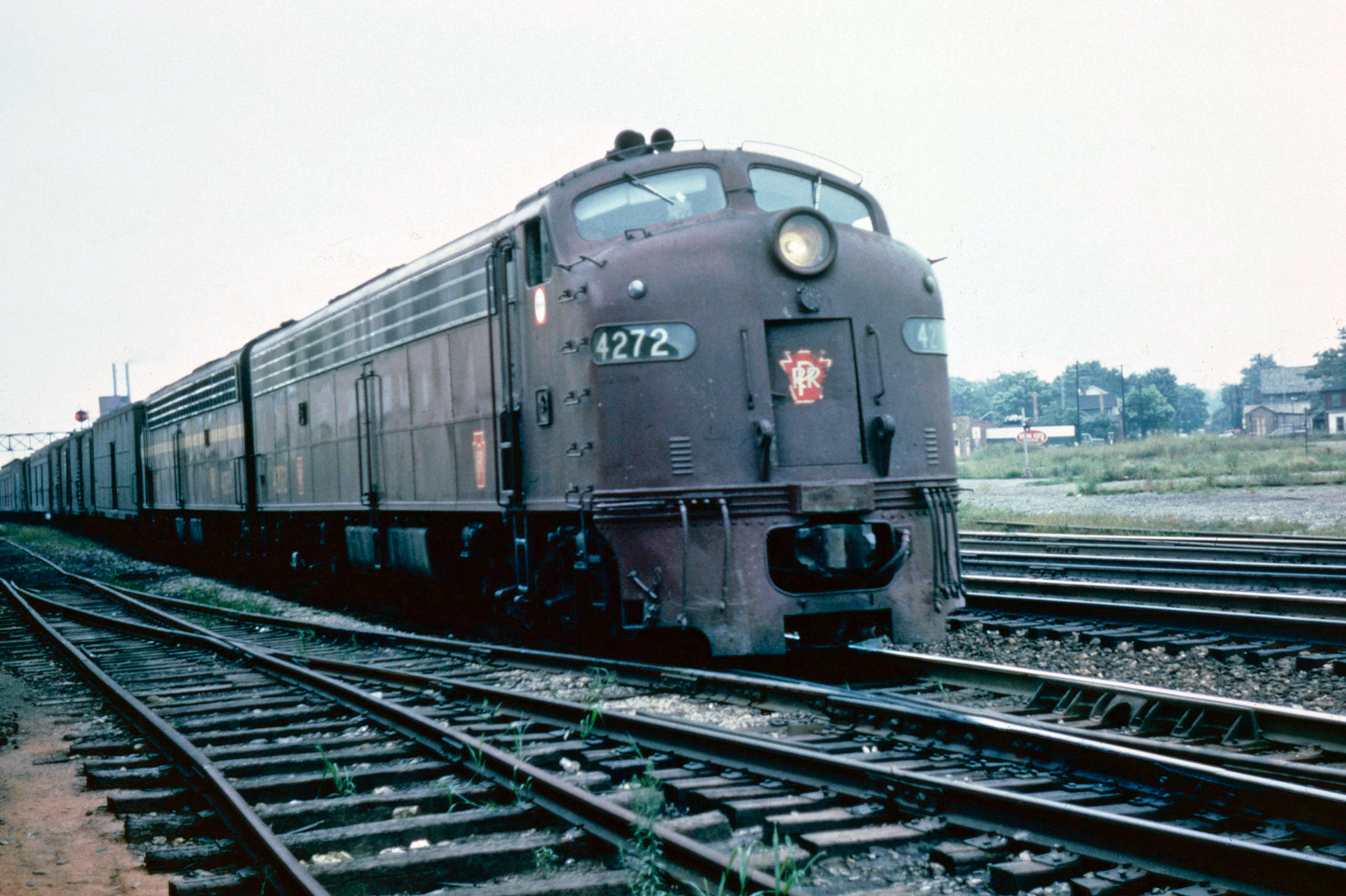
E8A #4272 on an eastbound mail and express train at Canton, Ohio, August 24, 1967. Author’s collection.
The postwar slide, and Penn Central
The railroad lost money in 1946 for the first time. The corporate habit was military: orders moved down, new ideas moved slowly, and a generation of officers had been trained to believe the property was inherently superior to every other railroad. Rush Loving, Jr., in The Men Who Loved Trains, wrote that the Pennsylvania and its managers were disliked almost universally in the industry, that the company was large enough to dominate eastern rate-making, and that its officers viewed the property as inherently superior. He also noted the trap in that rate-making. In the chase for tonnage the railroad sometimes priced a movement below what it cost to haul. The same habit followed the freight into Penn Central.
By 1957 management was talking to the New York Central. The merger movement was already underway. The Norfolk & Western, long a Pennsylvania subsidiary, took the Virginian in 1959 and later the Wabash and the Nickel Plate. The Erie and the Delaware, Lackawanna & Western became Erie Lackawanna in 1960. The Chesapeake & Ohio was circling the Baltimore & Ohio. The Central looked for another partner, including some combination with the Chesapeake & Ohio and Baltimore & Ohio, and in the end the Pennsylvania was the merger it could get.
The Interstate Commerce Commission approved a combination that put most of the Northeast’s trunk-line mileage under one name. Penn Central Transportation Company began on February 1, 1968. The operating departments did not combine so much as collide. Trains were lost in the yards. A year later, on January 1, 1969, the bankrupt New Haven was forced into the same company. Penn Central was burning cash at a rate approaching a million dollars a day. It filed for bankruptcy on June 21, 1970.
The failure pulled on every railroad that interchanged with it. Congress created the Consolidated Rail Corporation. Conrail began on April 1, 1976, with the usable pieces of Penn Central and the other northeastern bankrupts. The Staggers Rail Act of 1980 loosened the rate rules that had boxed the old companies in. Conrail made a profit, and on June 1, 1999, CSX and Norfolk Southern divided it. CSX took much of the old New York Central. Norfolk Southern took much of the old Pennsylvania.
What remains
Norfolk Southern still runs the Pittsburgh Line over the Alleghenies, Horseshoe Curve included, and pieces of the old Panhandle and Fort Wayne roads. Amtrak owns the Northeast Corridor and operates the Keystone service west to Harrisburg under the same wires the GG1s used. NJ Transit operates the old New York & Long Branch as the North Jersey Coast Line. The Long Island Rail Road has been an MTA railroad since 1968. 30th Street Station is still the Philadelphia terminal. The 1927 office building at 32nd and Market is now Drexel University housing. Pennsylvania Station in New York is a station under an arena; the 1910 building is gone. K4s 3750 and L1s 520 are at Strasburg. K4s 1361 is in the roundhouse at Altoona, under restoration. The Pennsylvania Railroad Technical & Historical Society still publishes The Keystone.
Sources
- Schafer, Mike, and Brian Solomon. Pennsylvania Railroad. Osceola: MBI Publishing, 1997. Charter dates, the first diesel, and the corporate outline.
- Drury, George H. Guide to North American Steam Locomotives. Revised edition. Waukesha: Kalmbach Books, 2015. Pages 267–271. Lines West, the five standard types, K4s and L1s counts, and the end of steam.
- Staufer, Alvin F. Pennsy Power: Steam and Electric Locomotives of the Pennsylvania Railroad, 1900–1957. Reprint, Brattleboro: Echo Point Books & Media, 2019.
- Loving, Rush, Jr. The Men Who Loved Trains: The Story of Men Who Battled Greed to Save an Ailing Industry. Bloomington: Indiana University Press, 2006.
- Edson, William D. Keystone Steam & Electric. Wayner Publications, 1974.
- Westing, Frederick. Apex of the Atlantics. Milwaukee: Kalmbach, 1963.
- Kibler, William. “K4 Steam Engine Needs $2.5 Million to Return to Service.” Altoona Mirror, July 10, 2026. Joe DeFrancesco on PRR 1361.
- Pennsylvania Railroad Technical & Historical Society. prrths.com.
Related pages: PRR steam roster (post-1906) · PRR diesel roster · GG1 · Broadway Limited · Horseshoe Curve · Trainphone · New York & Long Branch · Long Island Rail Road · Penn Central · Conrail
Recent Articles


-
Iowa Halloween Train Rides (2026)
Sep 29, 26 11:58 PM
 2026 Iowa Halloween train. Boone & Scenic Valley Pumpkin Express, October 10, 10:00 a.m. from 225 10th Street. About 1 hour 15 minutes. Children pick a pumpkin.
 -
Arizona Halloween Train Rides (2026)
Sep 29, 26 11:43 PM
 2026 Arizona Halloween train. Grand Canyon Railway Pumpkin Patch Train from Williams, $39 with a pumpkin included. Select October dates on the ticket calendar. Haunted train cars are optional.
 -
Nevada Northern Halloween Trains (2026)
Sep 29, 26 06:18 PM
 Nevada Northern 2026 Halloween trains in Ely. Pumpkin Patch Caper to Keystone Gulch and the Haunted Ghost Train. Adult tickets start at $45. Dates are on the railroad’s calendar. Confirm on nnry.com.
 -
Grand Canyon Railway Pumpkin Patch Train (2026)
Sep 29, 26 02:42 PM
 Grand Canyon Railway Pumpkin Patch Train—select October 2026 dates from Williams, $39 with a pumpkin included. Haunted train cars are optional. Days are on the ticket calendar. Confirm on thetrain.com…
 -
Cass Scenic Railroad Halloween Trains (2026)
Sep 29, 26 02:37 PM
 Cass Scenic Halloween Trains—October 30 and 31, 2026, steam, 5:00 p.m. from Cass Depot. About two hours to Whittaker. Adult $75. Candy for every child. Confirm on mountainrailwv.com.
 -
Halloween Train Rides (2026): Pumpkin Patch, Haunted & Spooky Trips
Sep 29, 26 11:26 AM
 2026 Halloween train rides in nine checked states. Conway Scenic Halloween Express October 24–25. Strasburg’s three fall tickets. Great Smoky Mountains Railroad’s October trains are the gorge and rive…
 -
Maine Halloween Train Rides (2026)
Sep 29, 26 11:08 AM
 2026 Maine Halloween trains. Seashore Pumpkin Patch Trolley through October 18, adult $17. Happy Trolleyween October 23–25 at $15. WW&F Pumpkin Pickin’ October 3, 12, 17, and 24. Downeast’s booking it…
 -
Kentucky Halloween Train Rides (2026)
Sep 29, 26 10:58 AM
 2026 Kentucky Halloween trains. Kentucky Railway Museum Trick and Track Express, October 24 and 31, from $17. Bluegrass Scenic pumpkin trains in Versailles. Confirm on the ticket shop.
 -
Connecticut Halloween Train Rides (2026)
Sep 29, 26 10:26 AM
 2026 Connecticut Halloween trains. East Windsor Pumpkin Patch Fridays through Sundays, October 2–31. Naugatuck coach $20. Shore Line Pumpkin Patch on nine October days. Confirm on each site.
 -
Pennsylvania Halloween Train Rides (2026)
Sep 29, 26 09:45 AM
 2026 Pennsylvania Halloween trains—Everett October 3, 4, 10, and 17, Strasburg’s three fall shows, Oil Creek on October 24, plus Kutztown, Kempton, Honesdale, Middletown, and West Chester.
 -
New York Halloween Train Rides (2026)
Sep 29, 26 12:08 AM
2026 New York Halloween trains—Catskill Pumpkin Express October 17–18 and 24–25, Adirondack pumpkin and family trains, Arcade & Attica haunt, Cooperstown patch and trick-or-treat, Tupper Lake triv… -
North Carolina Halloween Train Rides (2026)
Sep 28, 26 11:56 PM
 2026 North Carolina Halloween trains—New Hope Valley Track or Treat on October 10, 17, 23, and 24, and Tweetsie Ghost Train Friday and Saturday nights through October 31. GSMR’s October menu is the go…
 -
Tweetsie Railroad Ghost Train Halloween Festival (2026)
Sep 28, 26 11:44 PM
 Tweetsie Ghost Train—Friday and Saturday nights September 25–October 31, 2026, in Blowing Rock. Adult $65, child $45. One reserved steam ride plus the park. Ages 8 and up for the haunt.
 -
Milwaukee Road Class A 4-4-2: Specs, Roster, History
Sep 28, 26 11:20 PM
 Milwaukee Road Class A Atlantics 1–4, Alco 1935–1937, for the Hiawatha. Order S-1740, 84-inch drivers, 19x28, 300 psi, 30,685 lb. Full builder specs, roster, and the May 15, 1935 run at 112.5 mph. All…
 -
Strasburg Rail Road Halloween Trains (2026)
Sep 28, 26 11:00 PM
 Strasburg’s 2026 Halloween tickets—Pumpkins in Paradise on October 3, The Haunting of Pumpkin Junction, and The Brakeman’s Curse through October 25. Three fares. Legacy of Sleepy Hollow is an earlier…
 -
GSMR Peanuts Pumpkin Train (2026): Not on This Year’s Ticket Menu
Sep 28, 26 10:50 PM
Great Smoky Mountains Railroad’s September 28, 2026 ticket menu lists Nantahala and Tuckasegee excursions. A Peanuts Great Pumpkin train is not on that menu. Polar Express is on the November calendar. -
New Jersey Halloween Train Rides (2026)
Sep 28, 26 06:45 PM
2026 New Jersey Halloween trains—Black River & Western to Everitt Farms through October 25, Delaware River Great Pumpkin through November 1, Whippany October 4, 10, and 11, Pine Creek night trains. -
New Hampshire Halloween Train Rides (2026)
Sep 28, 26 05:17 PM
 2026 New Hampshire Halloween train—Conway Scenic Halloween Express, October 24 and 25, about 1 hour from North Conway. Coach adult $30. Confirm on conwayscenic.com.
 -
Conway Scenic Pumpkin Patch Express (2026): Dates, Tickets & Tips
Sep 28, 26 05:09 PM
 Conway Scenic Halloween Express—October 24 and 25, 2026, about 1 hour from North Conway. Coach adult $30. A pumpkin after the ride while supplies last. Confirm on conwayscenic.com.
 -
Black River & Western Pumpkin Trains (2026): Dates, Tickets & Tips
Sep 28, 26 02:20 PM
 Suggested meta description: Black River & Western Pumpkin Train—Flemington to Everitt Farms, weekends September 26–October 25, 2026. Pumpkin patch, maze, and wagon rides. Confirm on blackriverrail…
 -
Scenic Dinner Train Rides (2026): A Complete Guide
Sep 28, 26 01:30 PM
 2026 scenic dinner trains by state—a seated meal on the train. Branson through October 30, Cincinnati Saturdays, Potomac Eagle, and the full state list. Confirm on the railroad.
 -
West Virginia Dinner Train Rides (2026): A Complete Guide
Sep 28, 26 11:58 AM
 2026 Potomac Eagle dining from Romney—about 3 hours in the Trough. Premium three courses $124. Superior four courses $159, ages 17 and older. Confirm on potomaceagle.com.
 -
Washington Dinner Train Rides (2026): A Complete Guide
Sep 28, 26 11:51 AM
 2026 Chehalis-Centralia dinner trains have run. The July 18 Roaring 20s dinner was $89. The planning calendar lists no later dinner. Confirm on steamtrainride.com.
 -
Texas Dinner Train Rides (2026): A Complete Guide
Sep 28, 26 11:27 AM
 2026 Texas has no plated dinner aboard the train. Grapevine sells snacks. The Texas State Railroad Dogwood lunch was served at the Rusk depot. Confirm on the railroad.
 -
Ohio Dinner Train Rides (2026): A Complete Guide
Sep 28, 26 10:15 AM
2026 Ohio dinner trains—Cincinnati Saturdays, $140, about 3 hours, ages 12 and up. Hocking Valley Elegant Dinner Train October 17 and November 7, from $95. -
Missouri Dinner Train Rides (2026): A Complete Guide
Sep 28, 26 10:09 AM
 2026 Branson Scenic Railway dinner train—three courses, about 2 hours, Fridays and Saturdays through October 30. Dome $123.50 plus tax. Confirm on bransontrain.com.
 -
Minnesota Dinner Train Rides (2026): A Complete Guide
Sep 28, 26 09:40 AM
 2026 North Shore Scenic Northwoods Dinner Train in Duluth—four courses in the SkyView dome, 2½ hours, $90, through September 26. Confirm on duluthtrains.com.
 -
Maine Dinner Train Rides (2026): A Complete Guide
Sep 28, 26 09:29 AM
 2026 Maine has no dining-car dinner. WW&F Pig Roast at SeaLyon Farm was June 13 and has run, $54.95. Sunset Express was a drink and ended September 5.
 -
Greenbrier, Cheat & Elk Railroad: Western Maryland's Logging Line
Sep 26, 26 11:59 PM
 Greenbrier, Cheat and Elk—the logging railroad the Western Maryland bought in 1927. Cass to Spruce, Summit Cut at 4,066.6 feet, Elk River Branch, Laurel Bank.
 -
Elkins (Western Maryland): Yard, History, Operations
Sep 26, 26 11:56 PM
 Western Maryland at Elkins—the Elkins Division yard, roundhouse, and wash rack. Belington, Durbin, Black Fork, and the Elk River branches met here.
 -
B&O's "Cincinnatian" (Train): Route, Consist, Timetable
Sep 26, 26 11:51 PM
 B&O Cincinnatian—Mount Clare five-car streamliner, January 19, 1947, trains 75 and 76. P-7d Pacifics 5301–5304. Detroit–Cincinnati from June 25, 1950, trains 53 and 54. Last run April 30, 1971.
 -
The Semaphore: Railroading's Classic Signal
Sep 26, 26 11:51 AM
 Railroad semaphore signals: blade and spectacle, lower quadrant and upper quadrant, US&S Style B and GRS Model 2A, Robinson’s track circuit, and the last blades on the Raton Subdivision.
 -
Black Fork Grade (Western Maryland): History and Operations
Sep 26, 26 11:47 AM
 Black Fork Grade—the Western Maryland climb through Blackwater Canyon. Thomas to Hendricks, past 3 percent, an H-9 and ten loads, helpers off at Fairfax.
 -
Western Maryland Steam Locomotives: History & Roster
Sep 26, 26 11:39 AM
 Western Maryland steam—H-9 Consolidations, I-2 Decapods, Lima 2-8-8-2s, Baldwin Challengers, and twelve Baldwin Potomac 4-8-4s. Post-1900 roster.
 -
Western Maryland Diesel Roster: All-Time
Sep 26, 26 11:32 AM
 Western Maryland diesels—S1 102 in 1941, fourteen F7 boosters, BL2s, hammerhead RS3s, Circus SD40s, and Chessie GP40-2s. Serials and order numbers.
 -
The Dutch Line (Western Maryland): History, Map, Operations
Sep 25, 26 09:38 PM
 Western Maryland Dutch Line—the Hanover Subdivision. Emory Grove to Highfield via Hanover and Gettysburg, York branch 1893, stone trains, and the route CSX still runs.
 -
The Durbin Branch (Western Maryland): History, Map, Operations
Sep 25, 26 09:13 PM
 Western Maryland Durbin Branch—the Coal & Iron Railway, 46.9 miles Elkins to Durbin, opened July 27, 1903. Mixed train until April 10, 1959. H-7B Consolidations.
 -
Western Maryland Railway: Map, Rosters, Logo, History
Sep 25, 26 10:24 AM
 Western Maryland Railway—the Fast Freight Line. Baltimore, Carroll & Frederick, May 27, 1852. Connellsville Extension 1912. Chessie, then into the B&O May 1, 1983.
 -
Illinois Dinner Train Rides (2026): A Complete Guide
Sep 25, 26 09:52 AM
2026 Monticello Railway Museum Murder Mystery Dinner Train—June 13, July 11, August 1, and September 5 have run. Three courses, about 2 hours, $112. Confirm on mrym.org. -
Georgia Dinner Train Rides (2026): A Complete Guide
Sep 25, 26 12:29 AM
 2026 Azalea Sprinter dinner train from Nashville and Willacoochee, Georgia—2½ hours. Club Car adult $147, Executive adult $177. Confirm on azaleasprinter.com.
 -
Baldwin "Centipede" Locomotives: Specs, Roster, Photos
Sep 25, 26 12:02 AM
 Baldwin DR-12-8-1500/2 Centipede—2-D+D-2, two 608SC engines, 3,000 hp. SAL 4500 from the 1943 test bed. 54 on the serial list, 52 sold. PRR BP60 then BH50. None preserved.
 -
Florida Dinner Train Rides (2026): A Complete Guide
Sep 24, 26 11:56 PM
 2026 Seminole Gulf Murder Mystery Dinner Train in Fort Myers—five courses cooked onboard, 3½ hours, $129 or $135 Saturday, plus tax and gratuity. Confirm on semgulf.com.
 -
West Virginia Northern Railroad: Map, Photos, History
Sep 24, 26 11:27 PM
 West Virginia Northern—Kingwood to Tunnelton, 11 miles of Preston County coal. Narrow gauge 1888, standard gauge 1895. Last freight February 19, 1991. Consolidations 8 and 9 survive.
 -
Rutland Railroad: Map, Rosters, History, Logo
Sep 24, 26 01:18 PM
 Rutland Railroad—Follett’s Champlain & Connecticut River, November 1, 1843. Bellows Falls–Burlington December 18, 1849. Green Mountain Gateway. Last train September 25, 1961. Vermont Railway Janua…
 -
Arkansas Dinner Train Rides (2026): A Complete Guide
Sep 24, 26 01:12 PM
 2026 Eureka Springs & North Arkansas Dinner Train—Eurekan dining car, about 2 hours, $53.62 tax included, opens May 9, Tuesday, Wednesday, Friday, and Saturday. Confirm on esnarailway.com.
 -
Arizona Dinner Train Rides (2026): A Complete Guide
Sep 24, 26 01:01 PM
2026 Arizona has no plated dinner train. Grand Canyon Railway sells snacks in the cars and meals in Williams or at the rim. Verde Canyon includes a charcuterie tray. -
Rail News, The Latest
Sep 24, 26 12:36 PM
This page provides a portal to the latest in rail news, from preservation and restortation subjects to other notable topics. -
Cotton Belt 819 Moved Outside at Pine Bluff for Evaluation
Sep 24, 26 12:35 PM
Cotton Belt 819 left the Pine Bluff shop on September 22, 2026, first time outside in about 30 years. RDG Steam Services is evaluating the engine. No donation link posted. -
Reading Steam Locomotives: History, Roster & Photos
Sep 24, 26 12:14 PM
 Reading steam—Wootten fireboxes, Camelback Consolidations, Mallets, K-1 Santa Fes, G-3 Pacifics, T-1 4-8-4s. Post-1900 roster after Drury. Rambles ended October 17, 1964.
 -
Reading Diesel Roster: All-Time
Sep 24, 26 12:10 PM
 Reading diesel roster—AGEIR boxcabs, FTs, FA-1s, RS-3s, Train Masters, GP30s through GP39-2s. Serials and order numbers. Conrail April 1, 1976.


