
Rio Grande's "Chili Line": History, Route, Map
Last revised: February 25, 2025
By: Adam Burns
The Denver & Rio Grande Western's so-called "Chili Line" certainly held a catchy title and was appropriately-named given its location in the United States' southwestern region.
The corridor officially became known by the D&RGW as the Santa Fe Branch and when originally built in the late 19th century was envisioned as the road's primary route from Denver to the Mexican border.
Unfortunately, a number of factors precluded this from ever happening although the Rio Grande did prosper into a profitable railroad thanks to leadership that took the company in a different direction and opened new lines to the west.
Over time the Chili Line saw decreasing use as competition increased and was eventually abandoned during the early 1940s.
The history of the Rio Grande has been thoroughly covered over the years in countless books, articles, and other publications highlighting everything from its construction and operation to motive power and individual lines.
The D&RGW holds a mystique and fascination for a multitude of reasons, largely due to its once expansive narrow-gauge operations.
The railroad was originally conceived as a three-foot system but its principal routes were later upgraded to standard-gauge for more efficient service and interchange with other carriers.
However, a collection of its southerly network, located west and south of Alamosa, Colorado maintained its three-foot status until abandonment during the 20th century. One such corridor was the so-called "Chili Line."
Map
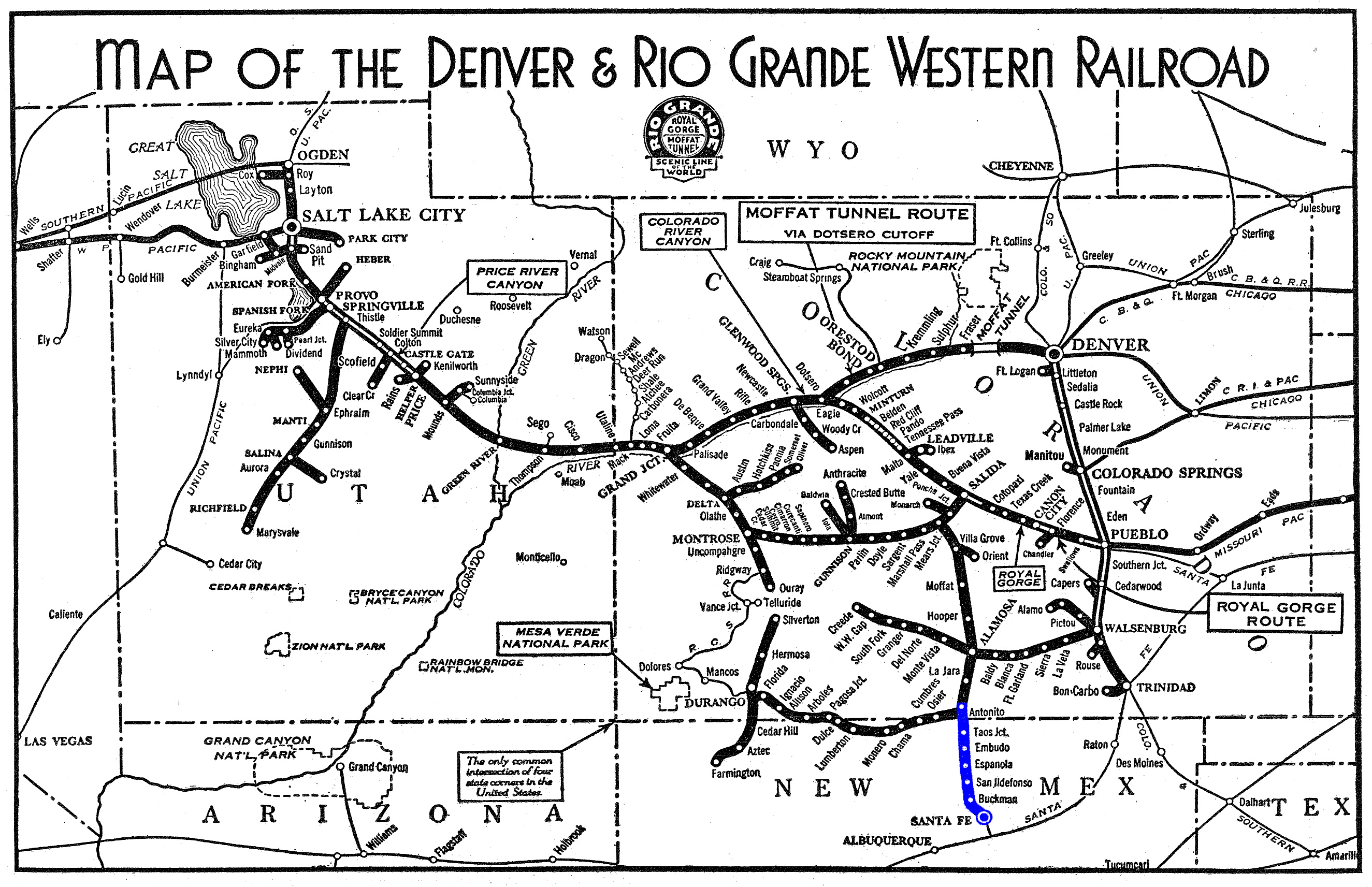
What later became a stub-end branch was envisioned by William J. Palmer, original promoter of the Denver & Rio Grande Railway incorporated on October 27, 1870, as part of a through extension to the Mexican border.
The D&RG began construction on July 28, 1871 and as George Hilton notes in his book, "American Narrow Gauge Railroads," was the first to employ the three-foot gauge in the United States, the most widely adopted of the narrow-gauge layouts.
Palmer's plan would entail running a line south through New Mexico and reaching El Paso, Texas where an interchange would be established with the Mexican Central Railway. Ultimately, the dream was to have rail service established to Mexico City made up entirely of three-foot gauge.
While Palmer's primary interest with the D&RG did encompass this southern connection what is often unknown is that the railroad was originally projected to stretch west as well to Salt Lake City via Grand Junction, Colorado just as it would eventually do some years later.
This effort began soon after rails reached Pueblo in 1872 when a branch was constructed to Cañon City along the Arkansas River to tap coal mines.
After the financial Panic of 1873 slowed work things resumed in 1876 when Palmer pushed the line south to Cucharas and west to Alamosa, reaching the latter town by July of 1878.
It was then that warfare broke out with the Atchison, Topeka & Santa Fe as both roads staked claim to Raton Pass, a prize AT&SF ultimately claimed.
Unfortunately, the fighting did not end here as both companies then began battling for access into the lucrative mining region near Leadville.
After Jay Gould acquired a large interest in the D&RG he was able to negotiate a treaty between the two parties that led signing the Tripartite Agreement on March 27, 1880.
In this document the companies agreed to a number of stipulations; the D&RG would not attempt to build south of Trinidad, Colorado or Espanola, New Mexico while the Santa Fe turned over its subsidiaries located west of Cañon City to the D&RG and stayed out of Denver and Leadville for 10 years.
While Gould steered the D&RG westward, Palmer did not give up his intentions of completing a southern routing.
With work already underway towards Alamosa, with a goal of reaching Albuquerque, he finished the line as far south as he could at Espanola on December 30, 1880. However, to complete the route to Santa Fe required a bit of corporate ingenuity.
A group of independent businessman, hoping to see the Rio Grande reach the city formed the Texas, Santa Fe & Northern Railroad.
During 1881 grading for the 34-mile line was predominantly completed but funding was exhausted. In 1886 it came under the control of General L.M. Meily which finished the project on January 8, 1887.
It was renamed as the Santa Fe Southern on January 4, 1889 but financial difficulties led to bankruptcy at which point it was acquired by D&RG and renamed again as the Rio Grande & Santa Fe Railroad. The RG&SF was then merged into its parent on August 1, 1908.
Under Rio Grande operation the line became known officially as the Santa Fe Branch although it quickly earned a nickname as the "Chili Line" due to the propensity by local farmers to ship their red chili crop by train.
While agriculture, and some manufactured goods, comprised part of the line's traffic base according to Dr. Hilton's book it was fed largely by timber and related products.
Unfortunately, while the Rio Grande eventually boasted a system stretching more than 2,400 miles, reaching as far west as Salt Lake City and Ogden, the Chili Line wasn't particularly profitable.
The route ran 153 miles between Alamosa-Santa Fe and was plagued by stiff grades (as high as 4% between Embudo and Barranca) with curves as sharp as 22 degrees.
Aside from the main line there were two short branches; one ran between No Agua, New Mexico and Stewart Junction while another extended 16 miles between La Madera via Taos Junction.
The latter was constructed in 1914 to ship out finished lumber from the Halleck & Howard company.
Alas, this operation was brief; unhappy with the quality of timber its mill was shuttered in 1927 along with rail operations soon afterwards.
For whatever reason the Rio Grande chose to leave the Chili Line as a narrow gauge corridor although a third-rail was added along the 28 miles between Alamosa and Antonito in 1901.
Additional infrastructure upgrades included the installation of heavier rail, which allowed larger Class K 28 Mikados to use the line. In any event, the decision to leave most of the route narrow-gauge certainly hurt additional interchange traffic potential with the Santa Fe.
Despite its inherent problems the line has drawn a lot of interest over the years from enthusiasts and historians due to its narrow-gauge operations.
Passenger service remained until the very end with mixed trains, #425 and 426, running until all operations ceased after September 1, 1941. The Rio Grande had received permission to abandon line earlier that January and tracks were removed within days of the final runs.
Recent Articles


-
Delaware & Hudson Diesel Roster (All-Time)
Jun 05, 26 12:20 AM
 Long tied to Alco’s Schenectady plant on its own lines, the D&H boasted an almost exclusively Alco first-generation fleet although did settle for some GE products later on.
 -
Atlantic Coast Line Diesel Roster (All-Time)
Jun 04, 26 10:01 AM
 The Atlantic Coast Line was an early pioneer in dieselization, acquiring its first diesel locomotives in 1939 and completing the transition from steam by the mid-1950s.
 -
Delaware & Hudson Steam Roster (Post 1900)
Jun 03, 26 11:55 AM
 The Delaware & Hudson Railway (D&H), one of America’s oldest railroads, traced its roots to 1823 as a canal and gravity railroad operation hauling anthracite coal from northeastern Pennsylvania. Steam…
 -
Florida 'Whiskey Tasting' Train Rides
Jun 02, 26 12:39 PM
 If you’re dreaming of a whiskey-forward journey by rail in the Sunshine State, here’s what’s available now, what to watch for next, and how to craft a memorable experience of your own.
 -
Kentucky 'Whiskey Tasting' Train Rides
Jun 02, 26 12:29 PM
 Whether you’re a curious sipper planning your first bourbon getaway or a seasoned enthusiast seeking a fresh angle on the Kentucky Bourbon Trail, a train excursion offers a slow, scenic, and flavor-fo…
 -
Chessie System Diesel Roster (All Time)
Jun 02, 26 11:35 AM
 Though Chessie itself owned no equipment—locomotives remained on the books of its subsidiaries with C&O, B&O, or WM reporting marks—the system unified operations across 11,700 route miles, hauling vas…
 -
New York 'Whiskey Tasting' Train Rides
Jun 02, 26 11:09 AM
 For those keen on embarking on such an adventure, the Arcade & Attica offers a unique whiskey tasting train at the end of each summer!
 -
Connecticut 'Wine Tasting' Train Rides
Jun 02, 26 11:04 AM
 If you’re looking for a signature “special occasion” experience, the Essex Steam Train's Wine & Chocolate Dinner Train stands out as a decadent, social, and distinctly memorable take on dinner on…
 -
Massachusetts 'Wine Tasting' Train Rides
Jun 02, 26 10:24 AM
 This article dives into some of the alluring aspects of wine by rail in Massachusetts, currently offered by the Cape Cod Central Railroad.
 -
Buffalo, Rochester & Pittsburgh Steam Roster (Post 1900)
Jun 02, 26 12:32 AM
 The BR&P's steam locomotive roster evolved from modest 19th-century power to some of the heaviest articulated engines in the Northeast, reflecting the railroad’s growing tonnage demands and challengin…
 -
Virginia 'Dinner Train' Rides At Staunton
Jun 01, 26 12:11 PM
 If you’ve ever wished you could pair a classic scenic train ride with a genuinely satisfying meal—served at your table while the countryside rolls by—the Virginia Scenic Railway was built for you.
 -
Oregon 'Dinner Train' Rides At Hood River
Jun 01, 26 12:06 PM
 The Mt. Hood Railroad is the moving part of that postcard—a century-old short line that began as a working railroad.
 -
Maryland 'Wine Tasting' Train Rides
Jun 01, 26 11:58 AM
 This article delves into the enchanting world of wine tasting train experiences in Maryland, providing a detailed exploration of their offerings, history, and allure.
 -
Indiana 'Whiskey Tasting' Train Rides
Jun 01, 26 11:50 AM
 Among IRE’s most talked-about offerings is the Wine & Whiskey Train—an adults-only, evening-style trip that leans into the best parts of classic rail travel: atmosphere, comfort, and a little…
 -
Maryland 'Dinner Train' Rides At Cumberland
Jun 01, 26 11:44 AM
The Western Maryland Scenic Railroad (WMSR) has become one of the Mid-Atlantic’s signature heritage operations—equal parts mountain railroad, living museum, and “special-occasion” night out. -
Massachusetts 'Dinner Train' Rides At Cape Cod
Jun 01, 26 11:43 AM
 The Cape Cod Central Railroad (CCCR) has carved out a special niche by pairing classic New England scenery with old-school hospitality, including some of the best-known dining train experiences in the…
 -
Rhode Island 'Dinner Train' Rides In Portsmouth
Jun 01, 26 11:41 AM
 Despite its small size, Rhode Island is home to one popular dinner train experience where guests can enjoy the breathtaking views of Aquidneck Island.
 -
Maine 'Dinner Train' Rides At Portland
Jun 01, 26 11:38 AM
 While this isn’t generally a “dinner train” railroad in the traditional sense—no multi-course meal served en route—Maine Narrow Gauge does offer several popular ride experiences where food and drink a…
 -
New Hampshire - Murder Mystery - Dinner Train Rides
May 31, 26 11:27 AM
 The state's murder mystery trains stand out as a captivating blend of theatrical drama, exquisite dining, and scenic rail travel.
 -
New York - Murder Mystery - Dinner Train Rides
May 31, 26 11:25 AM
 New York State, renowned for its vibrant cities and verdant countryside, offers a plethora of activities for locals and tourists alike, including murder mystery train rides!
 -
Pennsylvania 'Murder Mystery' Dinner Train Rides
May 31, 26 11:23 AM
Pennsylvania, steeped in history and industrial heritage, offers a prime setting for a unique blend of dining and drama: the murder mystery dinner train ride. -
New Jersey 'Murder Mystery' Dinner Train Rides
May 31, 26 11:18 AM
There are currently no murder mystery dinner trains available in New Jersey although until 2023 the Cape May Seashore Lines offered this event. Perhaps they will again soon! -
Colorado 'Wine Tasting' Train Rides
May 31, 26 11:14 AM
 To truly savor these local flavors while soaking in the scenic beauty of Colorado, the concept of wine tasting trains has emerged, offering both locals and tourists a luxurious and immersive indulgenc…
 -
Georgia 'Wine Tasting' Train Rides In Cordele
May 31, 26 11:03 AM
 While the railroad offers a range of themed trips throughout the year, one of its most crowd-pleasing special events is the Wine & Cheese Train—a short, scenic round trip designed to feel like a tasti…
 -
Iowa 'Wine Tasting' Train Rides
May 31, 26 10:55 AM
 The state not only boasts a burgeoning wine industry but also offers unique experiences such as wine by rail aboard the Boone & Scenic Valley Railroad.
 -
Arizona 'Wine Tasting' Train Rides
May 31, 26 10:47 AM
 For those who want to experience the charm of Arizona's wine scene while embracing the romance of rail travel, wine tasting train rides offer a memorable journey through the state's picturesque landsc…
 -
Atlantic Coast Line Steam Roster (Post 1900)
May 31, 26 10:43 AM
 The Atlantic Coast Line Railroad (ACL), operating primarily over the relatively flat terrain of the Southeast from Virginia to Florida and Alabama, built a steam roster emphasizing versatile, efficien…
 -
Norfolk & Western 611 Debuts In "America250" Livery
May 30, 26 11:19 PM
 The Virginia Museum of Transportation has announced that Class J No. 611 will receive a temporary special red, white, and blue livery in celebration of America’s 250th Anniversary.
 -
Boston & Maine Diesel Roster (All-Time)
May 30, 26 03:08 PM
 The Boston & Maine Railroad pioneered dieselization in the Northeast, beginning in the 1930s and completing the transition by the mid-1950s.
 -
Boston & Maine Steam Roster (Post 1900)
May 30, 26 02:52 PM
The Boston & Maine Railroad (B&M) operated one of New England’s most varied steam locomotive rosters from the late 19th century until the mid-1950s. -
Ohio 'Whiskey Tasting' Train Rides
May 30, 26 11:57 AM
 LM&M's Bourbon Train stands out as one of the most distinctive ways to enjoy a relaxing evening out in southwest Ohio: a scenic heritage train ride paired with curated bourbon samples and onboard refr…
 -
Washington 'Whiskey Tasting' Train Rides
May 30, 26 11:56 AM
 Climb aboard the Mt. Rainier Scenic Railroad for a whiskey tasting adventure by train!"
 -
Texas 'Murder Mystery' Dinner Train Rides
May 30, 26 11:54 AM
 Here’s a comprehensive look into the world of murder mystery dinner trains in Texas.
 -
Arkansas 'Wine Tasting' Train Rides
May 30, 26 11:51 AM
 This article takes you through the experience of wine tasting train rides in Arkansas, highlighting their offerings, routes, and the delightful blend of history, scenery, and flavor that makes them so…
 -
California 'Wine Tasting' Train Rides
May 30, 26 11:48 AM
 This article explores the charm, routes, and offerings of these unique wine tasting trains that traverse California’s picturesque landscapes.
 -
Wisconsin 'Wine Tasting' Train Rides
May 30, 26 11:44 AM
 Wisconsin might not be the first state that comes to mind when one thinks of wine, but this scenic region is increasingly gaining recognition for its unique offerings in viticulture.
 -
Bessemer & Lake Erie Diesel Roster (All Time)
May 30, 26 11:40 AM
 The Bessemer & Lake Erie Railroad (B&LE) transitioned to diesel power efficiently, completing full dieselization in 1953 thanks to its focused heavy-haul profile.
 -
Bessemer & Lake Erie Steam Roster (Post 1900)
May 30, 26 11:30 AM
 The Bessemer & Lake Erie Railroad (B&LE), the vital iron ore and coal hauler linking Lake Erie docks at Conneaut, Ohio, to Pittsburgh-area steel mills, operated one of the most specialized steam fleet…
 -
Bangor & Aroostook Steam Roster (Post 1900)
May 29, 26 11:48 PM
 The Bangor & Aroostook Railroad (BAR), Maine’s legendary potato and paper hauler stretching deep into the Aroostook County wilderness, relied on a compact yet hardworking steam fleet for much of its i…
 -
Bangor & Aroostook Diesel Roster (All Time)
May 29, 26 11:33 PM
 BAR prioritized Electro-Motive Division (EMD) products for their reliability in harsh northern Maine winters and on light branch lines, resulting in a roster heavy on versatile road switchers.
 -
Western Pacific Timetables (August, 1952)
May 29, 26 10:09 PM
 These timetables capture the Western Pacific in the final golden years of its passenger operations—offering travelers one last chance to enjoy the dramatic scenery of the Feather River Route in comfor…
 -
Maine 'Dinner Train' Rides At Portland
May 29, 26 12:04 PM
While this isn’t generally a “dinner train” railroad in the traditional sense—no multi-course meal served en route—Maine Narrow Gauge does offer several popular ride experiences where food and drink a…


